JEWISH IN ITALY?

A NOTE TO VISITORS:
Read through this post.
Then —if you are ready for a deeper dive into my years as a puzzled and puzzling outlander in "Catholic" Italy —click below:
JEWS AS JEWS
You will find a chapter from my unpublished book CARNIVAL BLOOD, where I share some of my more memorable adventures.
For me, the Sordevolo Passion of Christ remains in a class of its own— a journey to the edge of rational experience, terrifying yet sweetly absurd.
THE SORDEVOLO PASSION: Jewish Infamy Takes Center Stage in the Foothills of the Alps
Then GET IN TOUCH with me if you have stories to share!
Edward Goldberg
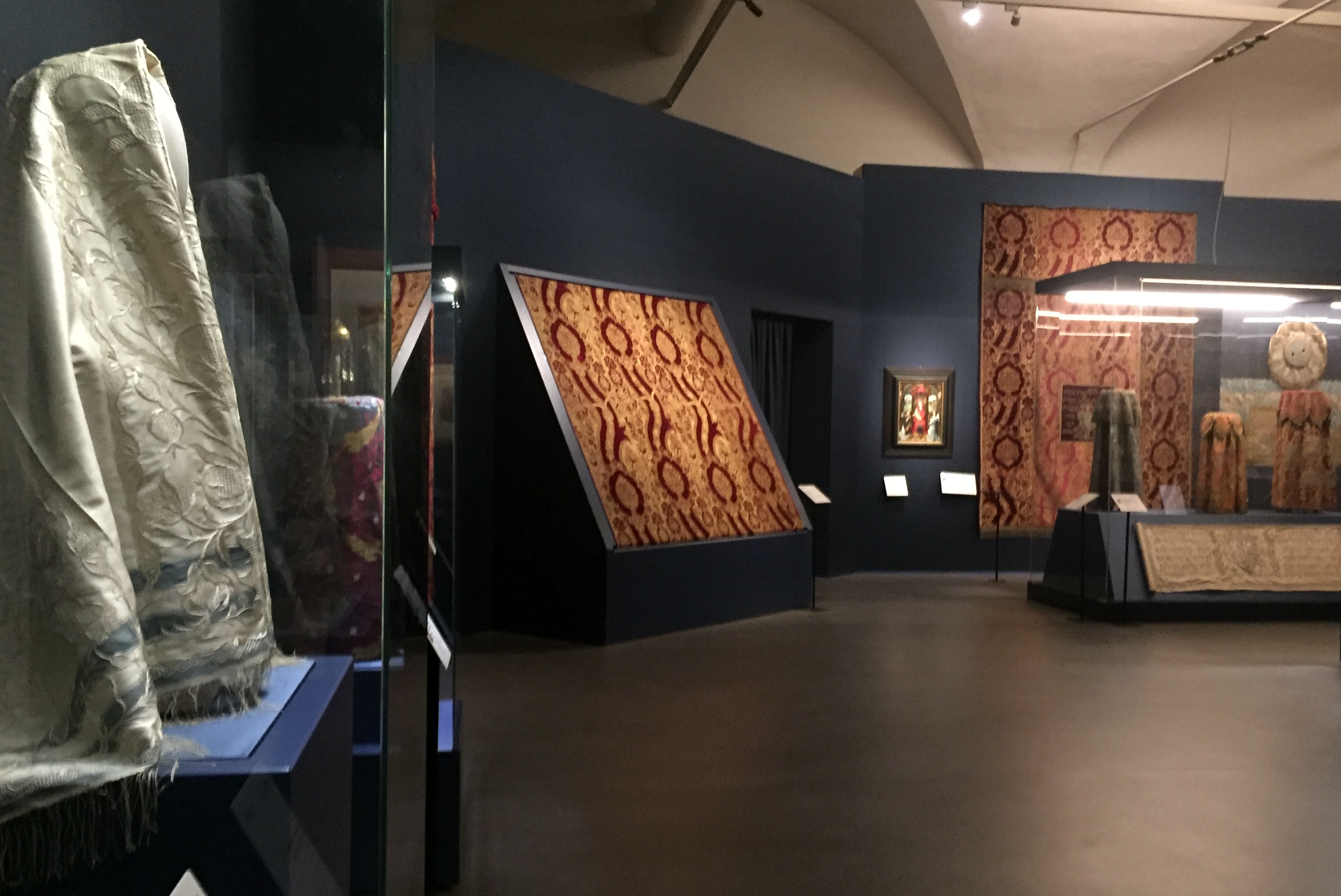
All the Colors of Jewish Italy (2019): this stunning, once-in-a-lifetime show at the Uffizi Gallery in Florence featured textiles and other decorative arts by and for Italian Jews.
There are 60 million people in Italy of whom 30 thousand are Jewish.
Virtually everyone else is Catholic —by history, habit and culture at least.
Even today, Jews in Italy occupy an obscure realm of their own. Thus my long and often perplexing experience, in the midst of things but just out of sight.
There are museums, of course. There are memorials, cemeteries and ruins. All the usual markers of a puzzling people who survived for millennia against the odds.
But when it comes to living breathing Jews, Italians instinctively look away. Is there really nothing to see?
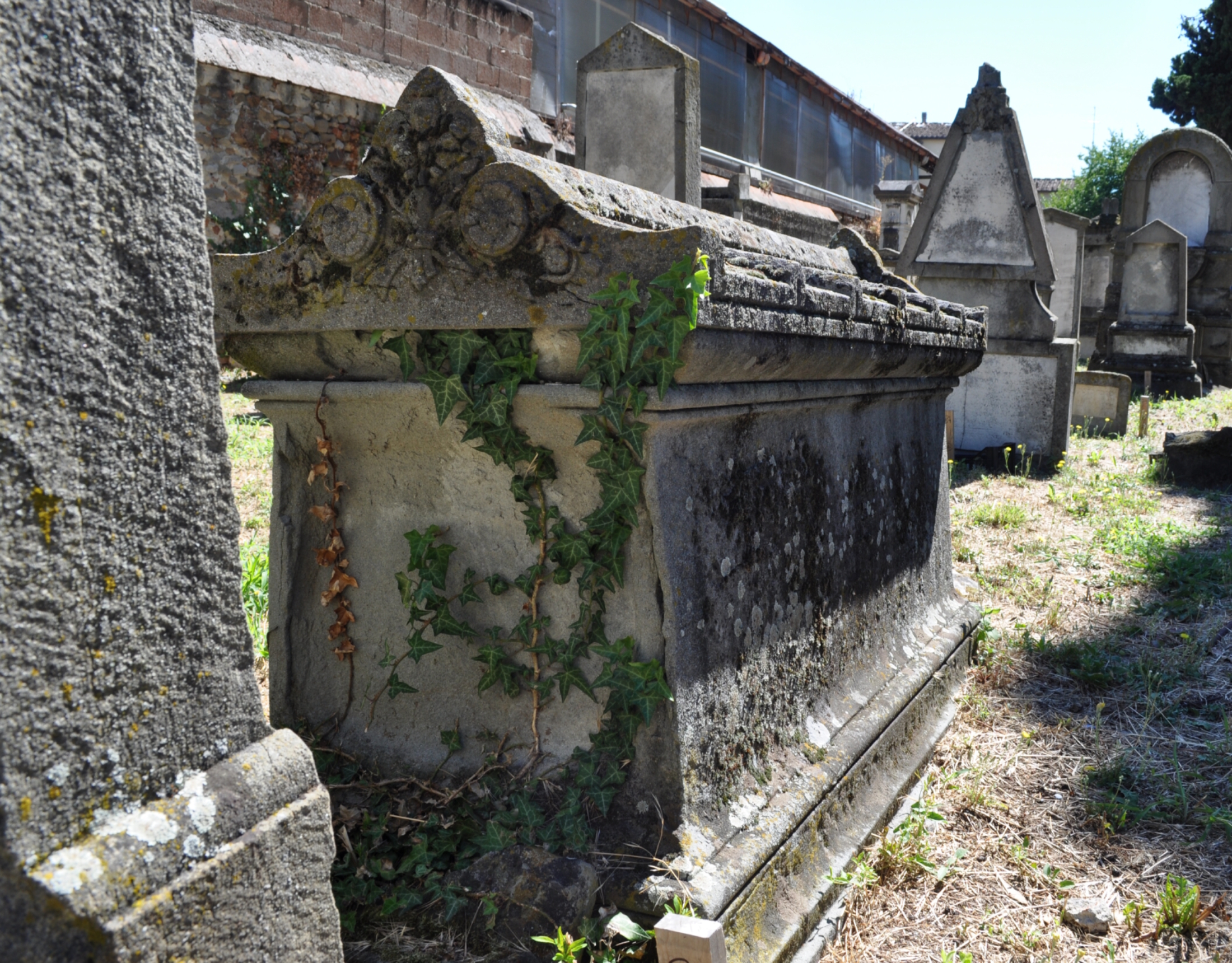
This nineteenth-century Jewish tomb is in the Etruscan style.
Regarding Jewish irreality in contemporary Italy, I have long fixated on the opening scene in Giorgio Bassani's great novel, The Garden of the Finzi Continis:
"The Etruscans are at the very beginning of the history book, right near the Egyptians and the Jews."
"But tell me, Dad! Who do you think are older?"
"The Etruscans or the Jews?”
(Translation: Isabel Quigley)
Thus speaks Giannina, a nine year-old Roman girl back in the 1950s, on a weekend jaunt to the Etruscan Necropolis of Cerveteri.
The Holocaust was still a recent memory and there was a non-dead Jew in the car —standing in for the author himself.
So, a good laugh (or at least a wry chuckle) was had by all. Then a heavy silence ensued...
For more on Giorgio Bassani at Cerveteri, see:
WHO CAME FIRST? Jews, Etruscans, Someone Else...
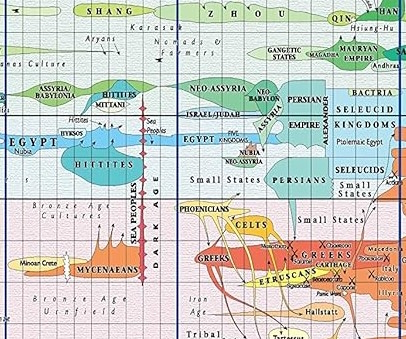
This was not exactly the one that I encountered in my fifth grade classroom, but it represents the same school of thought. "Israel/Judah" (light blue, above) —not "Hebrews", alas— clocks in just ahead of "Etruscans" (yellow, below).
At about the same time— late 1950s —but thousands of miles away, I encountered such chronology in a wall-chart in my fifth grade classroom.
We were studying what passed for Ancient History back then. Each nation, people or culture had a beginning and end date, plus a defining "contribution" or two. "Hebrews" included...
As the lone Hebrew in the room, I was proud to figure as an Ancient People (albeit at the very bottom of the list, slipping from BC over into AD). My "contribution" was "One God" and "Biblical Literature" (thereby finessing the "Old Testament/New Testament" thing).

This is the 2024 edition, published long after my time.
Meanwhile, there was another requisite that only I could claim. Unlike my classmates, I knew my way around the Ancient Peoples' Neighborhood— just by doing the normal things that Jewish kids do ("Jewish" meaning East Coast Suburban Ashkenazi).
I had already met the Egyptians (Slavery and Passover), the Babylonians (Destruction of the First Temple, then Talmud), the Persians (Queen Esther and Purim), the Assyrians (Judith of Bethulia with Holofernes) and the Seleucids (bad guys at Chanukah, defied by the Maccabees).
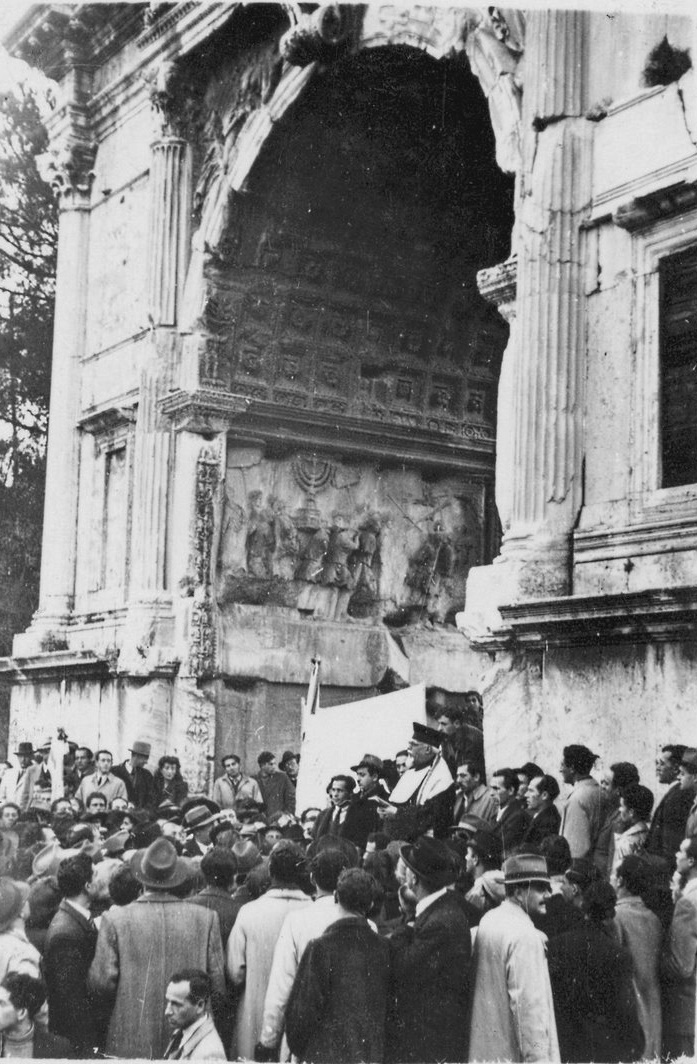
Survivors of the Holocaust gather at the Arch of Titus with Rabbi David Prato to celebrate the United Nations declaration of the partition of Palestine, paving the way for the State of Israel.
There have been Jews in Italy for two thousand years— well before there were "Italians", I would argue.

This relief shows looted sacred objects from the Temple in Jerusalem which had been destroyed a decade before.
The Hebrew captives in Titus' imperial triumph in 71 AD knew perfectly well that they were Iudaei— a designated people with a shared faith.
At that time, the surrounding Italici were a mixed lot— merely Roman residents of the peninsula, not even Christian yet.
They would have to wait until the Risorgimento ("National Resurgence")— eighteen hundred years later— for "Italian" to mean what we take for granted today.
FOR THE PROMINENT ROLE OF JEWS IN THE UNIFICATION OF ITALY, SEE:
JEWS IN THE RISORGIMENTO
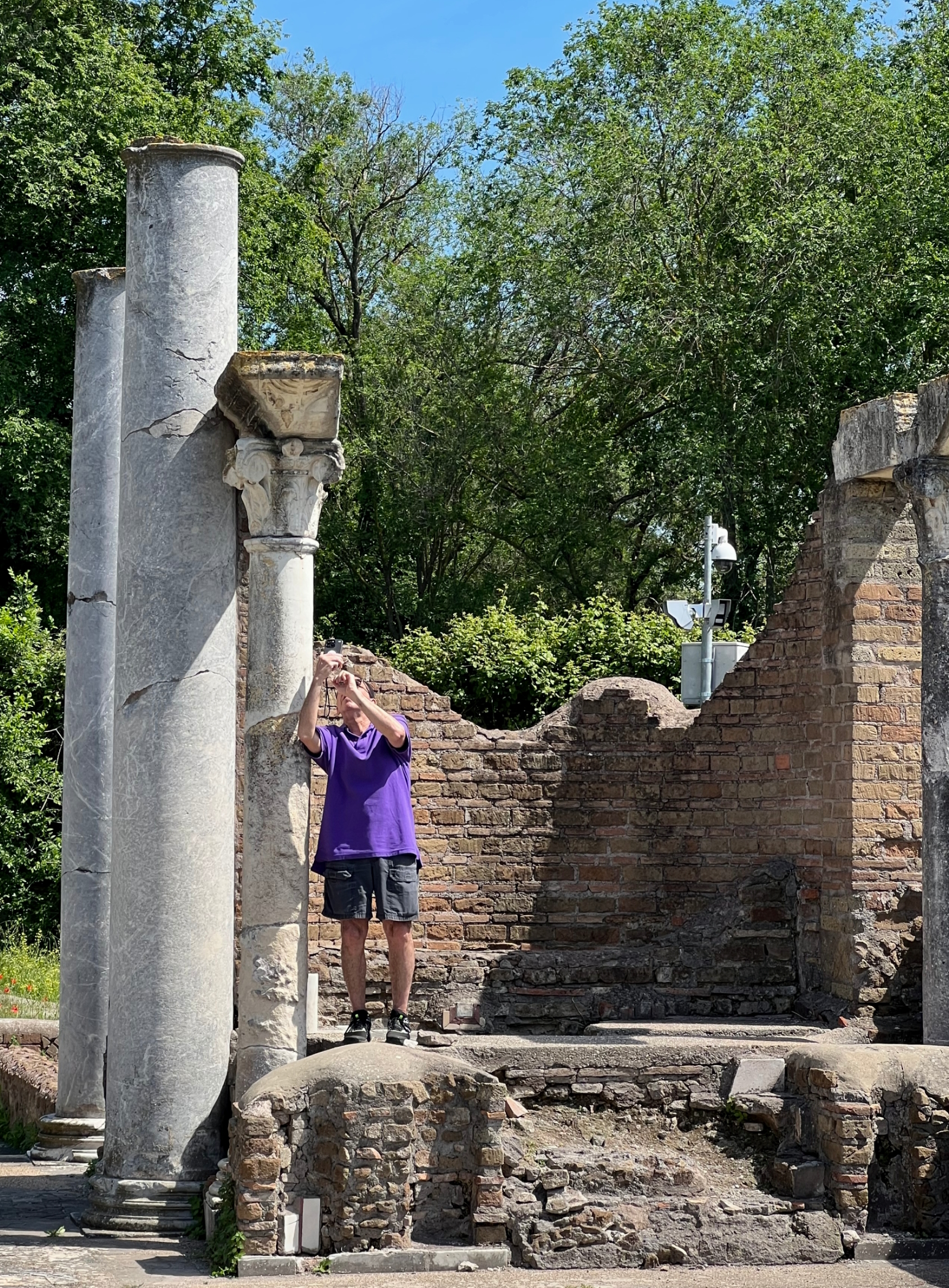
Lyle Goldberg photographs the remains of the synagogue at Ostia Antica,the ancient port of Rome; it probably dates from the Severan dynasty, 193-235 AD.
Theories abound regarding the first appearance of Jewish travelers and traders in Italy— perhaps even before the Judaean Wars and the diaspora of 71 AD.

Jewish ritual items on a capital amidst the ruins of the Synagogue at the ancient port of Rome.
But do objective dates really matter, when it comes to Jews and their doings?
For Italians, they embody a remote history of their own— which is to say, no tangible history at all.

Italians just don't get it when it comes to Jews...
But it's funny how little that matters when you are there on the ground.
From the moment of my first arrival, Italy felt like home.
How could that possibly be?!

The multiple Josephs and Marys mingle with other more exotic characters.
Above all, there is the counter-effect of everyone in Italy being more-or-less Catholic.
Since the legacy of the Church permeates most aspects of life, few stop and take notice in the course of a normal day.

Oxford: me in pompa magna taking my doctoral degree (1980), plus a few views of my college, Lincoln.
Then there is my own personal history...
I spent most of the 1970s as an Art History grad student at the University of Oxford, commuting to Italy for my dissertation research.
It didn't take long for me to grasp an essential truth:
The God of My People never meant me to be an Englishman —but somehow, a quasi-Italian seemed just fine.

Beginning in the center, autumn in the Chianti just before the grape harvest (circa 2000; photo Agostino Quaranta). Looking over my shoulder, Maria Callas, tutelary deity of Temperament. (Portrait by Ulisse Sartini, Museo Teatrale alla Scala, Milan)
Let me explain...
Oxford is a wonderful place and it was a huge privilege to spend years there.
Still, temperament is temperament and it was never "home".
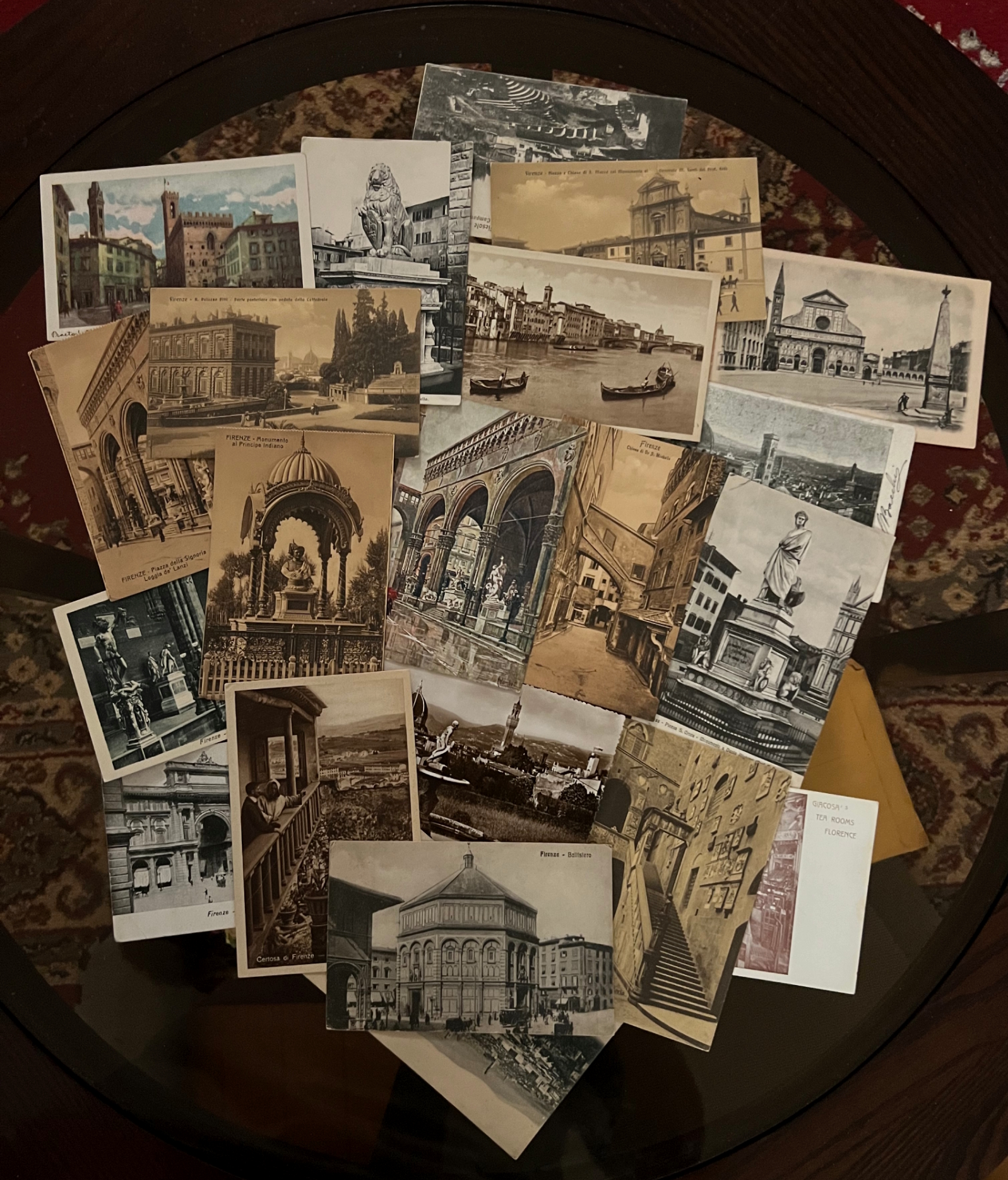
Miscellaneous postcards from Florence picked up over the years.
Sure, there is art and history in Italy—lots of both.
But there are also human relationships and daily life.
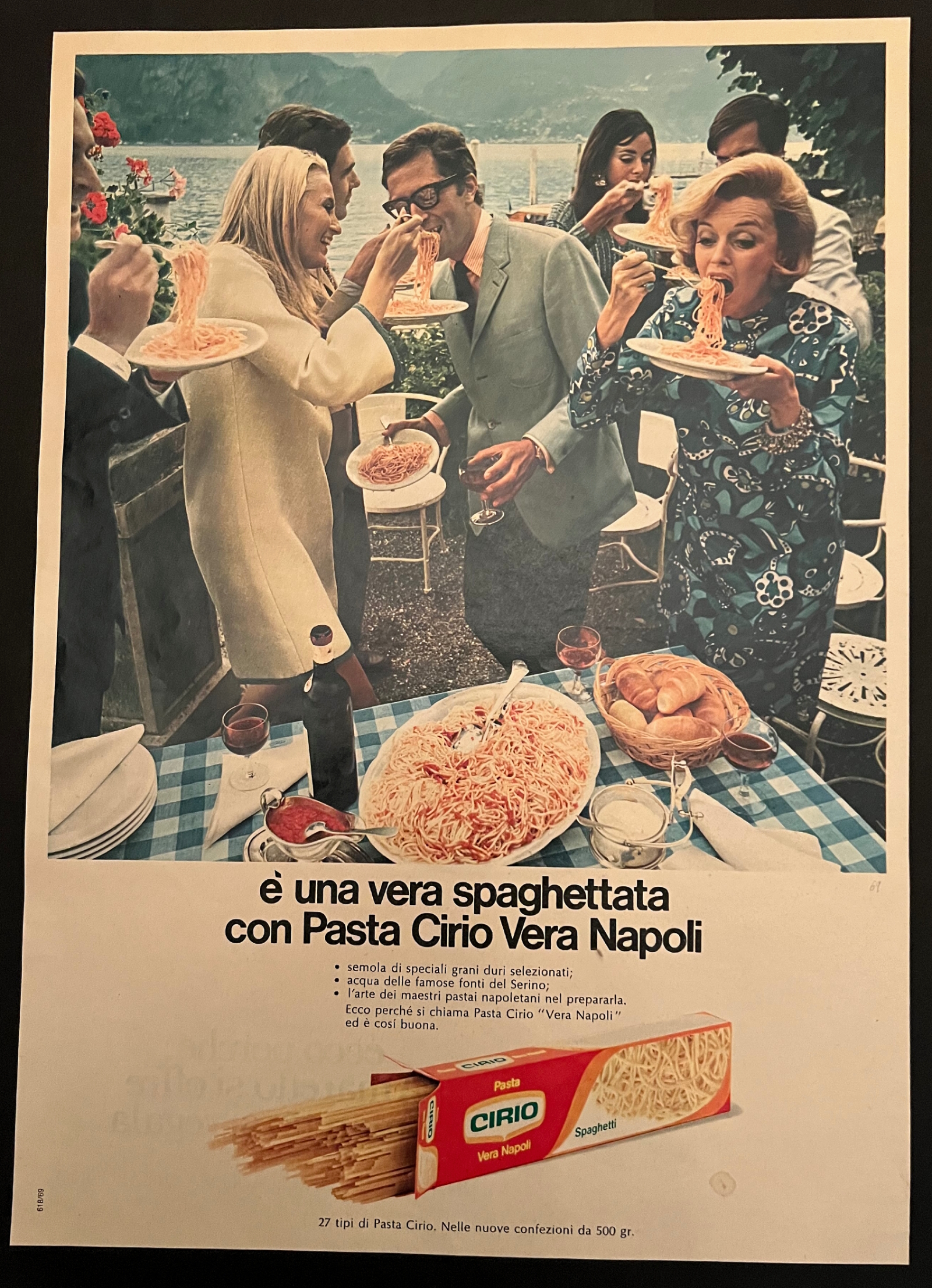
Neapolitan Spaghetti; a vintage magazine advertisement found in Piazza dei Ciompi, Florence's famous flea-market. Not a Bar Mitzvah buffet but close enough.
Whether you are American Jewish or Italian Catholic— observant or not on either side— there is always the Big Three: Family (Famiglia), Food (Mangiare) and Looking Good (Bella Figura).
So, I was seldom taken by surprise, when it came to the basics at least.
Meanwhile, the old Mediterranean gene pool kicked in. Wherever I went in Italy, I could count on melting into the crowd.
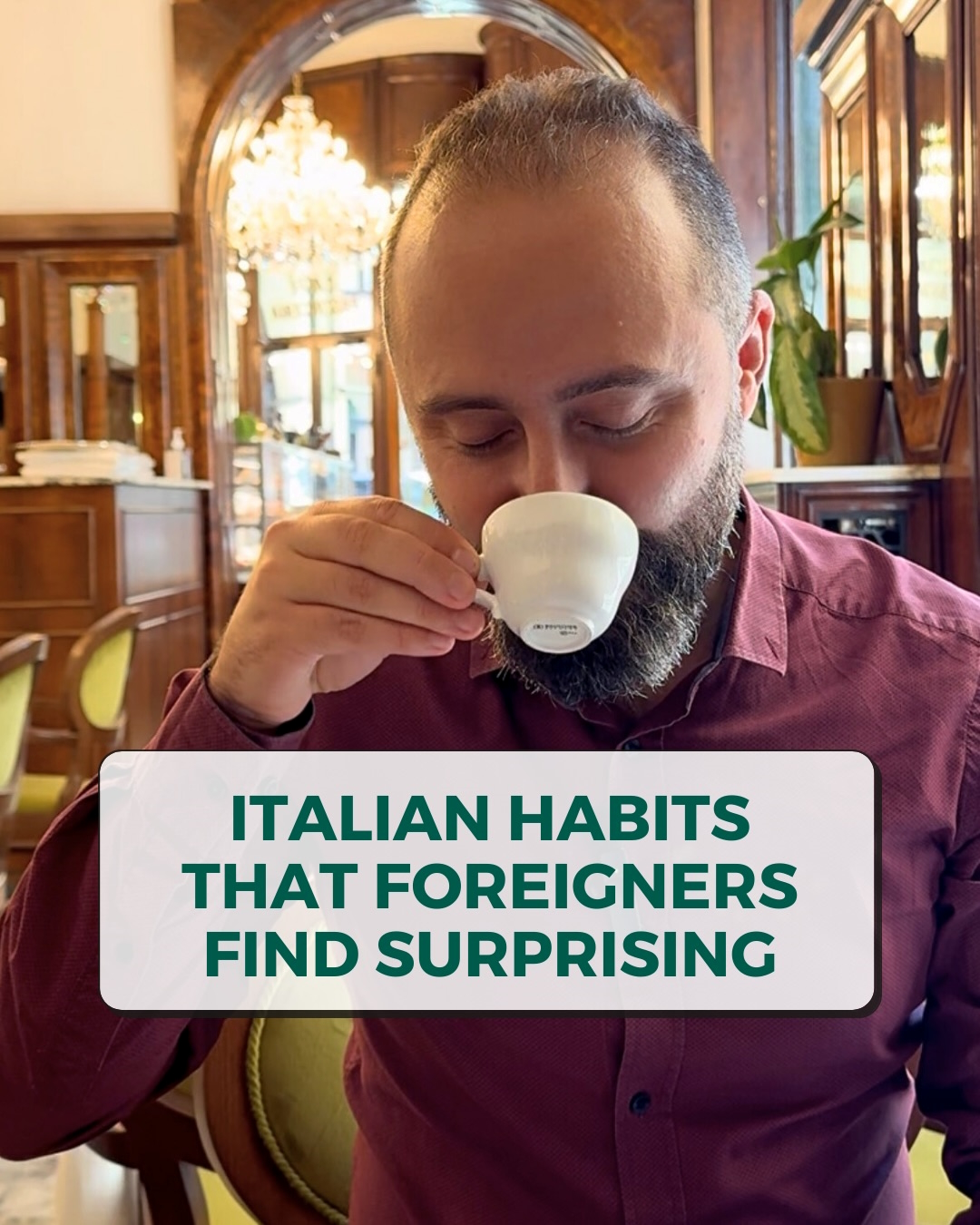
Unlike me, American and British friends (Gentile, of course) were constantly thrown for epic loops by Italians simply acting ike Italians.
They would make grave observations. All would nod in shared bemusement. And I was left wondering, "What's your point?"

"IN ITALY, IT’S NOT WHAT YOU KNOW, IT’S WHO YOU KNOW!"
Objective standards should count more than personal relations? Interesting idea, but I don't see it catching on.
"TIME HAS NO MEANING! HE WAS SUPPOSED TO PICK ME UP ME AT WHATEVER O’CLOCK AND WE WERE SUPPOSED TO GO… (etc)."
Italian Time meets Jewish Time! He will do his best to leave his house at whatever o’clock and you can plan accordingly.

ESS! ESS! ESS GESUNTERHEYT!
MANGIA! MANGIA! MANGIA CON BUONA SALUTE!
EAT! EAT! EAT IN GOOD HEALTH!

Barbara Streisand stops the show as Miss Marmelstein in Jerome Weidman's hit play.
There is nothing worse than paying full price— whether you are Jewish or Italian. And it’s not only (or even mostly) about the money.
Buying retail is a pathetic admission that you are an utter loser who has flunked out of the system, with nary a “connection” to his name.
“Conosce una persona...” with a nudge and a wink. (“He knows a guy...”)
“Er ken zikh oys...” (“He knows his way around..."), with the nudge and the wink already built in.
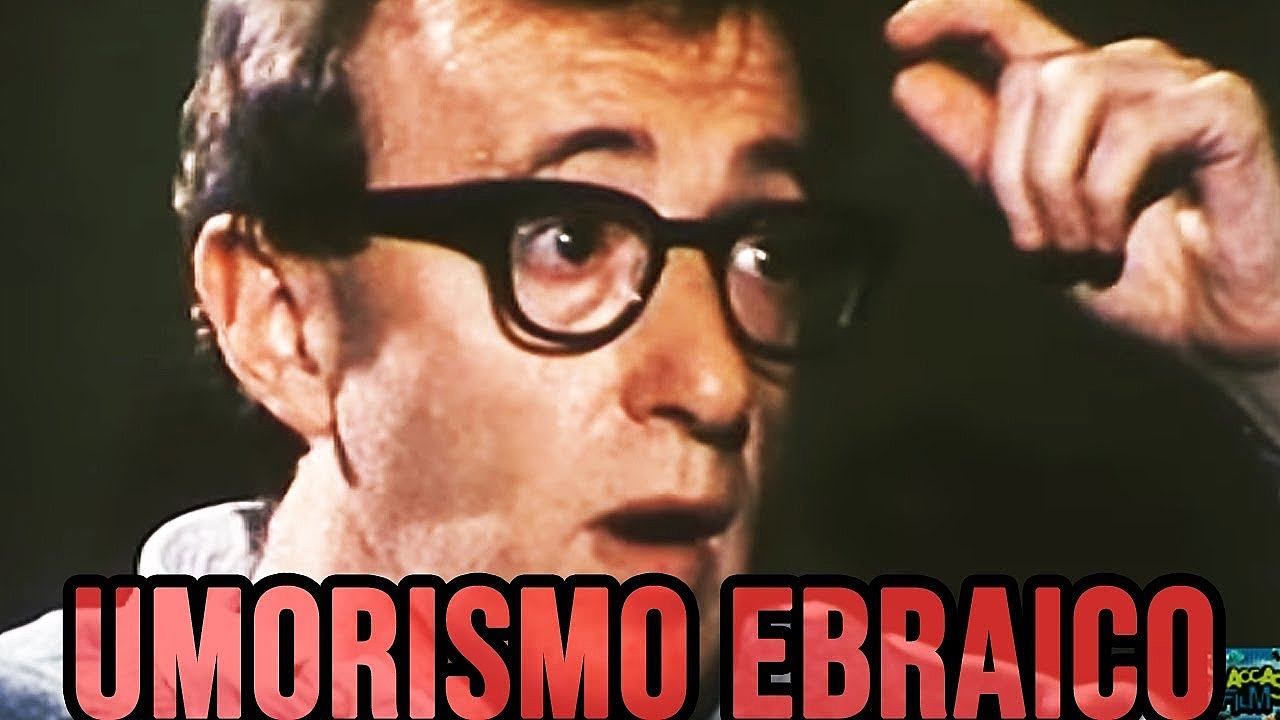
"Neuroses, you want? Neuroses, I got!" I am devoted to JEWISH HUMOR but could never stomach that annoying and unfunny Woody Allen thing. Meanwhile, my Italian friends hailed him as the chief exponent of American Jewish culture— being the only one they knew.
If your response to most queries is “Funny you should ask!” or "Bella domanda!" ("Fine question!"), you are already in the zone— especially in Florence where cynical humor reigns (and has done so for centuries).
Even in the earliest days— when my spoken Italian was still emerging from its cave— I was hailed for my irony in the local style. "Appena arrivato e già uno spiritoso alla fiorentina!" ("Barely arrived and already a Florentine-style wit!")
I felt like I was cheating of course... All I had to do was translate the sarcastic back-chat I grew up with.

Do you know any good jokes about 09/11?
A group of mostly academic friends and I planned a casual dinner in Florence for the evening of September 11, 2001— but then...
So, we found ourselves sitting around the television in the living room, balancing plates of pasta on our laps, watching that same damned video over and over again.

There was only one other American —not a member of the tribe —a lumbering pedant who pounded away at "the situation", shedding truth and meaning from every pore.
At last, he lurched to a stop, flinging a final pronouncement into the air:
"Ma noi proponiamo altri valori e questo è il prezzo della libertà!"
("But we profess other values and this is the price of liberty!")
It was too much for a mere mortal like me.
"Si fanno degli sconti?!"
("Do they offer discounts?!")
That was 25 years ago and the guy I knee-capped hasn't spoken to me since —but il castigo di Dio (Divine Punishment) was quick to come.

"Umorismo ebraico!"
("Jewish humor!")
"Abbiamo Woody Allen fra di noi!"
("We have Woody Allen in our midst!")
"Hannah e le sue sorelle m'è piaciuto da morire!"
(“I loved Hannah and her Sisters!”)
"Annie Hall era la fine del mondo!"
("It doesn't get better than Annie Hall!")
I looked into their smiling faces— there was no escape!— so I gritted my teeth and smiled back.
For related themes— not in the Italian context— see Dara Horn's brilliant and disquieting book, PEOPLE LOVE DEAD JEWS: Reports from a Haunted Present.
Related posts
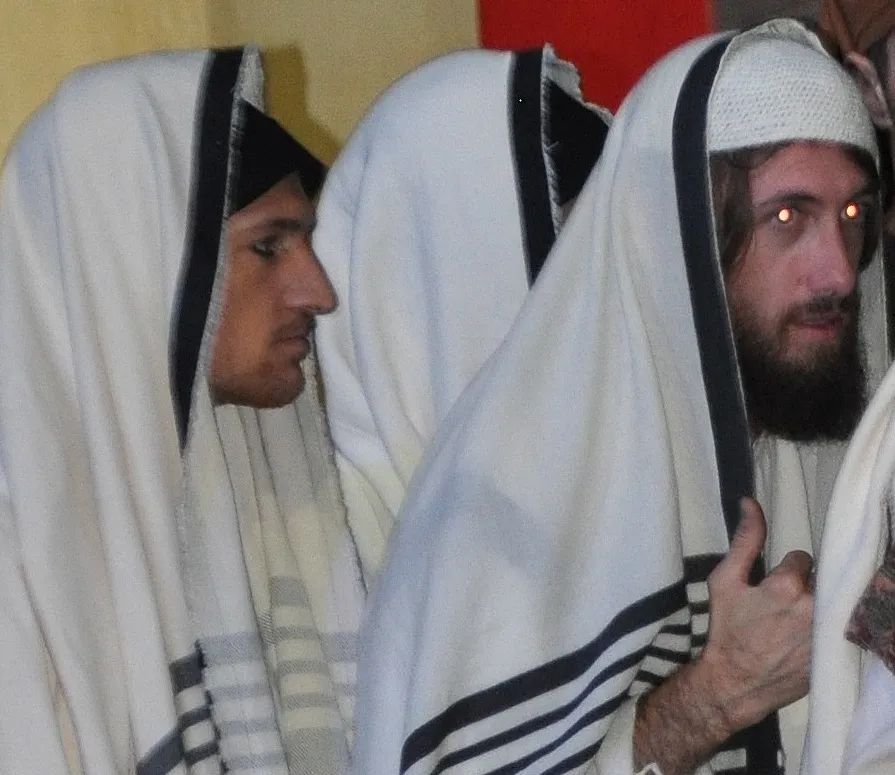
THE SORDEVOLO PASSION: Jewish Infamy Takes Center Stage in the Foothills of the Alps
Every five years, the inhabitants of the tiny Piedmontese town of Sordevolo stage a compelling recreation of the last days of Christ— as long imagined by Catholic believers.
There they are...before our very eyes....the cursed Killers of the Savior!
What on earth is happening here?!
I can promise you an answer, but not a simple one.
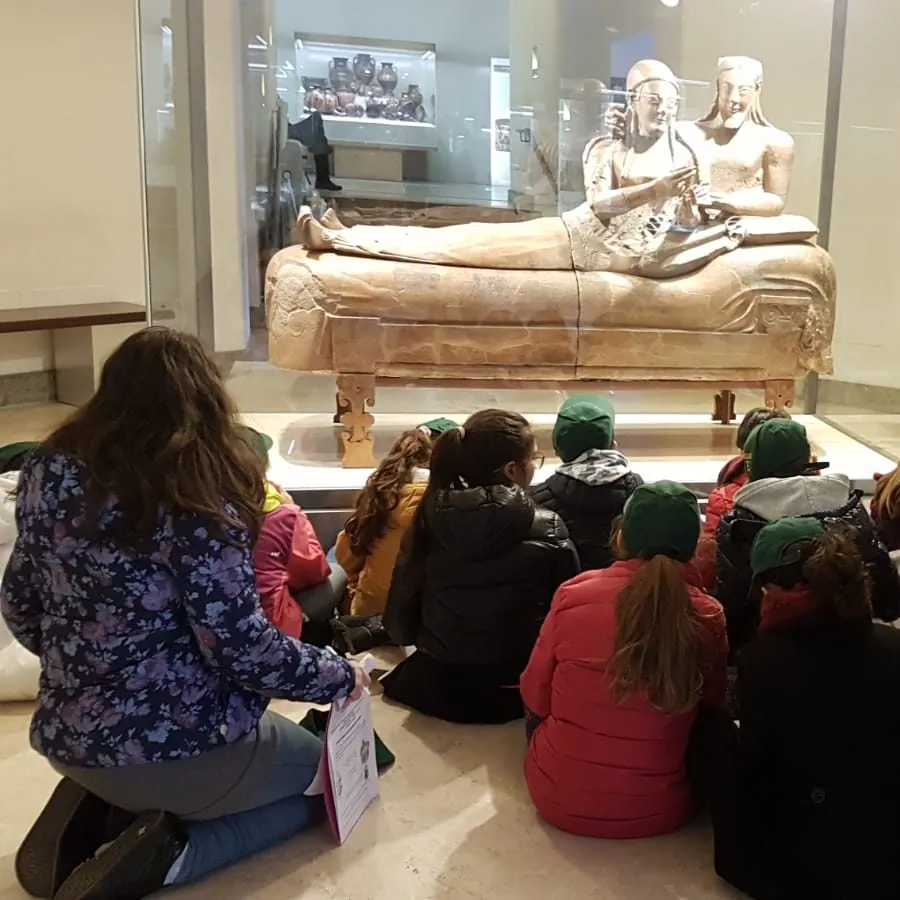
WHO CAME FIRST? Jews, Etruscans, Someone Else...
Why are the Etruscans so supremely "mysterious"? In the popular imagination, that is always the first word that comes to mind...
By way of Giorgio Bassani's 1957 novel, The Garden of the Finzi-Contini, we search for ancient clues in the Etruscan Necropolis of Cerveteri.
Who are these Etruscans anyway—real or imagined?
What secrets do they share with the author's own more recent dead —Holocaust victims from Jewish Ferrara?

Lorem ipsum dolor sit amet, consectetur adipiscing elit. Suspendisse varius enim in eros elementum tristique. Duis cursus, mi quis viverra ornare, eros dolor interdum nulla, ut commodo diam libero vitae erat. Aenean faucibus nibh et justo cursus id rutrum lorem imperdiet. Nunc ut sem vitae risus tristique posuere.