CALCIO STORICO = HISTORIC FOOTBALL: Ritual, Rivalry and What Else?
Reenactors in period costumes...
You see them all the time in Italian cities— those with a claim to history and culture, which is to say most Italian cities.
Few, however, can rival Florence when it comes to liveried heralds, gowned damsels, armed warriors, robed officials and caparisoned horsemen.
Wave after wave of them, day after day, tromping through the streets...
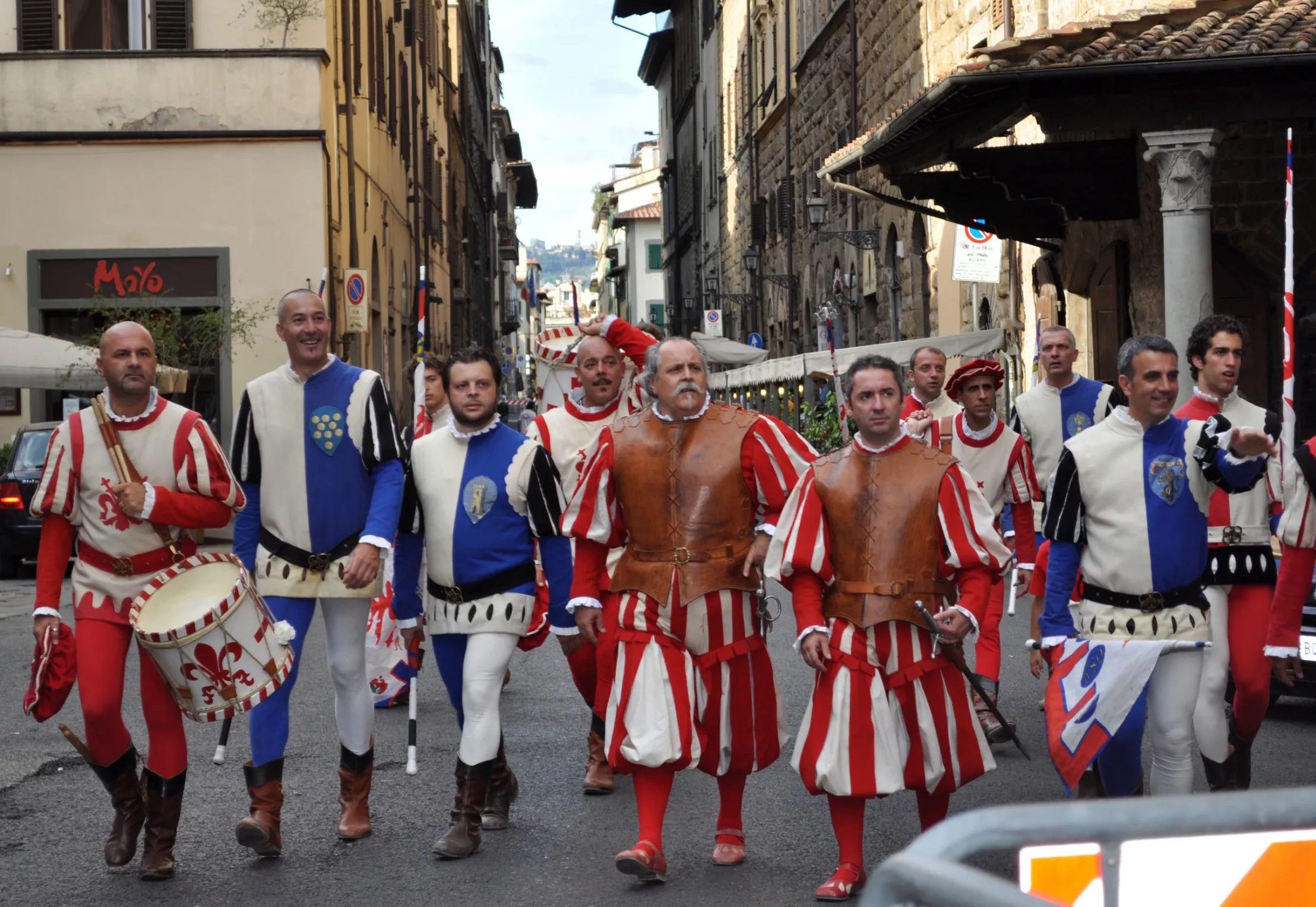
On 24 June 2015 (Feast of Saint John the Baptist, Patron Saint of Florence) the usual crew of Renaisssance Avatars head to Piazza Santa Croce for the culminating encounter— that year between the Verdi and the Bianchi.
Such exponents of living history are always perfectly turned out, painstakingly rehearsed and at the absolute top of their reenactor game.
Meanwhile, they have a hell of a lot of fun— cracking smiles, joking with the police and sharing the moment.
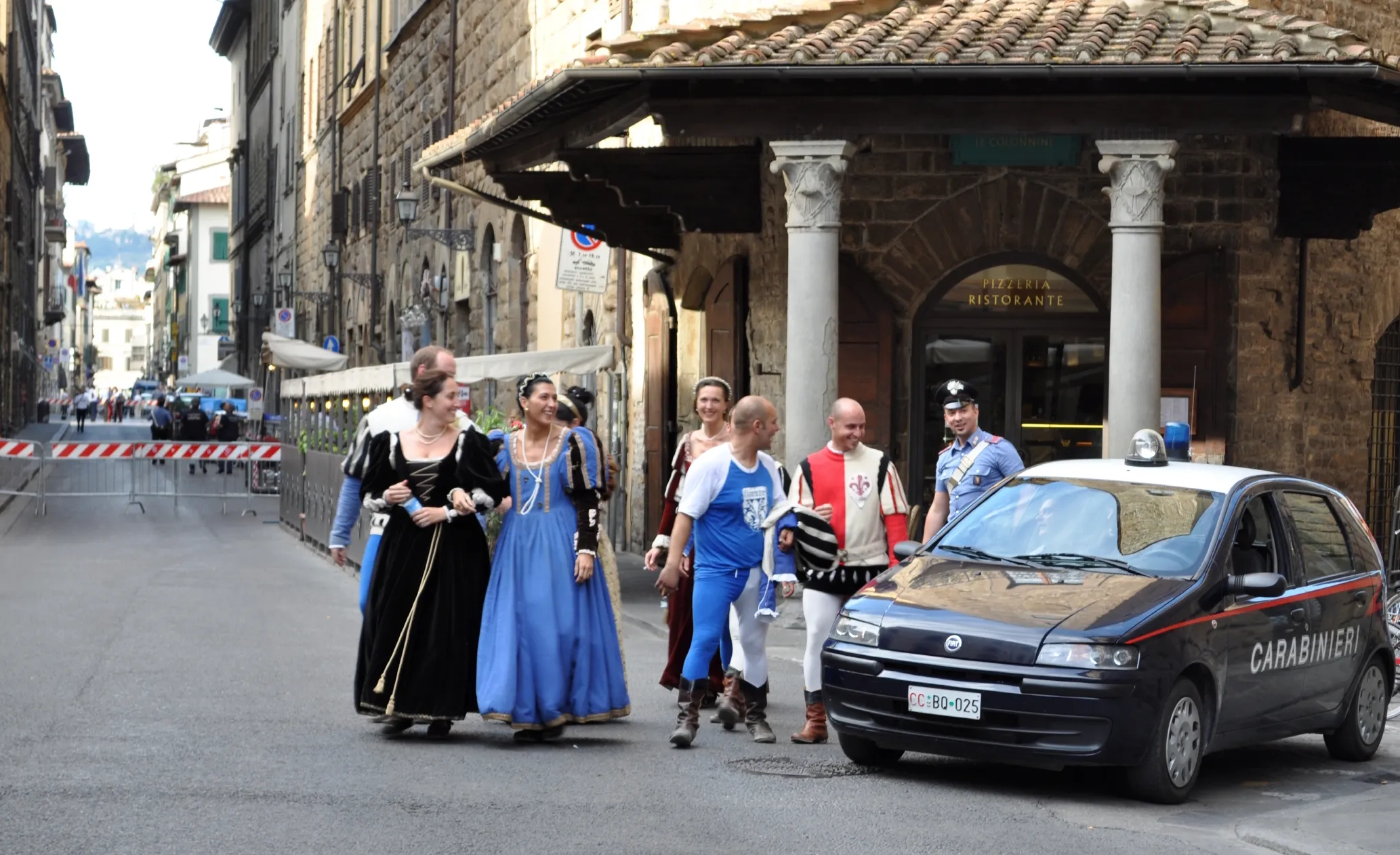
Others of that same group, also on the move, including women in a reasonable approximation of artistocratic dress circa 1530.
Past or present?
Whenever it is— here on the ground —the event belongs to them and that's the essential fact.
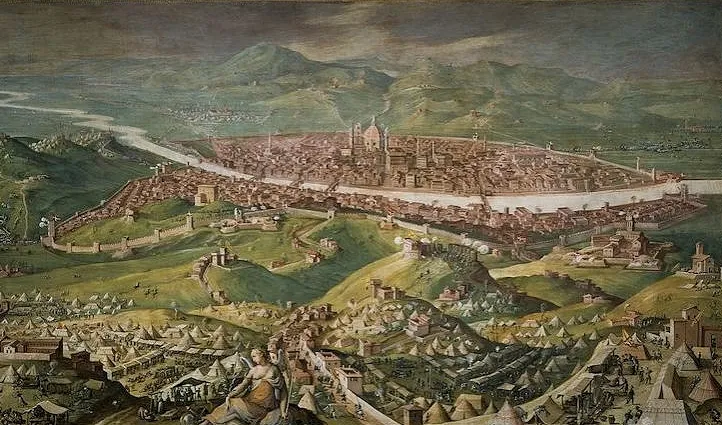
An expansive view of Florence from the south. The Imperial forces occupy the heights above the city (note the sprawling encampment along the bottom of the image).
For all its imaginative elaboration, Florence's Calcio Storico recalls a documented occurence.
During the autumn and winter of 1529-30, a coalition of forces assembled by the Holy Roman Emperor laid siege to the city.
The Florentines knew they were in trouble, but reacted with a bravura gesture for the ages.
On 17 February 1530, they processed in splendor to Piazza Santa Croce, with bells ringing and cannons firing,
There, in the public space most visible to the enemy in the hills, they enacted a festive contest— showing the world that they were neither down nor out.
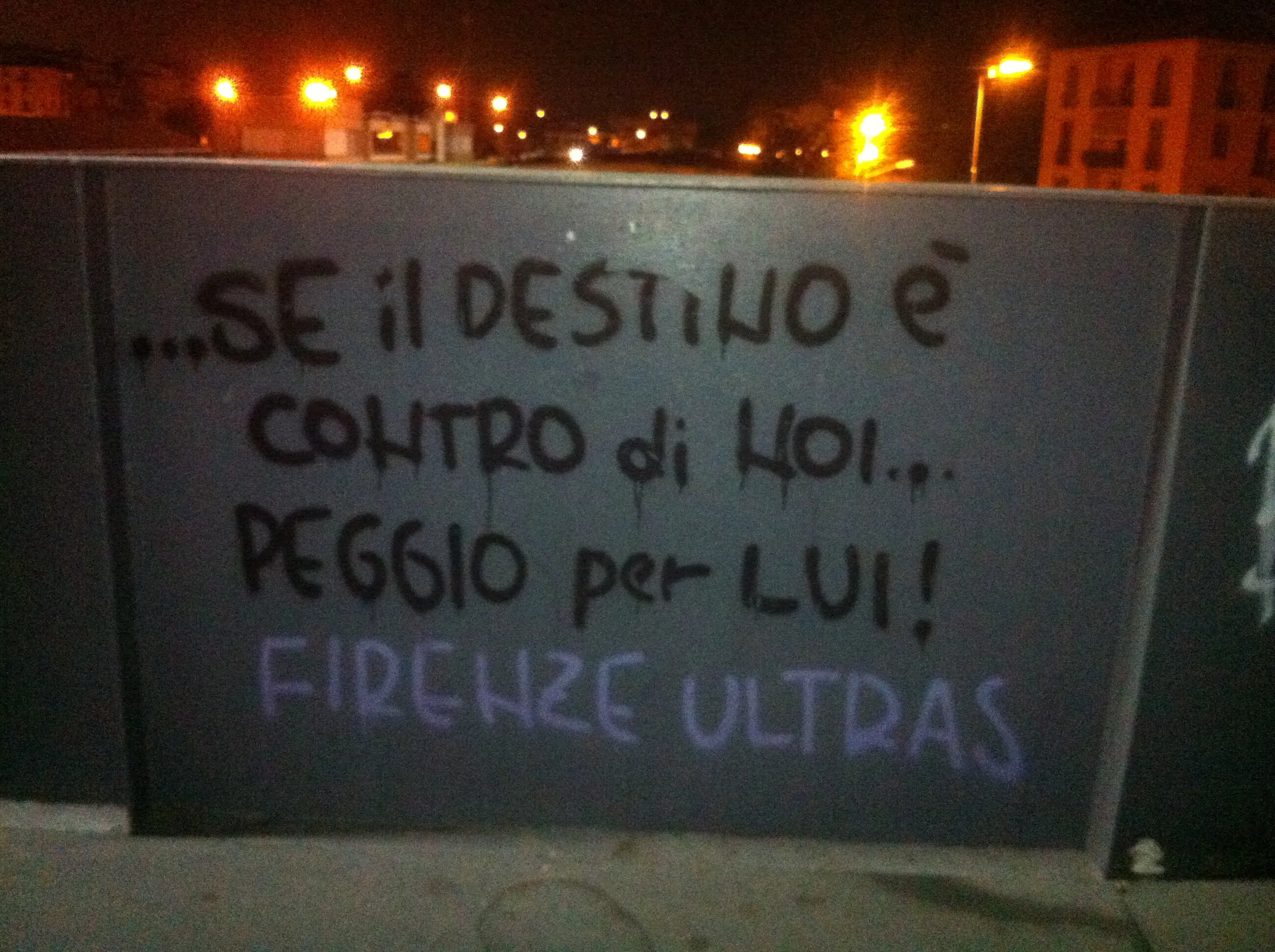
"... SE IL DESTINO È CONTRO DI NOI, PEGGIO PER LUI! FIRENZE ULTRAS"
"...IF DESTINY IS AGAINST US, THAT'S ITS PROBLEM! FLORENCE SUPERFANS"
The signature is in Viola (Purple), the color of Florence's present-day soccer team.
Thumbing noses at fate still comes naturally to Florentines —especially supporters of modern (rather than historic) football, who cherish the vagaries of their perennially problematic home team.
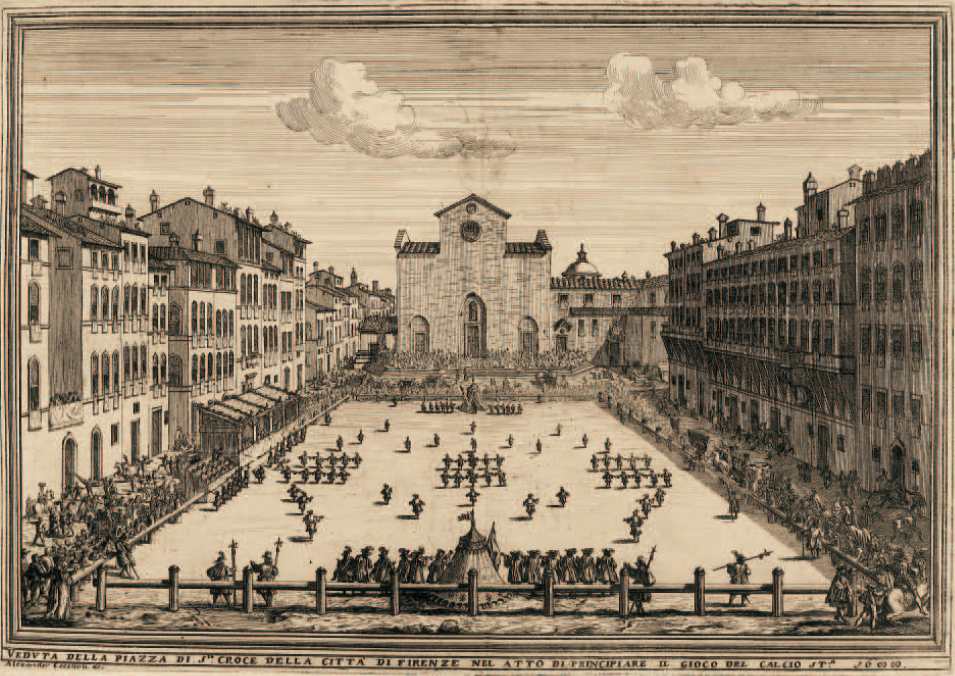

This stately football match was presented in Piazza Santa Croce for the Wedding of Grand Prince Ferdinando de' Medici and Violante di Baviera in 1688
In later centuries, there was ongoing fascination with this 1530 event and sporadic revivals under Medici patronage.
However, the Calcio Storico we know today dates back only to 1930.
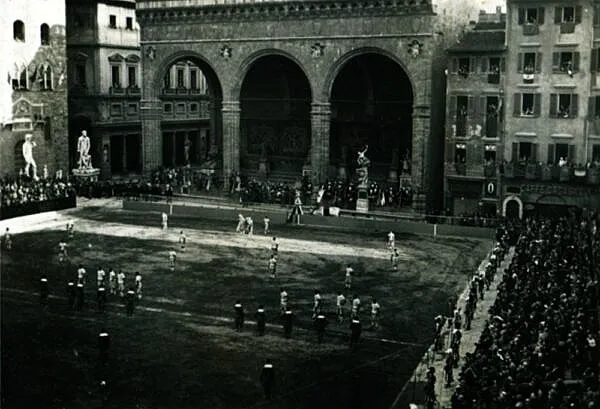
The 1930 Calcio Storico (in Piazza della Signoria, not Piazza Santa Croce) commemorated the 400th Anniversary of the 1530 engagement. It was recorded by the Istituto Luce, Mussolini's chief purveyor of filmed propaganda.
Alessandro Pavolini, chief proponent of the event, was a Florentine gentleman of exquisite culture, passionately devoted to local tradtions.
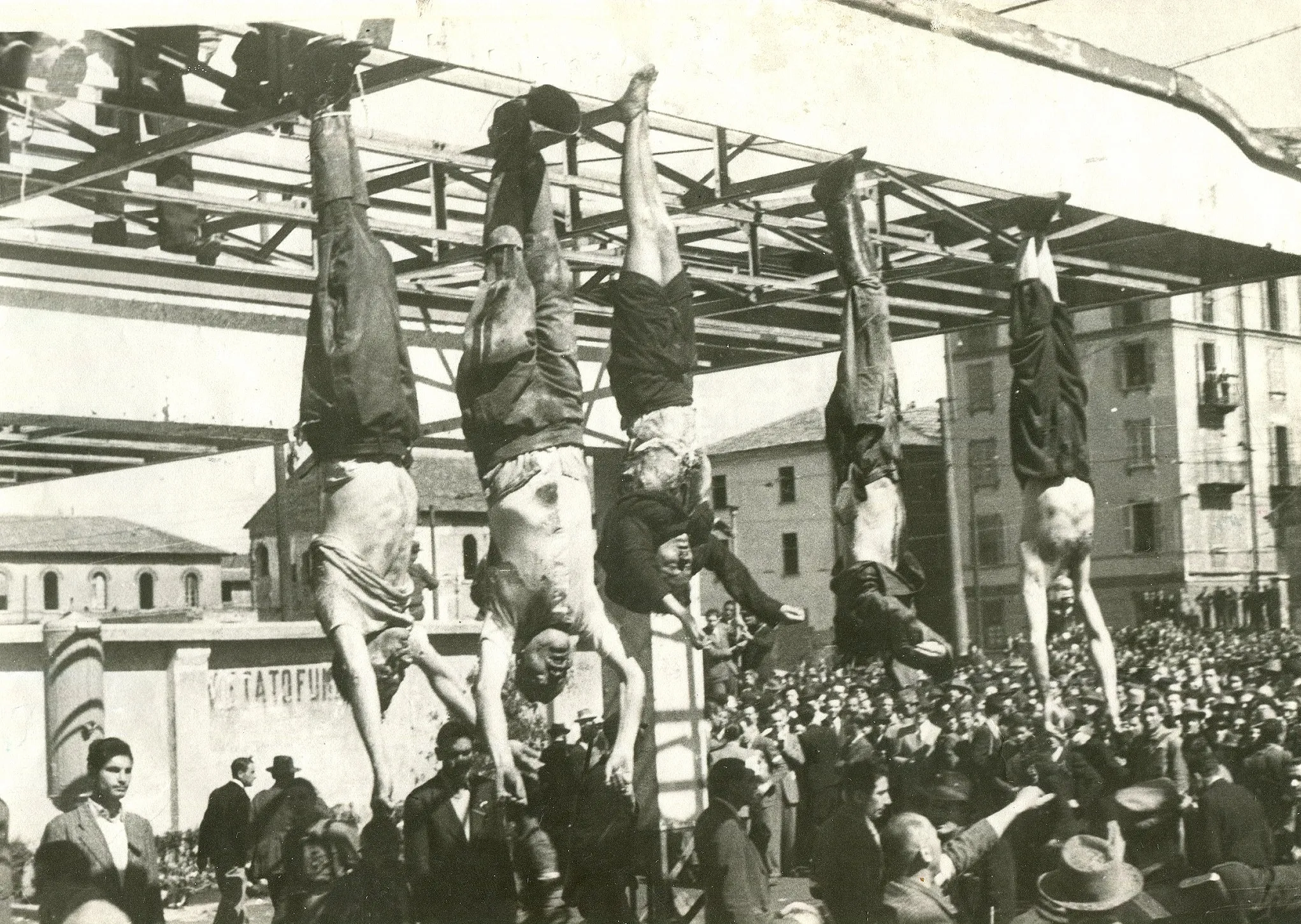

Mussolini is second from the left, Pavolini is second from the right, Claretta Petacci (Mussolini's mistress) is in the middle.
Alessandro Pavolini was also a despised fomenter of Fascist terror, widely loathed in his hometown and beyond.
He ended his days as a dangling carcass in Piazza Loreto in Milan, alongside Benito Mussolini.
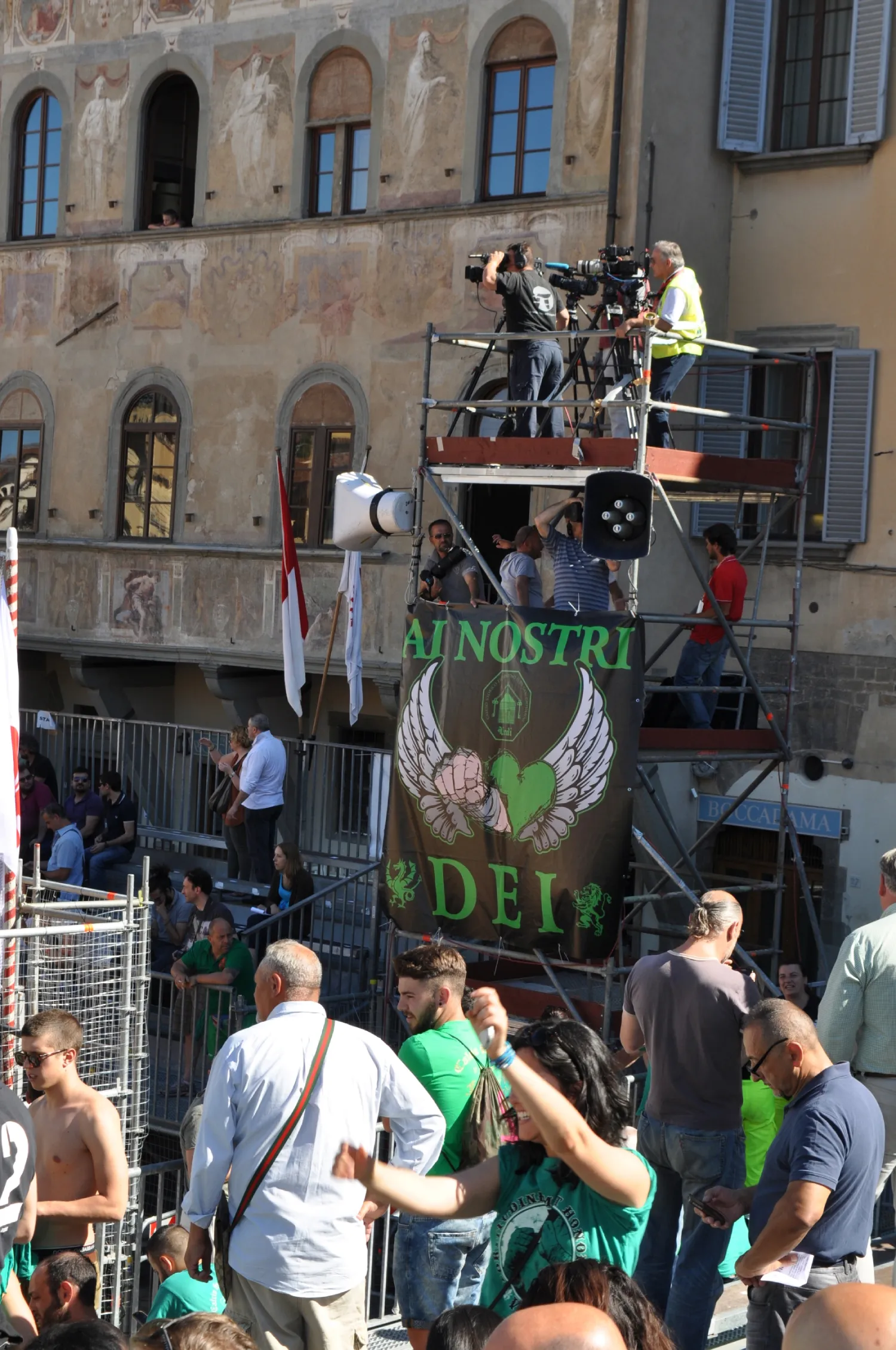
The Feast of San Giovanni (2015) and the championship encounter between the Verdi (Greens) of the San Giovanni quarter and the Bianchi (Whites) of Santo Spirito, viewed from the Verdi side.
There is much to say about the Calcio Storico, both in fact and theory.
Commentators usually focus on the exuberant pagentry of the spectacle and the thuggish violence of the actual game— both of which are notable.
But how about the contenders on the field and their families, friends and neighbors in the stands?
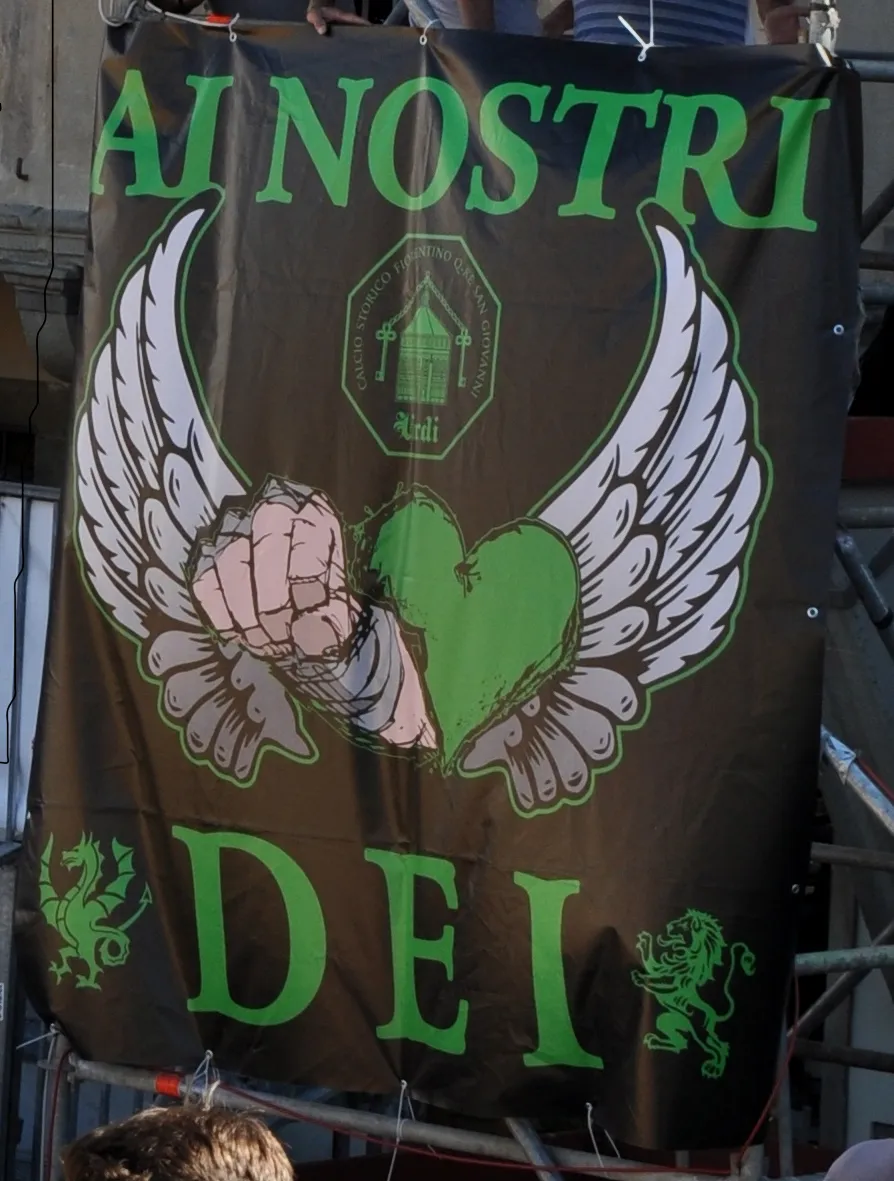
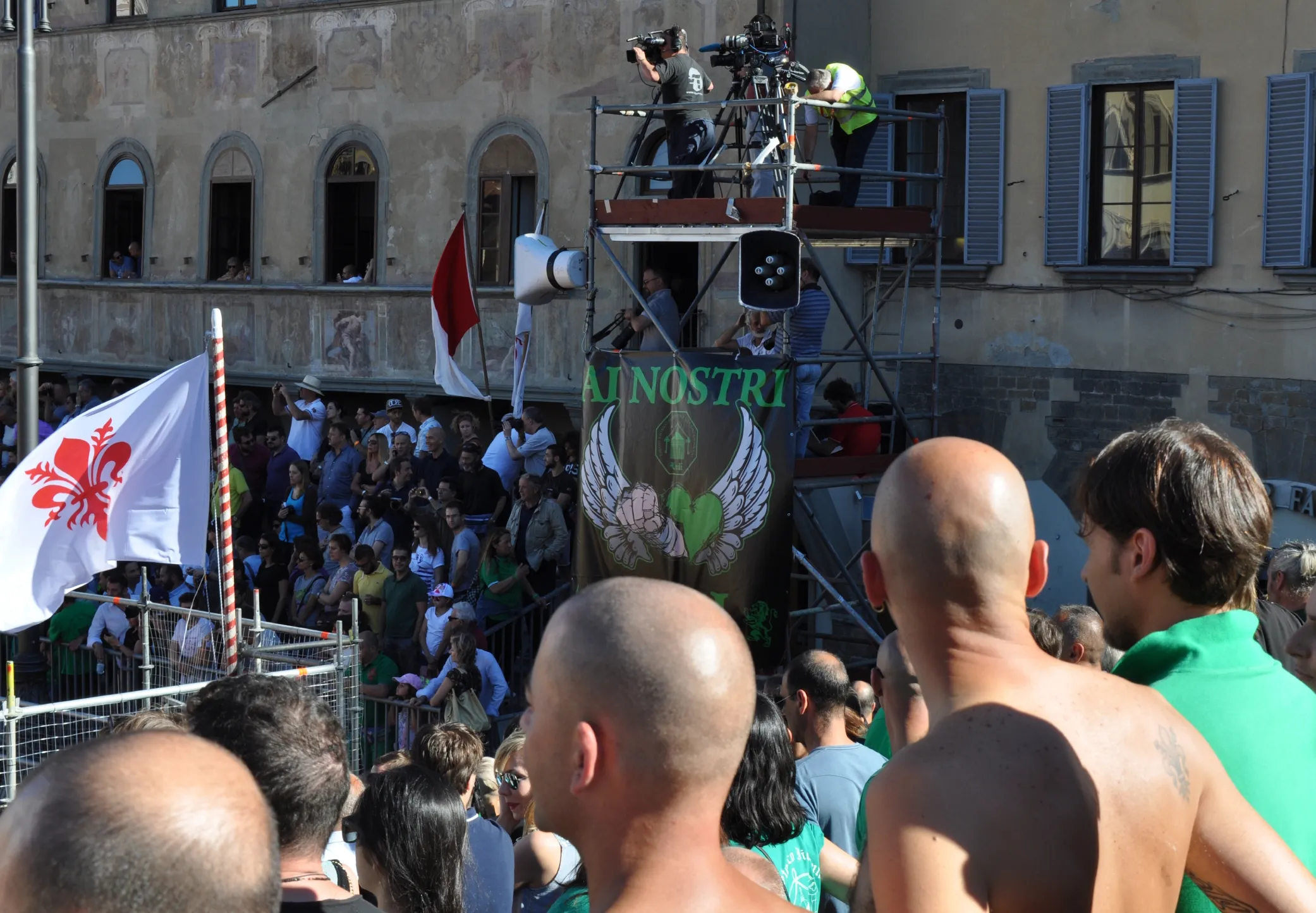
"AI NOSTRI DEI" = "TO OUR GODS"
Plus a Green Heart, a Massive Fist and Celestial Wings.
Heavy Metal? Hells Angels? WWE?
The Verdi are channeling a wide range of outside influences, but there is no question about what they mean.
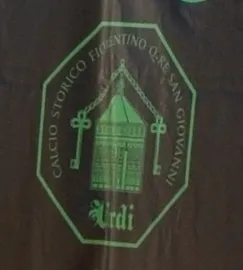
Florence's Baptistry, emblem of the Greens of the San Giovanni quarter.
What is this all about...really???
Florence as a united whole? Florence as four clashing quarters? Florence as it is now? Florence as it used to be?
Sorry, but only an outsider would think to ask those questions!
This is a city where age-old antagonism is the chief common bond.
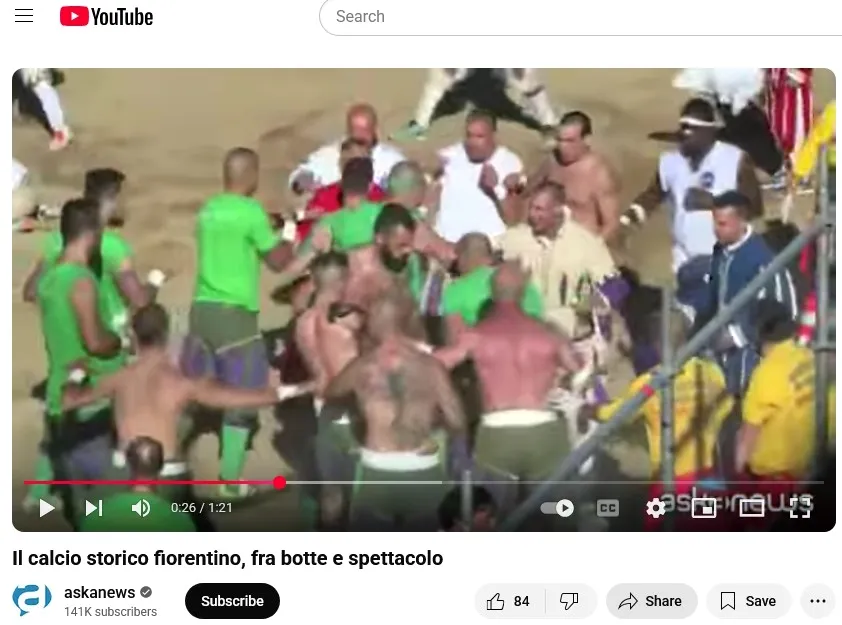
"Florentine Historic Football, Between the Bashing and the Spectacle".
Here is a brief video of the 2015 encounter between the Verdi and the Bianchi.
You can't be Florentine without being part of a neighborhood (even if you don't live there anymore).
You can't be part of a neighborhood without mercilessly deriding the others.
Ask any Verde (Green), Bianco (White), Rosso (Red) or Azzurro (Blue).
They will gladly share that tribal knowledge, usually with a laugh.
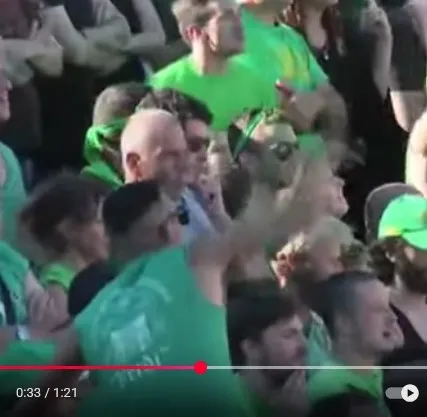
This guy with his back to us, we will be seeing him again soon.
"Total chaos out there, mate!" I remember the reaction of an Australian beer-drinker to a television replay of the Calcio Storico in a Florentine bar ages ago.
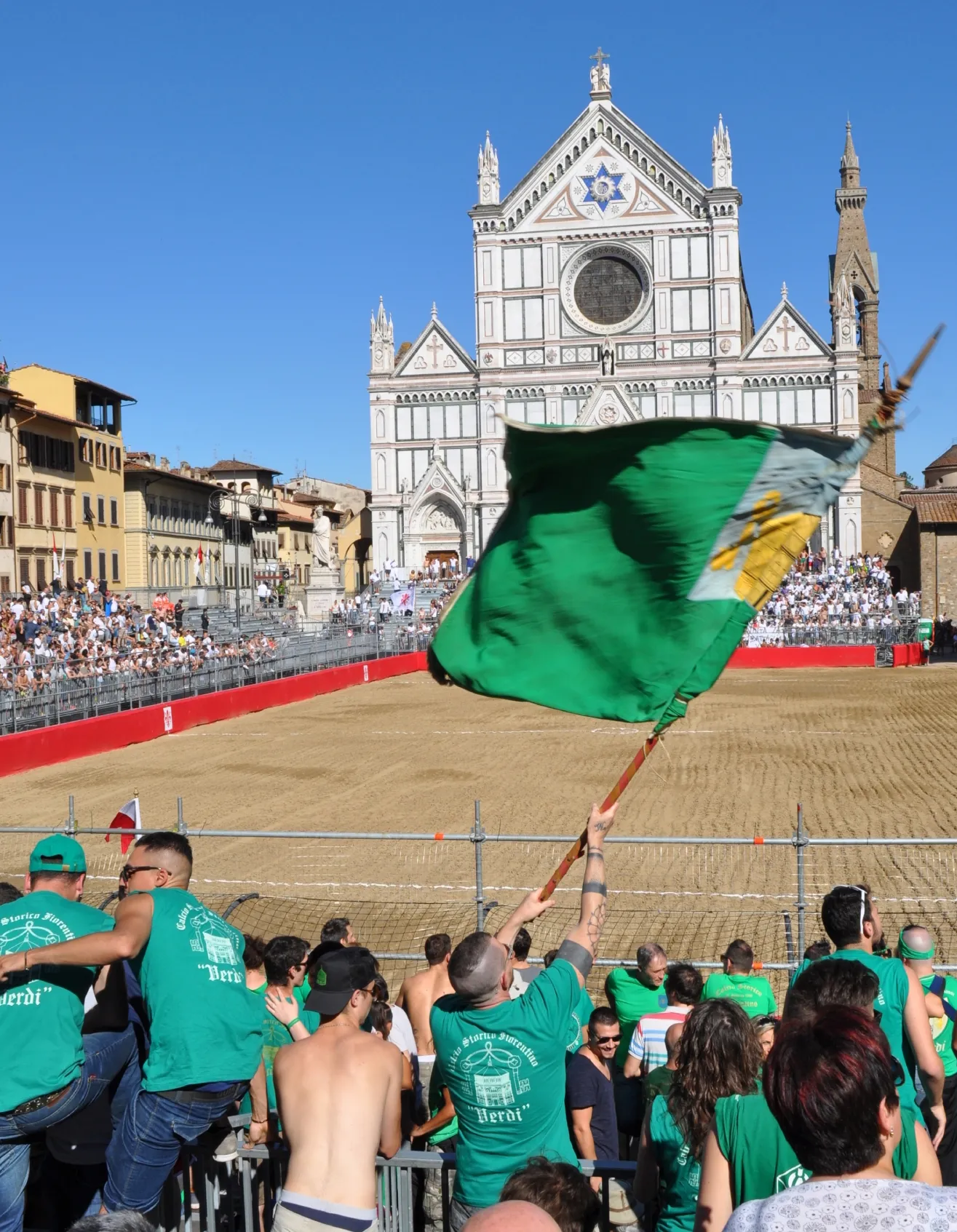
Chaos, not hardly... Apart from the essential chaos baked into the event.
The hyperactive fellow above, second from the left (with the sunglasses and the fresh fade) is just one of the guys.
He is also an admired leader with a crucial role in the big show.
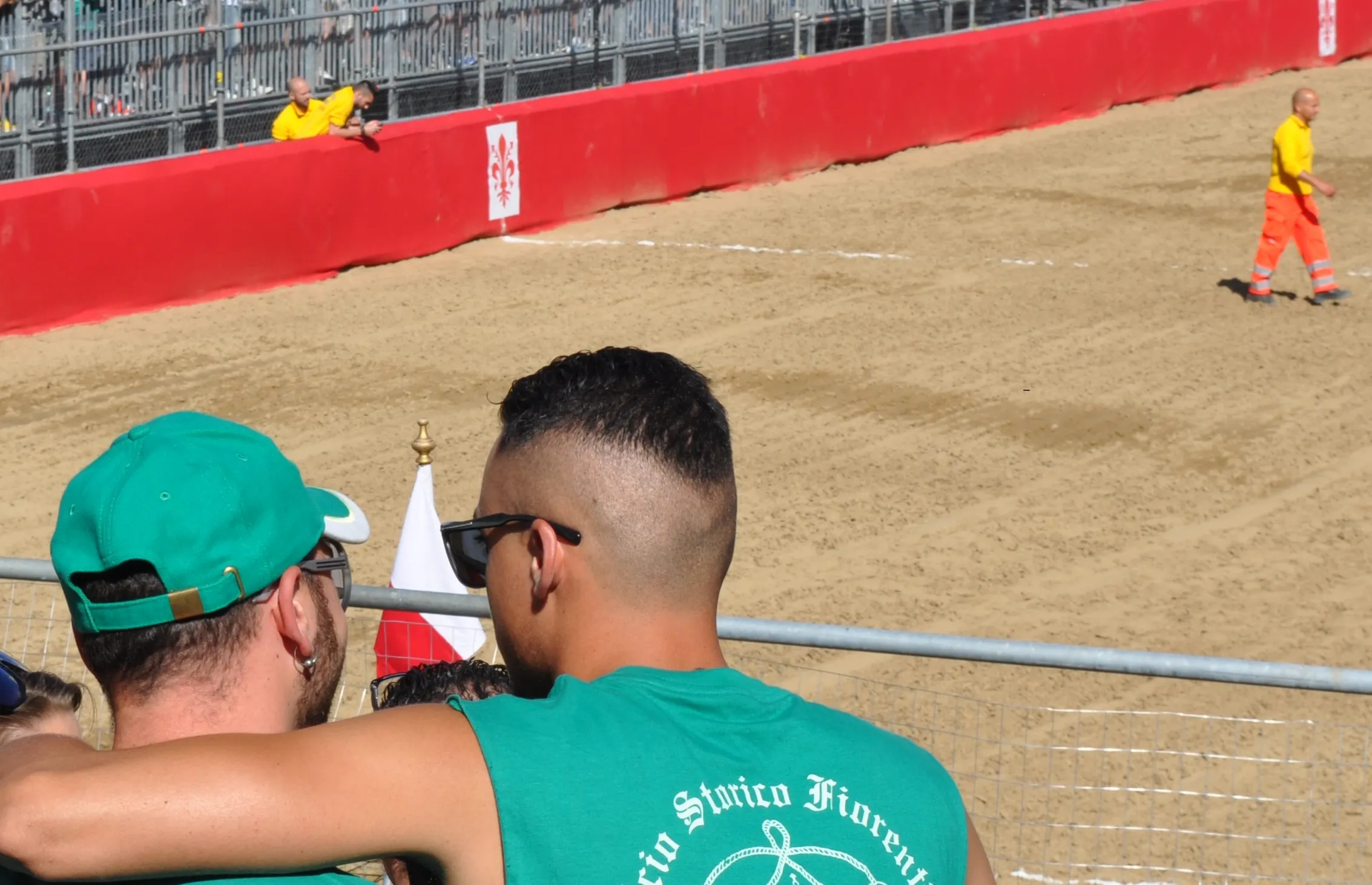
He pops up more or less everywhere in my brother's photos — just a a few rows in front of us, doing his amiably provocative best.
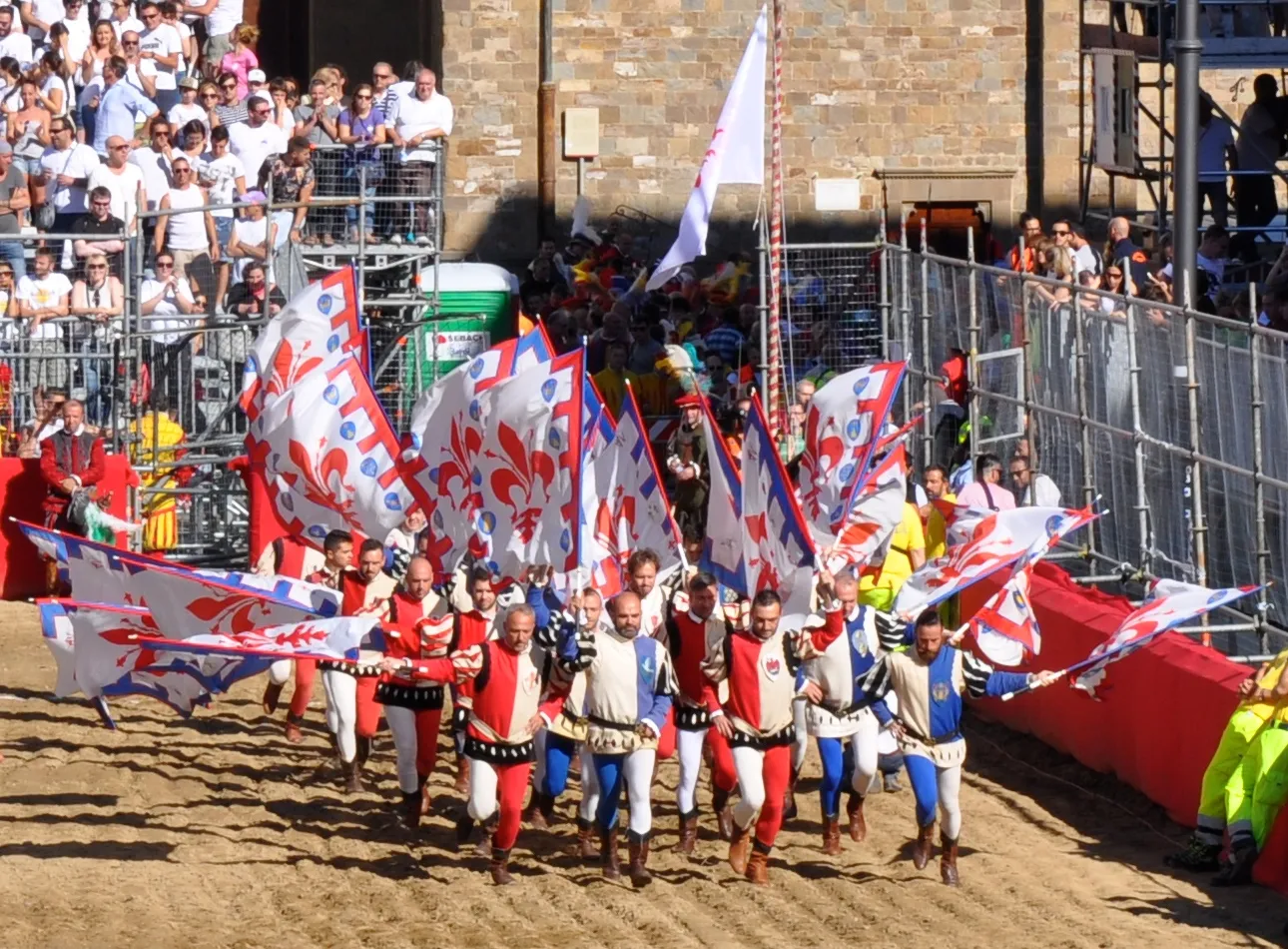
The city-wide corps of sbandieratori (flag wavers, flag jugglers and more) take the field.
First, some intricate counter-programming:
We see all of Florence out on the field.
Meanwhile, the Verdi and the Bianchi go through their motions in their own stands.
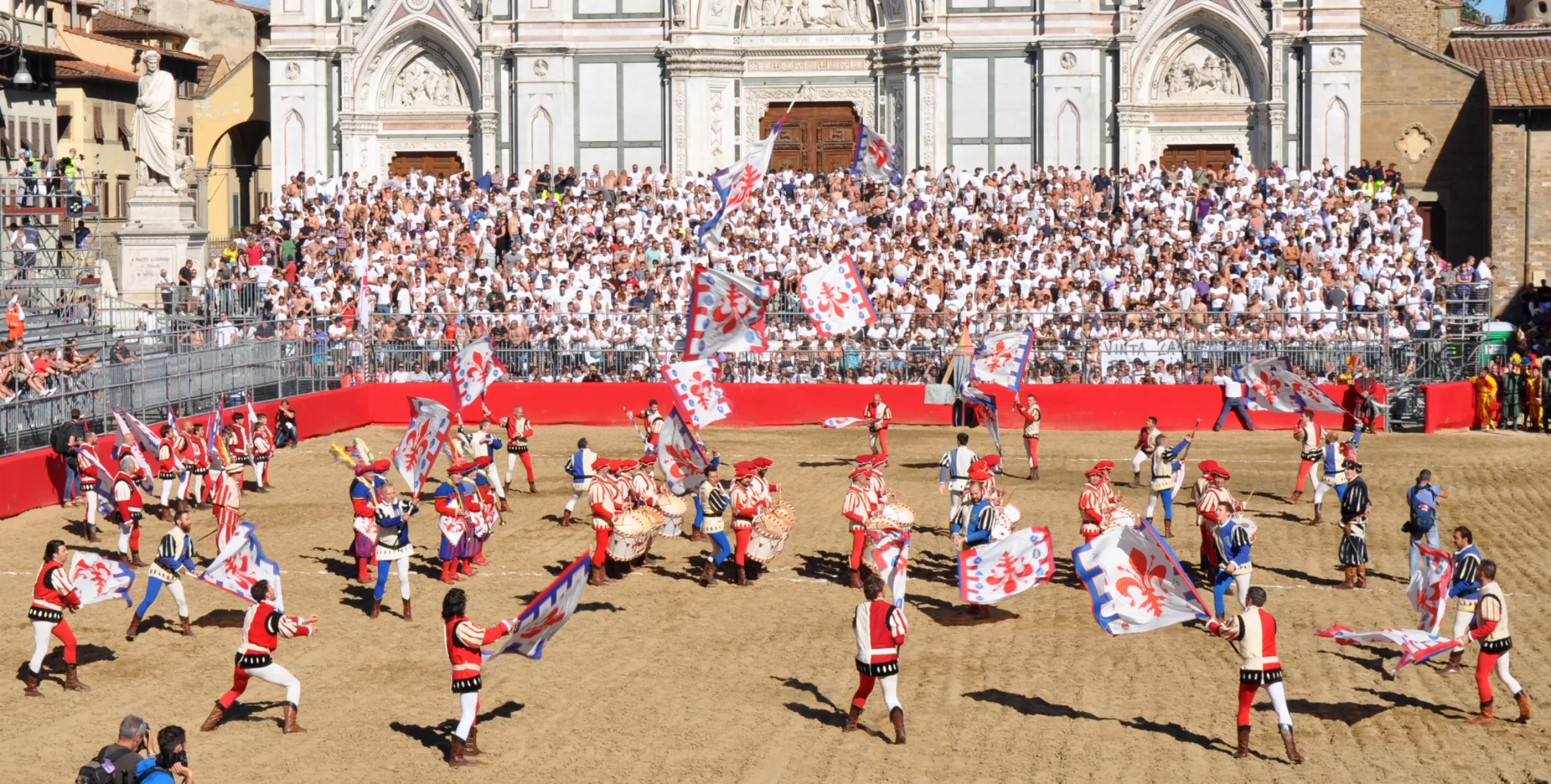
Flags with the emblems of Florence fly through the air, against a background of Santo Spirito White.
Meanwhile, across the piazza, on the Green side...
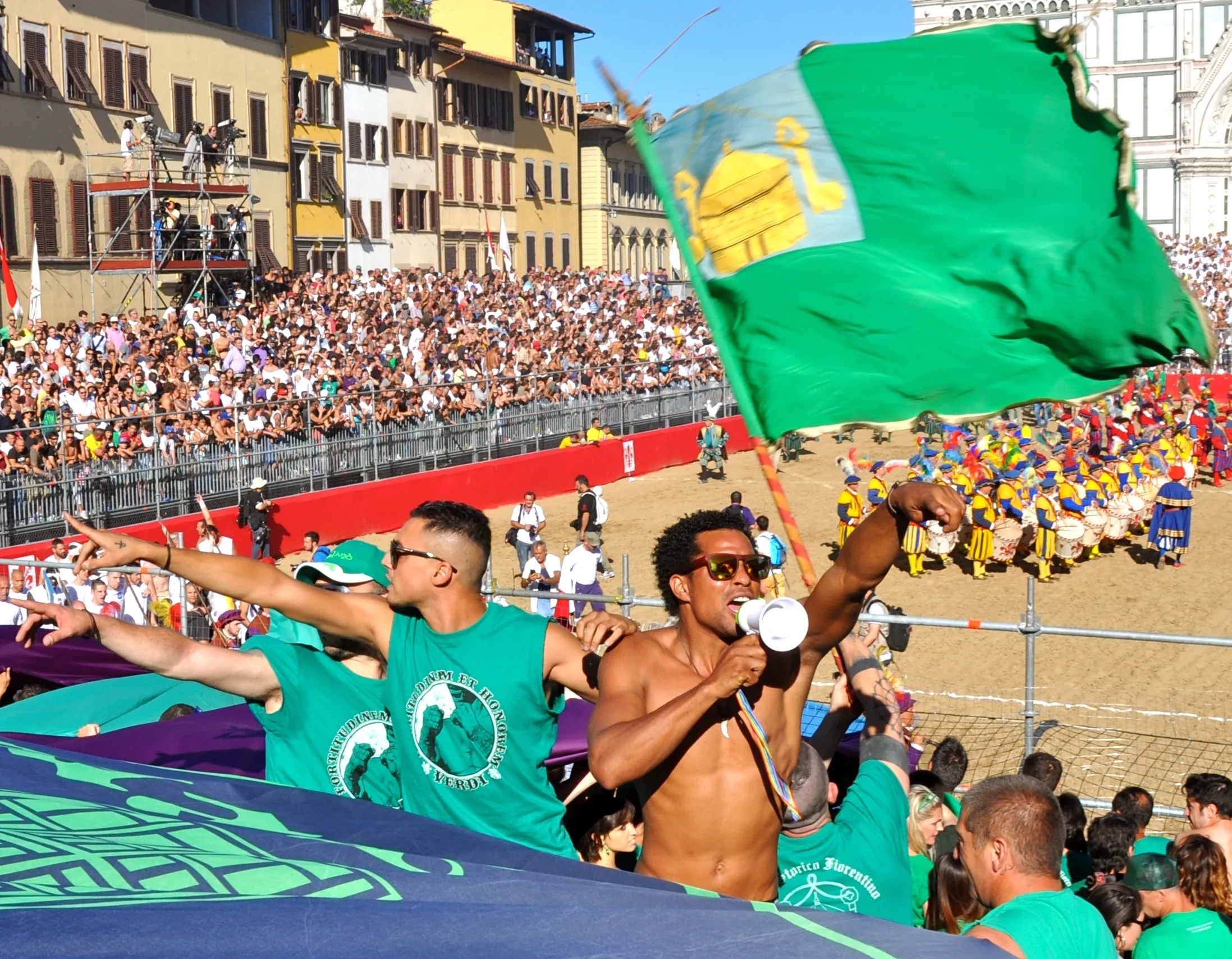
...a choreography worthy of Broadway.
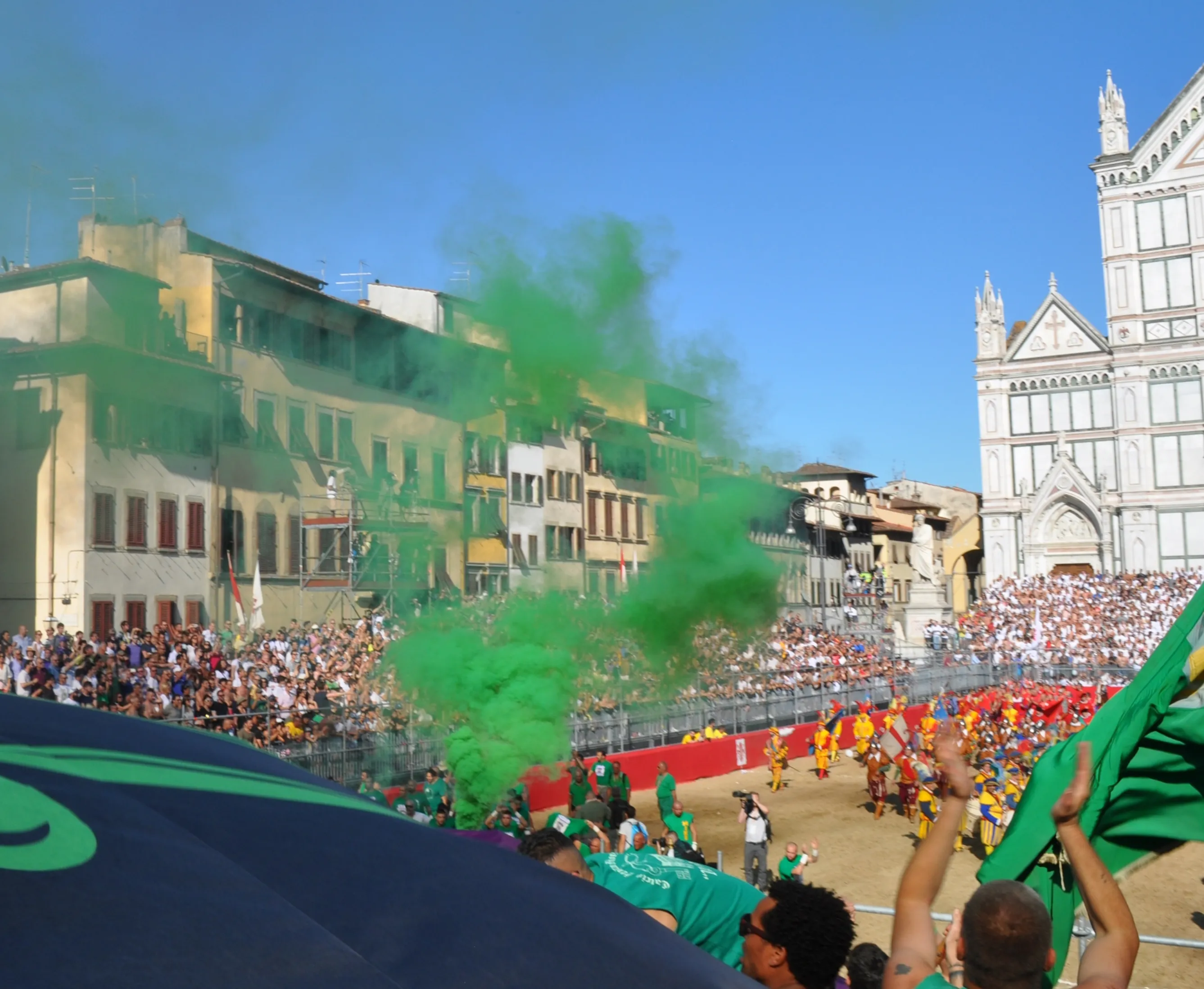
Or rather, a scenografia as they call it.
A total work of art, with green fumogeni (smoke bombs).
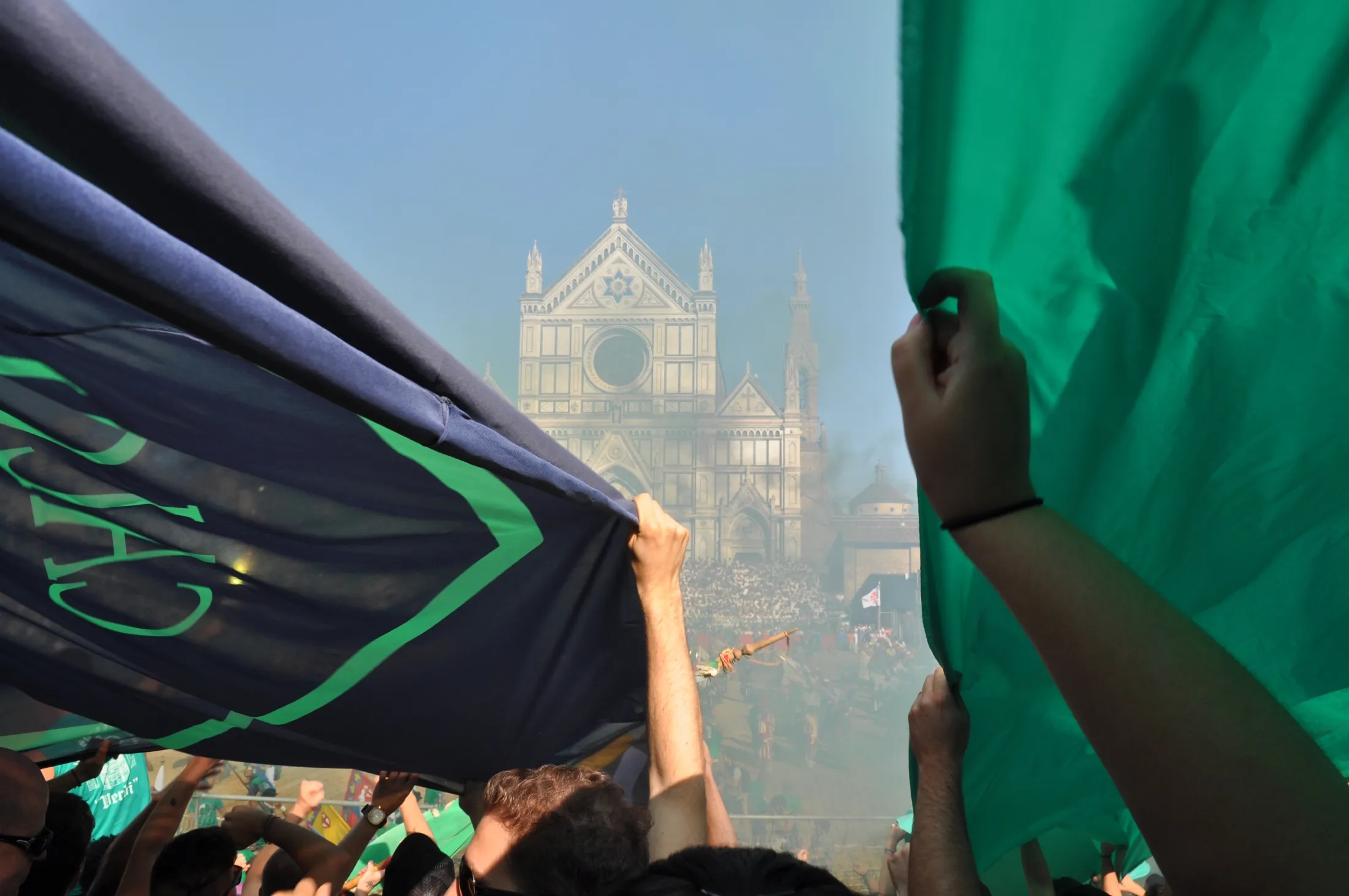
...and a vast super-striscione (the English word "banner" is hardly adequate) covering much of the stand and everyone in it...
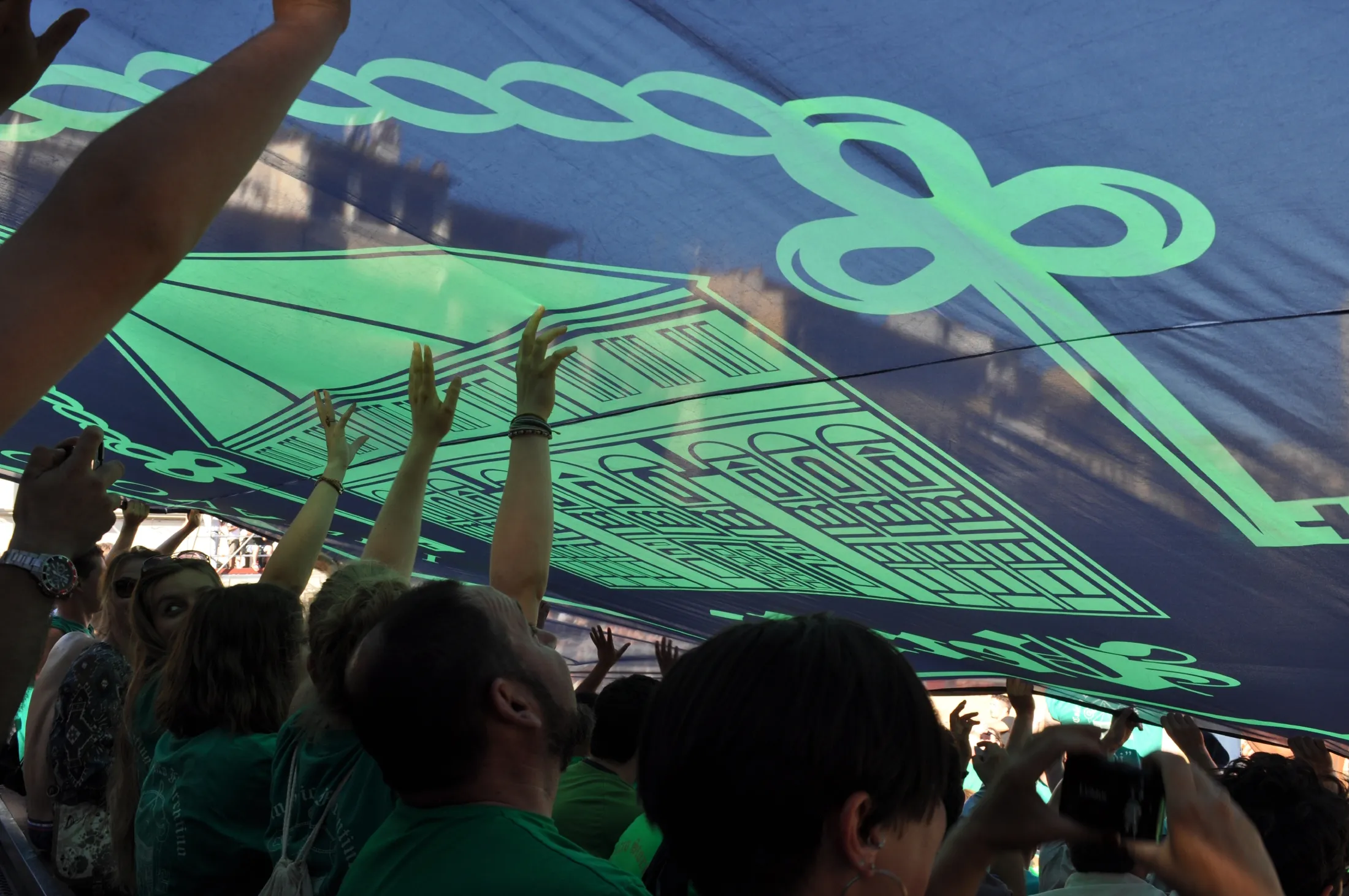
...sheltering them in the comforting shadow of the Baptistry, and by extension the Quartiere di San Giovanni.
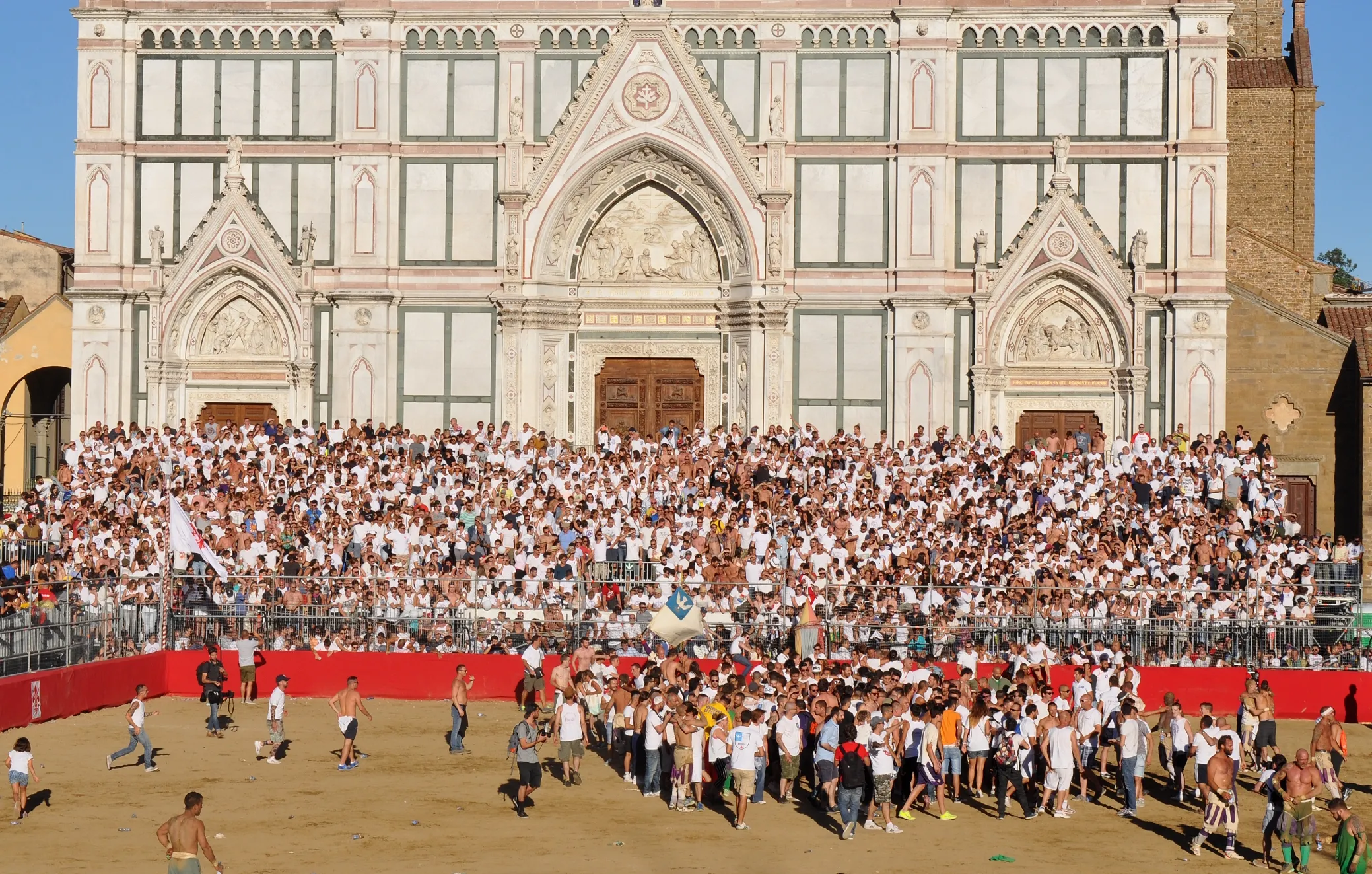
The Verdi clearly triumphed when it came to scenic effects, although the Bianchi had their share of banners, chants and colored smoke.
On the field, however, the Bianchi ran away with it— as everyone knew they would.
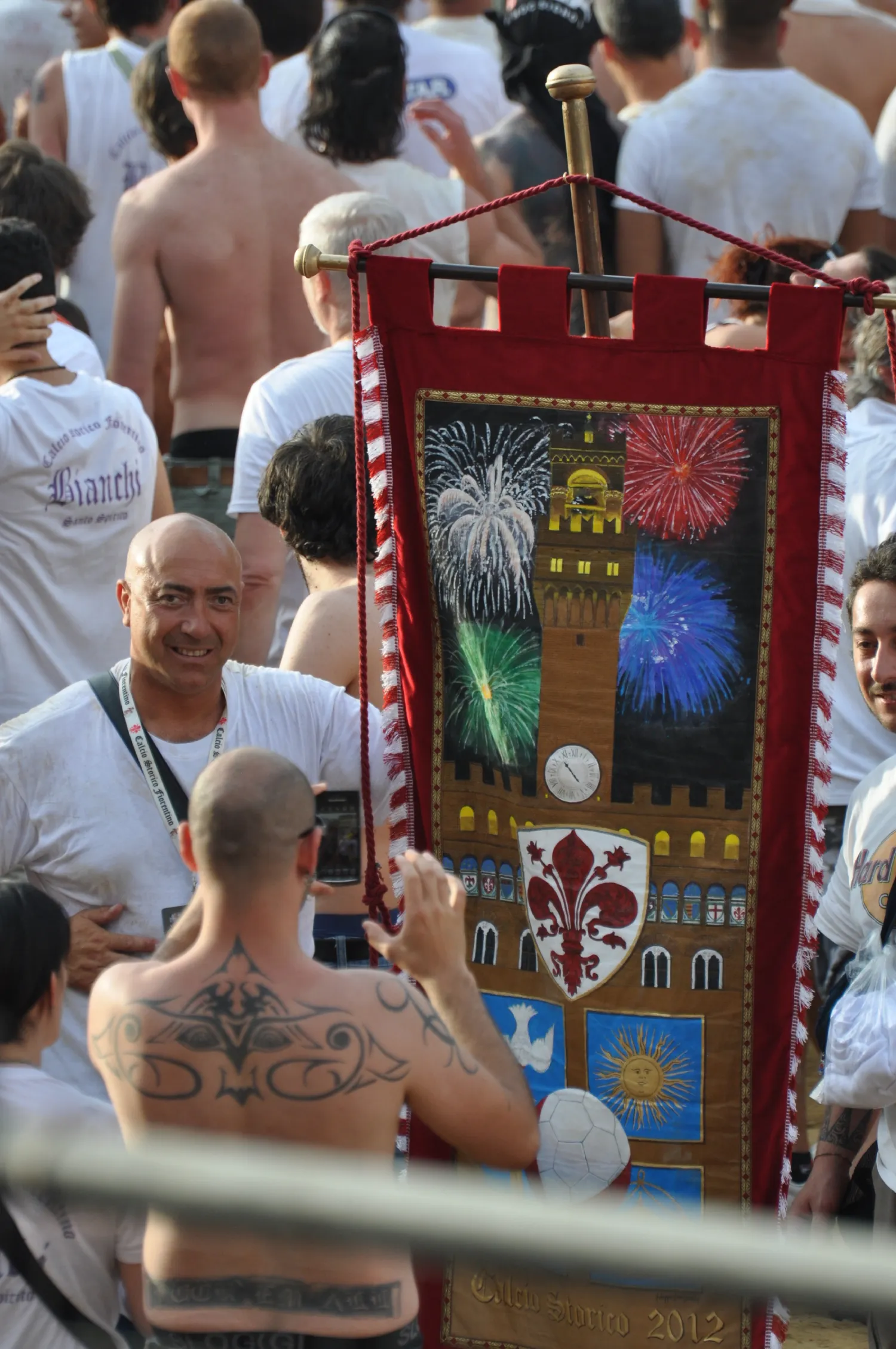
For the sake of transparency: these last two photos are from 24 June 2012, three years earlier than the others. Back then, however, the Bianchi always seemed to win, so we can split the difference.
These days, the chief prize is an artistic banner (the cencio, or rag, as it is affectionately called).
Once upon a time, the victors also took home a calf— mainstay of their celebratory banquet.
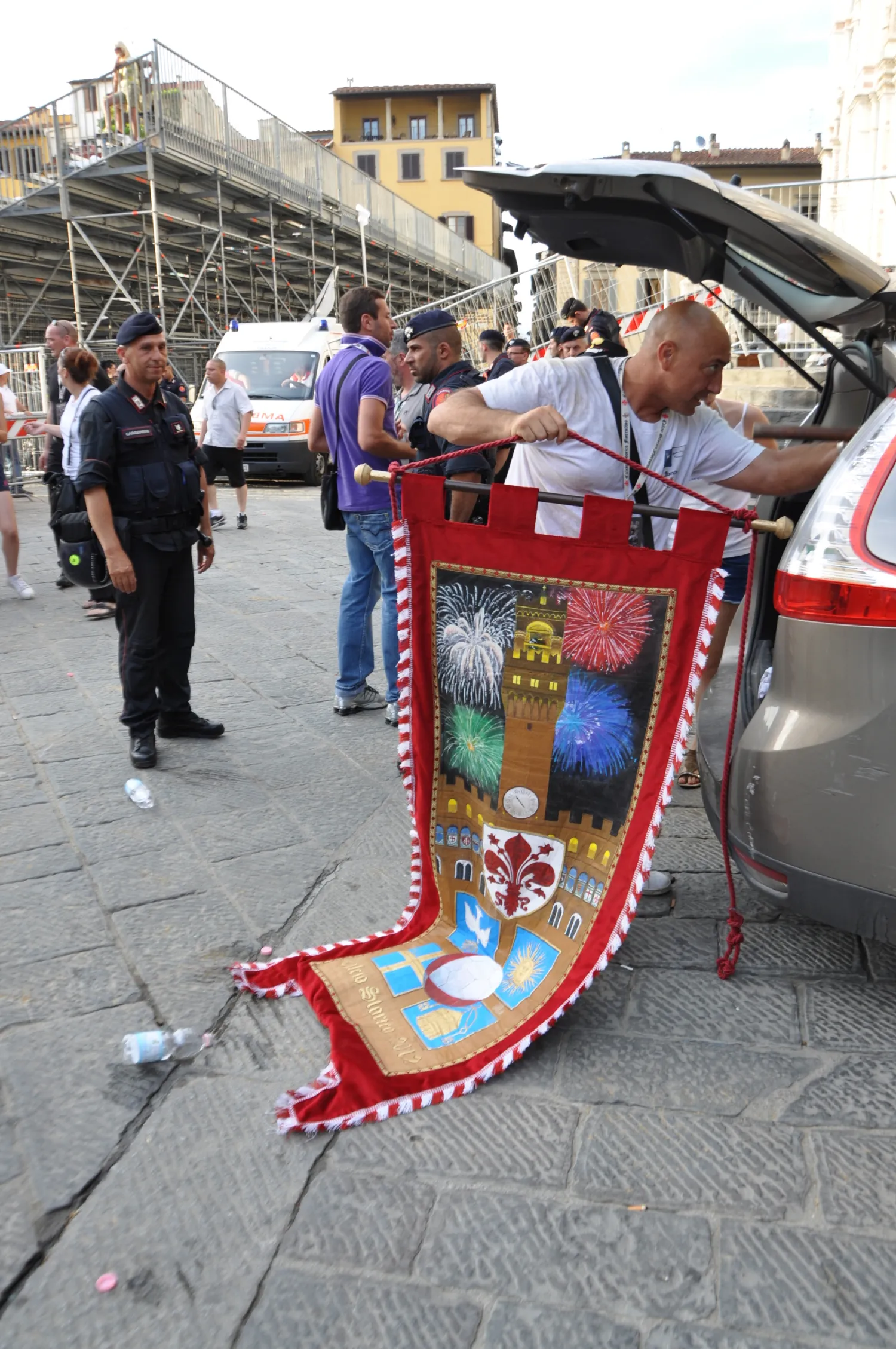
This cencio features the annual Festa di San Giovanni fireworks— scheduled for that very evening after the match. On the banner, they explode (notionally) over the tower of Palazzo Vecchio in the colors of the four quarters of the city.
But whatever else, "Keeping It Real" remains the name of the game.
So, you drag the cencio on the ground and cram it into the back of your car, while a local cop takes quiet notice.
Nothing is more fiercely Florentine than forcing yourself over the top.
Then— once you get there —you shrug your shoulders and say, "No big deal!"
Related posts
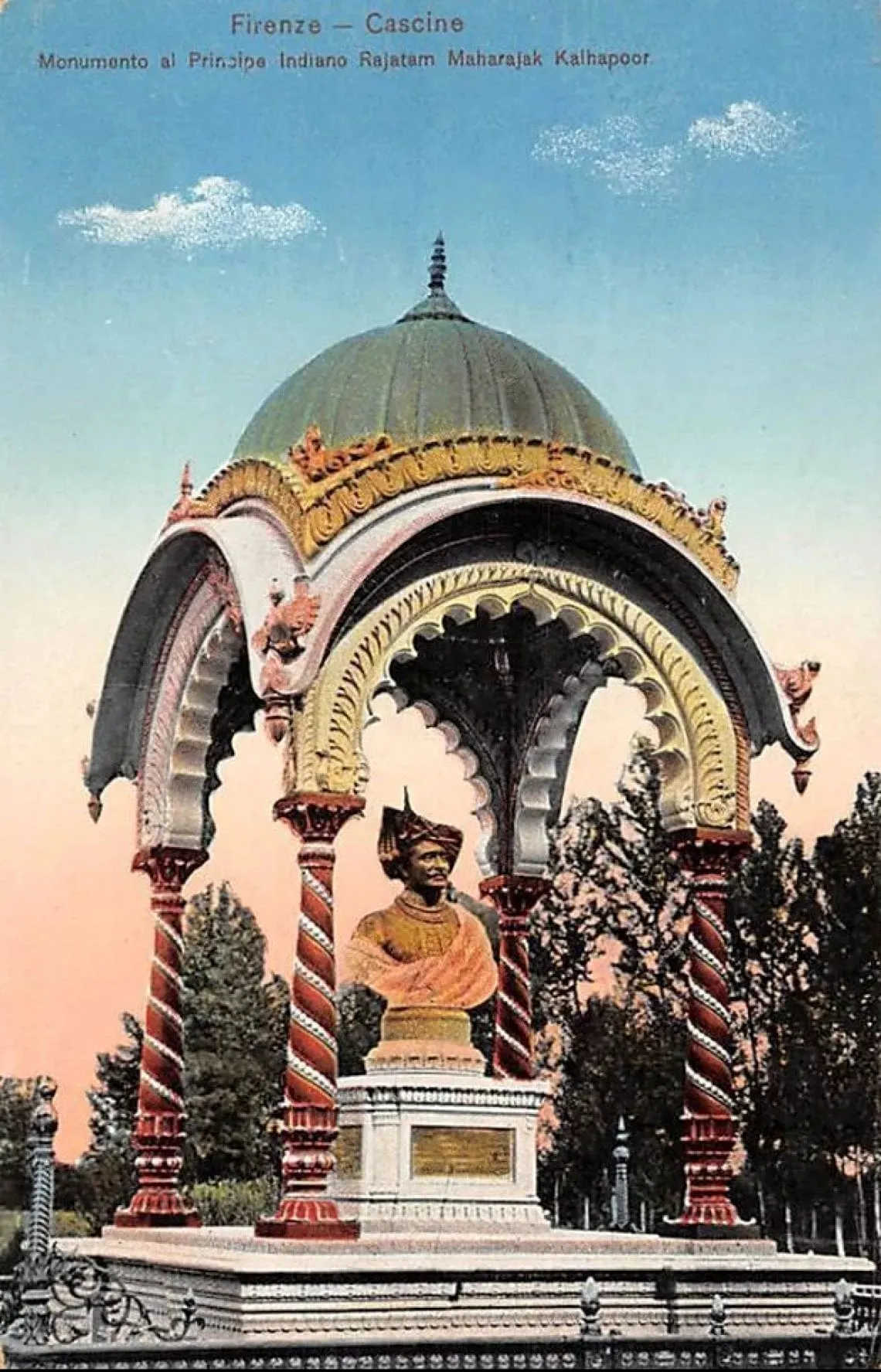
GOING TO THE INDIAN: Across Florence’s Cascine Park and off the Edge of the Earth (Part 3)
In Florence, “Going to the Indian” is more than a very long walk. It is an existential journey leaving the known world behind.
In 1870, the young Maharajah of Kohlapoor died in the Tuscan capital and a lavish monument was erected at the site of his cremation at the farthest limit of the city’s largest park.
Then Florentine culture and custom kicked in…
***
For centuries, the Cascine functioned as both a working farm and a princely hunting preserve.
Then in the course of the 19th and 20th centuries, modern athletic pursuits developed in that increasingly public park—making it ground zero for almost everything that is played in Florence today.
We cross the vast expanse of the Cascine, tracking half-forgotten pastimes like pallamaglio (a precursor of croquet and golf), pallone al bracciale and tamburello (cousins of handball and racquetball). Then comes soccer, tennis, horse racing and polo.
“Going to the Indian” means "trekking to the edge of the earth". But as we approach the Maharajah’s monument on the far side of the Cascine, another adage comes to mind,
“Go throw myself off the Indian” refers to the “Viaduct of the Indian”, an ill-omened highway overpass right nearby.
This potent magnet for local suicides has a dire history of its own.
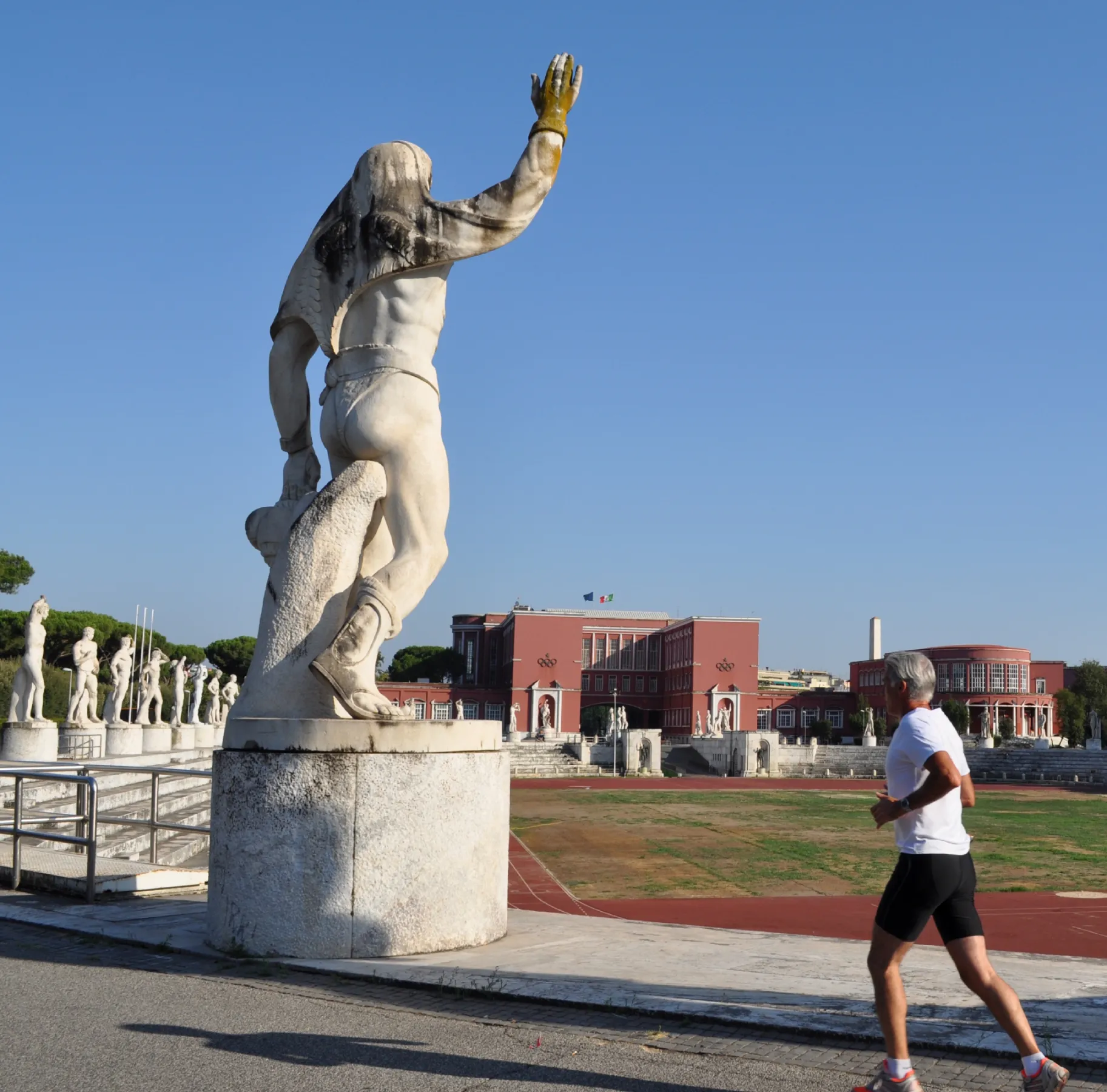
HEALTHY FASCIST MIND, HEALTHY FASCIST BODY: Mussolini’s Foro Italico in Rome
Mussolini enshrined this ideal in his Foro Italico (Italic Forum) in Rome, popularly known as the "Mussolini Forum".
Especially in the adjoining Stadio dei Marmi (Stadium of the Marble Statues), with its onslaught of colossal male nudes.
But then the years pass and present-day Romans move in, doing what present-day Romans do...
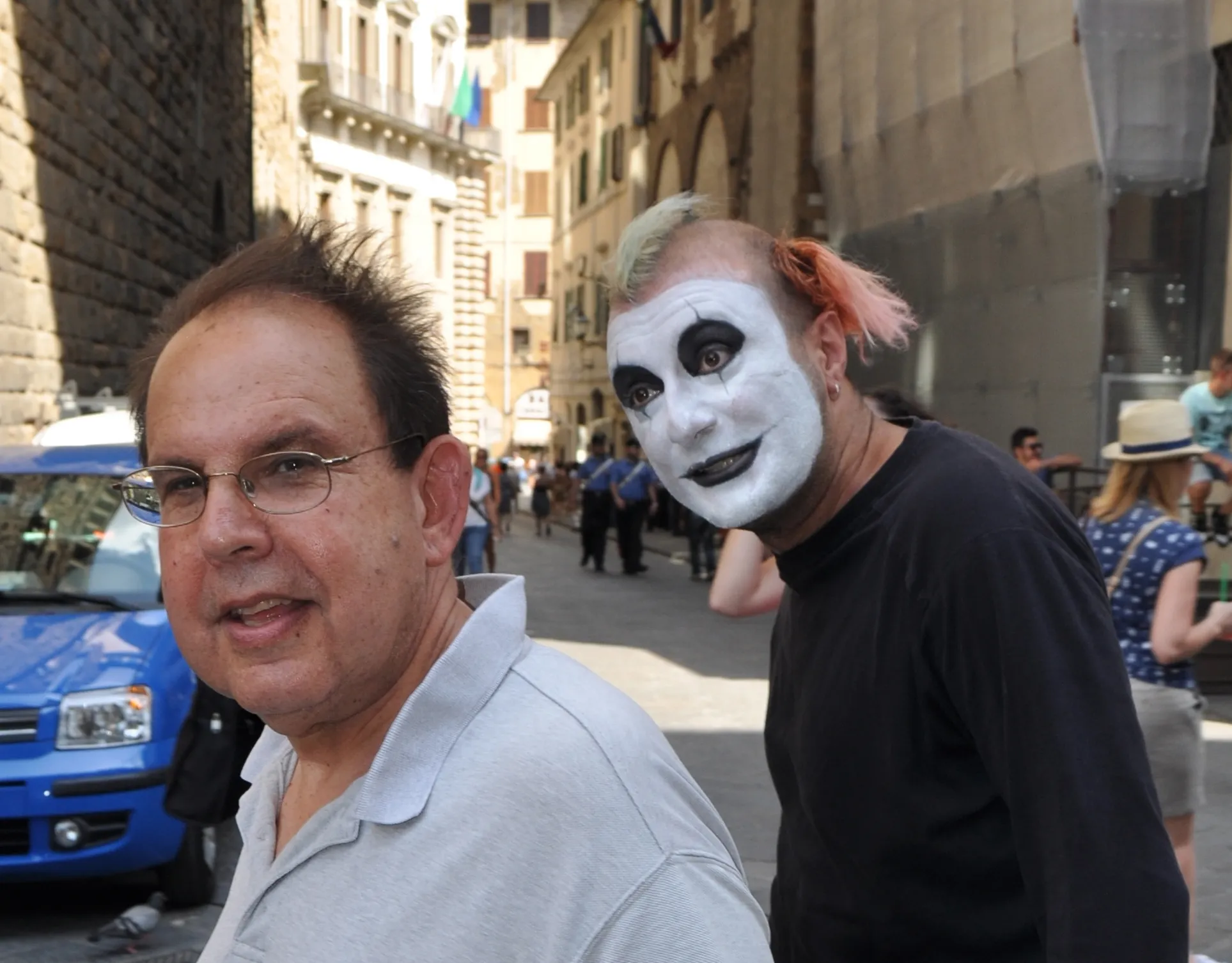
PUNKED BY A MIME ARTIST OUTSIDE THE UFFIZI GALLERY
Don't mess with Florentine Street Performers!
They are smarter than you, tougher than you and have secret powers.
Lorem ipsum dolor sit amet, consectetur adipiscing elit. Suspendisse varius enim in eros elementum tristique. Duis cursus, mi quis viverra ornare, eros dolor interdum nulla, ut commodo diam libero vitae erat. Aenean faucibus nibh et justo cursus id rutrum lorem imperdiet. Nunc ut sem vitae risus tristique posuere.