COLUMBUS, MARCONI, BALBO AND MUSSOLINI: Italian Heroes Collide in Chicago - Part 3
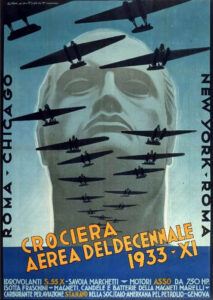
CONTENTS:
(9) BEHIND THE SCENES AT THE ITALIAN PAVILION
(10) ON MESSAGE AND OFF
FOR MORE OF THE CHICAGO CENTURY OF PROGRESS STORY, SEE:
COLUMBUS, MARCONI, BALBO AND MUSSOLINI: Italian Heroes Collide in Chicago - Part 1
COLUMBUS, MARCONI, BALBO AND MUSSOLINI: Italian Heroes Collide in Chicago - Part 2
COLUMBUS, MARCONI, BALBO AND MUSSOLINI: Italian Heroes Collide in Chicago - Part 4

On October 3, 1933, Guglielmo Marconi and his party visited the Italian Pavilion at the Century of Progress Exposition.
(9) BEHIND THE SCENES AT THE ITALIAN PAVILION
For the Facist regime, America was both a problem and an opportunity.
Then came Chicago's Century of Progress Exposition...
We could always jump in at the end and view the Italian Pavilion as a done deal —but there were constant stops and starts, pauses and hesitations, along the way.
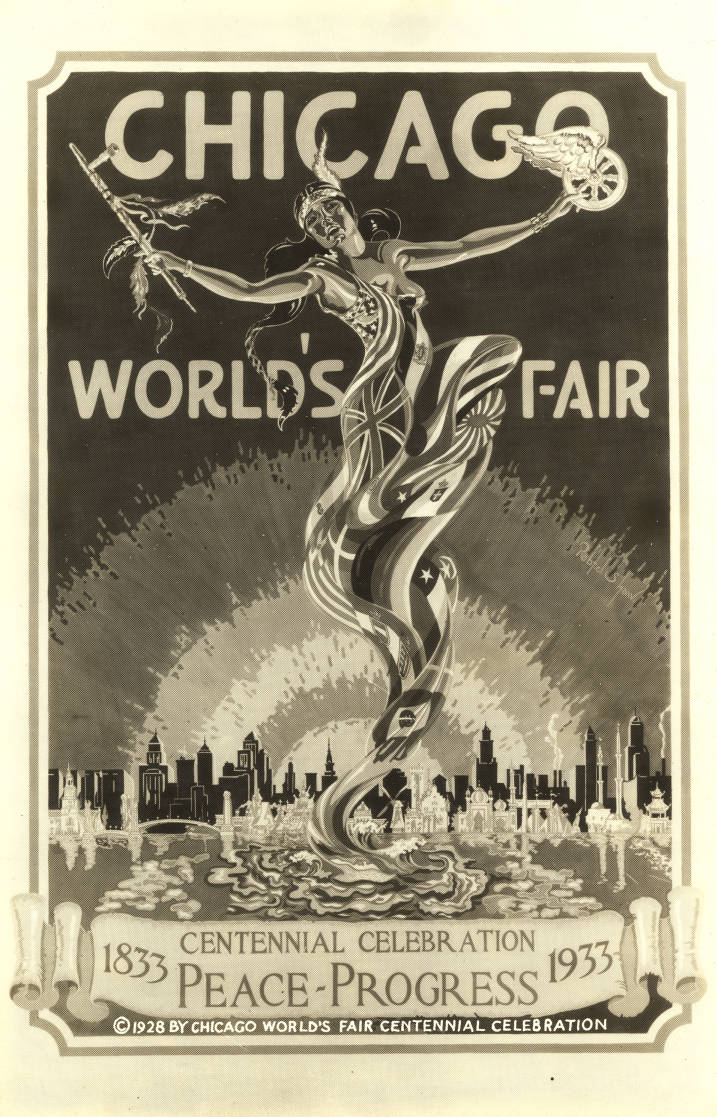
In January 1928, after years of discussion, Chicago proclaimed a World’s Fair marking the city’s hundredth anniversary (1833-1933).
A "Centennial Celebration of Peace and Progress" was the designated theme— extoling the great boom that followed the World War.
In their first blast of publicity, we see a chorus girl erupt from a swirl of flags— Indian Maiden-style —with a feather in her hair, a peace pipe in one hand and the winged Wheel of Progress in the other. A giddy moment, to be sure…
The poster is in black-and-white, including the panoply of implied national colors. Still, we know that international participation was in the mix from the very start— although Congress was yet to authorize the invitation of foreign exhibitors.
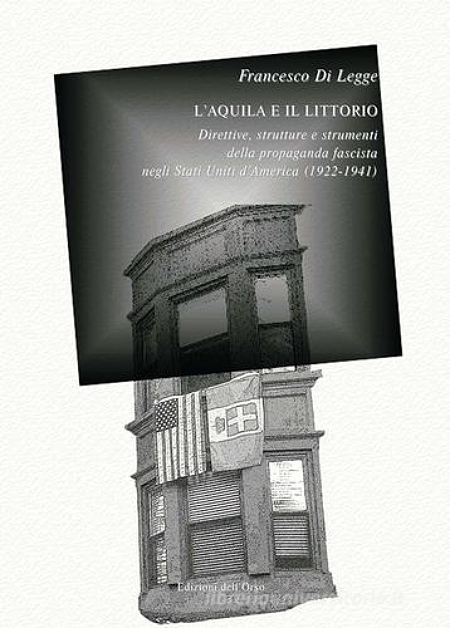
strumenti della propaganda fascista negli
Stati Uniti d'America (1922-1941) (Edizioni dell'Orso, 2027)
Title in English: "The Eagle and the Fasces: Directives, Structures and Instruments of Fascist Propaganda in the United States of America (1922-1941)". Here I cite the online version of Dr. Di Legge's preceding doctoral thesis (Università del Molise, 2013/2014)
In the files of the Minstero degli Esteri (Ministry of Foreign Affairs) in Rome, there is massive documentation of the Italian response to the evolving opportunities and challenges of the Century of Progress Exposition.
This material was mined to great effect by Dr. Francesco Di Legge in his masterful study of Italian Fascism in America during the twenty years of Mussolini's ascendancy.

Once Congress ratified the Chicago venture on February 5, 1929 —duly endorsed by outgoing president Calvin Coolidge— Consul Castruccio was quick off the mark.
On 4 March, he made the first of many pitches for Italian participation, writing Ambassador Giacomo di Martino in Washington.
From the outset, Castruccio had the goals and aspirations of the Fascist Regime firmly in mind.

"The 1933 Centennial Exposition is based on a concept that can be viewed as FASCIST in various ways. This Exposition will not be a display of manufacturers or artists competing among themselves. Instead, it will express the historical and logical development of the arts and industries etc.—starting from their inception, then registering the essential indicators of their advancement."
"In other words, this Exposition will not embody a competition between individuals or nations. Rather, it will demonstrate the progress of the arts and sciences through the ongoing collaboration of individuals, industries, corporate bodies and nations."
"Such an idea offers Italy an enormous opportunity since she is the cradle of all the arts, all the sciences and all the industries. Indeed, the Chicago Exposition seems made-to-order for Italy, allowing her full scope to assert her extraordinary contribution to the entire world."

Medals from nineteenth and early twentieth-century expositions are still the hall-mark of many traditional products in Italy.
For Castruccio, the Century of Progress promised a break from previous World Fairs with their emphasis on publicity and prizes, featuring a barrage of ingenious items —more or less commercial —in eclectic settings.
Castruccio led with a paean to “Progress” —a historical force propelled by the “ongoing collaboration of individuals, industries, corporate bodies and nations”.
After this transnational flourish, he changed course —hailing the specific advantages for the Italian people and their government.
The American connection was crucial to Italian prosperity, he explained, In that time of economic stagnation in Europe.
Meanwhile, there was an ideological dimension. Fascist Italy needed to consolidate her image as a modern and progressive country in the face of widespread denigration.
By affirming the prestige of Italian art and science, they could correct “the erroneous impression that we are a population of beggars and criminals, in other words an inferior people…demonstrating that the exact opposite is true”(“l’errate impressioni che noi siamo un popolo di pezzenti e criminali, in altre parole, un popolo inferiore... [per] mostrare in modo tangibile che la verità è precisamente all’incontrario”) (Di Legge, Aquila, p.210)

"Revise Nursery Rhymes"? Even The Daily News— "New York's Picture Newspaper"— would be hard put to maintain their famed insouciance as the economy collapsed.
The Consul made his initial move eight months before the the Stock Market Crash and ensuing Depression —which changed everything in America too.
The organizers of the Century of Progress found their Fair a much tougher sell and the Jazz Age frivolity of the initial proposal dropped out of sight —along with the public's fading enthusiasm for "Peace".

Felix Joseph Streyckmans (1877-1953), an eminent Chicago lawyer with political connections on the Republican side, managed foreign participation in the Century of Progress Exposition.
It was up to Streyckmans to enlist cash-strapped and often politically unstable nations for the Chicago fair. On February 11, 1931, he wrote Giuseppe Castruccio —demonstrating a keen understanding of what the Italian authorities wanted to hear.

“[T]he [Italian] Government could install dioramas showing Italian scenery and make such an exhibit as would show the progress of the Italian Government and of the Italian people under the present regime. I do not know of any better mode of propaganda to put Italy right before the people of the United States and also before the people of the rest of the world who will participate than to have an exhibit showing the development of the country and the real conditions under the present regime.”
The "present regime" meant Mussolini's Fascists and Streyckmans warmly welcomed their "propaganda" at the Century of Progress.
While Castruccio's superiors were eager to "put Italy right before the people of the United States", Streyckmans and his confederates were excessive in their demands— floating a participation package that cost 10 million lire (approximately half a million dollars then and 12 million dollars now).
So, in June 1931 the Italian government declined the invitation— gravely disappointing the Chicago Consul. He quickly proposed a personal visit to Rome, so that he might lobby the Ministry of Foreign Affairs and the Duce himself.
Meanwhile, Castruccio considered fall-back options —without a costly pavilion of their own. (Di Legge, Aquila, p.212)
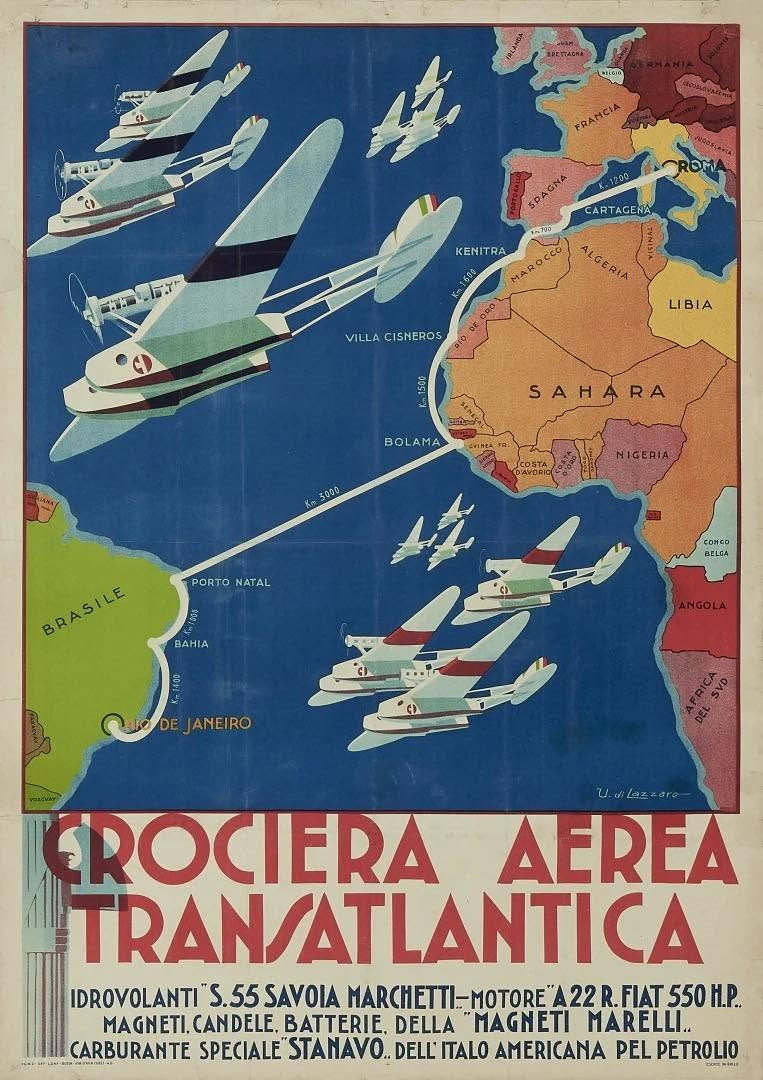
Italo Balbo and his hydroplane fleet had just completed a sensational transatlantic crossing in December 1930-January 1931— skirting colonial Africa and landing in the bay of Rio de Janeiro.
Now he was planning another crociera to New York, using the same technical components.
Might Balbo be induced to include the Chicago Exposition in his North American itinerary?

Council President Guglielmo Marconi is seated at the far left.
In 1929, the Regime founded the National Council for Research with its scientific superstar Guglielmo Marconi as president.
The CNR speaheaded a national effort to codify the history of Italian science through the compilation of archival documentation and the fabrication of working models of iconic inventions.

Francesco Savorgnan di Brazzà's popular introduction to the history of Italian science features the twin thunderbolts of Leonardo da Vinci and Guglielmo Marconi. It was published in 1932, with a Fasces and the date A.X. (Anno X = Year 10 of the Fascist Era).

Marconi presented two originals of this device to the King of England and the Czar of Russia in 1902.
The astronomer Giorgio Abetti and the mathematician Enrico Bompiani were responsible for the model-making.
Might copies be sent to Chicago— Castruccio asked —for the Exposition’s Hall of Science?

“MAY ENROLL FOREIGN COUNTRIES FOR FAIR: Confident that the leading nations of Europe will be represented at the Century of Progress Exposition in Chicago in 1933, Felix J. Streyckmans, chief of foreign participation, left Chicago recently on a world’s fair mission to Europe. Many foreign countries have already indicated their intention of participating.”
Streyckmans may have expressed confidence, but he was fighting an uphill battle—pursuing exhibitors with money to spend in the depths of a world-wide economic débacle.
Castruccio, on the ground in Rome during the summer of 1932, also had his work cut out for him— inducing the people at the top to rethink their previous refusal.
Castruccio and Streyckmans might have met in person, since they were lobbying many of the same officials— and they both wanted Italy at the Century of Progress for reasons of their own.
Streyckmans, it seems, also had a team of agents— American go-getters all— who trampled the Consul’s best-laid plans. (Di Legge, Aquila, p.212-13)

Gerardo Dottori was an advocate of Aeropittura (Airborn Painting), a branch of Futurism that extolled the speed and dynamism of flight. The title puns on “Wings of Italy” (Ali d’Italia) and the Fascist war cry, “Alalà!”. Balbo rises from a square-sailed, wooden ship alluding to heroic old-style seamanship (but not explicitly Columbus).
In Rome, with the support of their Embassy in Washington, Castruccio made the rounds of the relevant ministeries, presenting his case.
Meanwhile, Streyckmans and his deputies were tripping over their own feet —and Castruccio's too— calling on the same people and getting to “no” before the Consul could get to "yes”.
On the positive side, Minister of Aviation Balbo was favorably inclined to including Chicago in his next Atlantic transvolata.
So, Prince Potenziani took the matter to Mussolini himself. (Di Legge, Aquila, p.212-13)

For a contemporary newsreel of Mussolini’s inaugural visit to the Mostra and a gimpse of the installation, see Roma. L'inaugurazione della mostra della Rivoluzione Fascista from the Istituto Luce (the Regime’s photographic and cinematic operation).
Chicago’s Century of Progress was not the chief spectacle on the Duce’s mind in the summer of 1932. Like everyone else around him, he was focusing on the Exhibition of the Fascist Revolution —scheduled to open on October 4 (10th anniversary of the March on Rome).
Still, Castruccio managed to push his scaled-down proposal through the system, focusing on a range of adjunct activities.
In August, a series of resolutions emerged from a joint ministerial meeting:
(1) Italy would not construct a pavilion.
(2) Italy would participate conspicuously in the Hall of Science exhibition.
(3) Italy would figure in the Tourism exhibition.
(4) Italy would organize an Italian Day on August 3, 1933, in collaboration with the local Italian community, featuring the inauguration of Chicago’s monument to Christopher Columbus (already in progress).
Toward the end of August, Mussolini made this a fiscal reality— approving a relatively modest budget of two million lire (approximately $100,000 then and $2.5 million today). (Di Legge, Aquila, p.213)
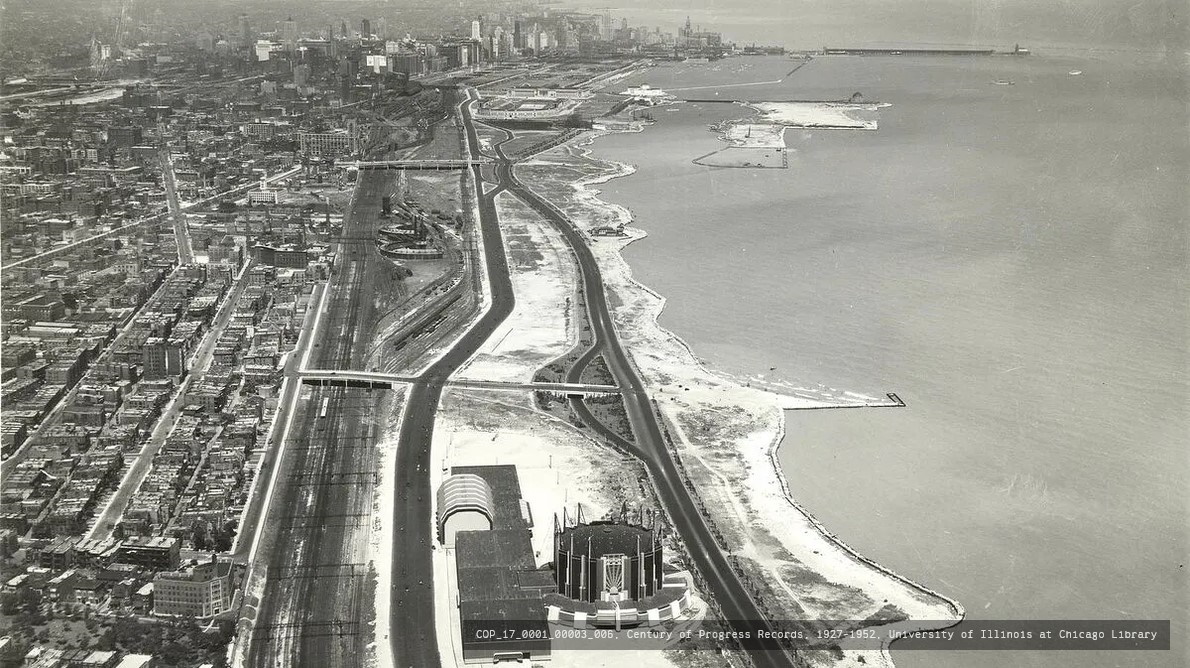
The Chicago commissioners were especially eager for an Italian Pavilion since the other major European countries were opting out —including Great Britain, France, Spain and Germany.
So, only a few days after the Italians settled on a modest plan, the Chicago organizers dispatched a new negotiator to make them a deal they couldn't refuse. For only another million lire, they could build their pavilion and take their place in the forefront of participating nations.
Mussolini quickly came around to this new idea and allocated the additional money. He specified, however, that the Italian Pavilion would be a stripped down affair with only a few broadly thematic exhibits.
It would offer “a synthetic expression of the spirit that the Regime has created in Italy and the resulting progress in the area of public works along with a demonstration of our craftsmanship.” (“una sintetica espressione dello spirito creato in Italia dal Regime, e del progresso realizzato nel campo delle opere pubbliche; e ad una manifestazione delle attività del nostro artigianato”; Di Legge, Aquila, p.213)


On 17 November 1932, Consul Castruccio expressed his satisfaction to outgoing Ambassador Pasquale Diana in Washington, "Italy will present with dignity, calm and assurance, demonstrating that she is a solid rock amidst the tempests. Many European nations will be missing but that is an incentive for us, showing the contrast between Fascist Italy and other major nations that are democratic and decadent."
Meanwhile, the American organizers were scaling down in the face of relentless economic pressure. To save money, they canceled the planned Art Pavilion— prominently sited on the Avenue of Flags next to Hall the Hall of Science —and offered the Italians this prime space.

The Century of Progress Exposition was scheduled to open on May 27, 1933 —only seven months after the new arrangement was finalized— so there was no time to spare.
The Italians needed an architectural design on the fly. In Rome, Adelberto Libera, Mario Derenzi and Antonio Valente were fresh off the Exhibition of the Fascist Revolution —but these accomplished practitioners would only be working on paper.
The Pavilion was going up in Chicago and people were required on the ground —ones who knew their way around local suppliers, local manpower and local laws.
Modernism was the Exposition's designated style, but Regime Modernism might hit too hard for American taste— the Italian planners feared —unless modulated by sympathetic insiders. (Di Legge, Aquila, p.215-16)
CHARLES MORGAN
ALEXANDER CAPRARO
Neither of these names figure in the official guidebook to the Italian Pavilion but we can still trace their profiles, nearly a century later.
They were the two American architects on the project, honored for their efforts in 1934 with the title of Cavaliere della Corona d'Italia (Knight of the Crown of Italy). They certainly earned it, getting the Pavilion up and running in record time.

Charles Leonard Morgan (1890-1947) seems an amiable footnote to history, an engaging and presentable type who came out of the office of Frank Lloyd Wright.

The Redpath Chautauqua circuit was a defining feature of American cultural life from the mid-19th through the early 20th Century. Their offerings varied according to the location and audience — with Morgan's "Chalk Talks" being a relatively sophisticated production.

An advocate of pleasing modernism with a knack for decoration, Morgan worked on a variety of projects and taught in several architecture schools. His papers are preserved at the Art Institute of Chicago.

We know quite a lot about Alessandro Vincenzo Capraro (also Alexander Vincent and Alex), thanks to his granddaughter Judy Gingerella and her blog, Blogging in Italy —which is a joy to read.

In 1895, Alessandro Vincenzo Capraro was born in Pietrabbondante, a small town in the Molise.
In 1899, he moved to Chicago with his parents at the age of four.
The rest is the stuff of fact but also local legend in Pietrabbondante (where he returned at least once in the late 1930s).

ALESSANDRO CAPRARO: L'Architetto Pietrabbondantese che conquistò Chicago.
ALEXANDER CAPRARO: The Architect from Pietrabbondante who conquered Chicago.

In 1916, Capraro became the first Italian-American admitted as an architect in the State of Illinois— a historic achievement that was celebrated with a very Italian sense of occasion.

"You are cordially invited to attend a banquet to be given on Thursday evening, December fourteenth, in the Louis XVI Room of the Sherman House, in honor of Alexander V. Capraro who has recently been licensed as an Architect by the Illinois State Board of Examiners."
The organizers— Mordente, Prignano and Vitullo (a local medical doctor) —all lived within sight of each other on Chicago's Near West Side, while the Sherman House was a grand new hotel downtown.

When Castruccio needed a local Italian architect, he found the solution right at hand.

In the Selected Directory of the Italians in Chicago of 1930— "issued under the Auspices of The Royal Italian Consulate of Chicago"— Castruccio would have seen seven candidates.

Only one took pride of place with a paid advertisement and a full-pager at that.
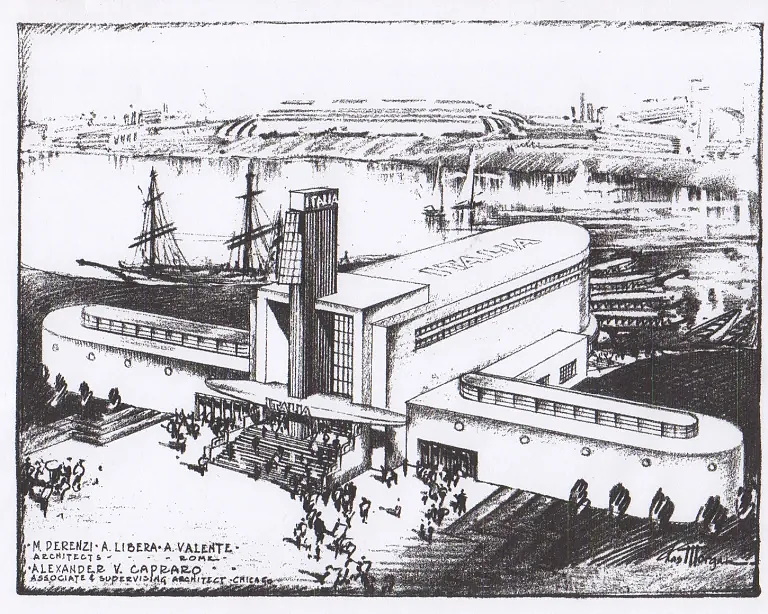
"M. Derenzi, A. Libera, A. Valente, Architects Rome; Alexander V. Capraro, Associate & Supervising Architect, Chicago" The rendering is signed by Chas [Charles] Morgan (lower right corner). Luigi Ranieri's name does not appear.


Capraro was instructed to rely on local Italians for labor, expertise and materials. He was clearly the man for the job, since he spoke the language, knew the community and was presumably a hero to many.
By mobilizing their compatriots, the Italian organizers hoped to save time and money, while demonstrating their people’s ability to get things done. Meanwhile, the Great Depression was raging, so they were eager for any business that came their way.

(10) ON MESSAGE AND OFF
In late January 1933, Chicago Consul Giuseppe Castruccio heralded their national pavilion in a radio address —a few weeks before the groundbreaking on February 17.
He promptly shared his text with Augusto Rosso, the newly-arrived Italian Ambassador in Washington.


“[The Italian Pavilion”] will house the most important facts concerning the Fascisti regime, and give the American public an intelligent explanation of what Fascism means."
"The American people or many of them, thanks to wrong information which have been so plentiful in the last 10 years, believe that 42 million Italians are living as slave, deprived of every liberty, under the stick of His Excellency Benito Mussolini, who has been [?portrayed] so many times as a cruel and ruthless tyrant, who dictates to the people what to do, and tolerates no criticism or cooperation from any one."
"The people of Chicago will see under the roof of the Italian pavilion that the Italian people are enjoying a liberty which is unknown of to many other nations, they are receiving the benefit of a wise and far reaching administration; they are enjoying prosperity, gold standard, government bonds which are advancing in value every day, and which stood firm as rocks during the stock market crash.”
Castruccio offered a beguiling mixture of ideological exuberance and damage control —on two fronts: America's often vehement but far from universal reaction against Italian Fascism and the economic crisis that was spiraling around the globe (Italy included, notwithstanding Mussolini's cult of modernization and progress).
Rosso was reading from the same page as Castruccio— or so it would seem thirty years later, according to the New York Times 1964 obituary for "Mussolini's Ambassador".

“A Professional Diplomat: Augusto Rosso was a popular member of the foreign diplomatic corps in Washington at a time when the cause he represented was in poor repute. He was a professional diplomat whose entire career was devoted to serving his country.”

"His early task was to arrange a settlement of Italy’s debt to the United States and to expand trade. But his most difficult assignment was to try to make the Fascist regime of Mussolini palatable to Americans."
In 1933, "Depression Denial" —or at least "Depression Ironization" —was at an all-time high. So was "Pseudosolvency" and the pretence that recovery was a done deal.

Good times were just around the corner in Chicago too —as the Century of Progress proclaimed contrary to most evidence.

Chasing the wolf from the door in rowdy American style with tin cans and fire-crackers tied to his tail.
Italy realized their Century of Progress pavilion against the odds (which was probably more or less true for the entire Fair). Then they began punching up their program with attention-grabbing public events.

"Rufus C .Dawes (left), Fair president, with Mrs. Giuseppe Castruccio, wife of Italian consul, and Prince Potenziani, Italian commissioner, when ribbon was cut admitting throngs to Italian building."
The Italian Pavilion opened on Saturday June 3, 1933, with the usual flurry of ribbon-cutting, flower-presenting and all the rest.
As to what it all meant —or was supposed to mean— Virginia Gardner of the Tribune had no doubt.

"Italian Pavilion at Fair, Tribute to Fascism, Opens; by Virginia Gardner"
In fact, the official messaging could not have been clearer —on both the Italian and the American sides.
Ludovico Potenziani (the Italian Commissioner) went Full Duce, outdone only by Rufus Dawes (the American Fair President).

“Within, Prince Potenziani addressed the assemblage, saying: ‘We wish to demonstrate by this building what our country has done, not in the 100 years but in the last ten years— that is, during the Fascist era, under the rule of Mussolini.’”


“Mr. Dawes paid tribute to the Fascist rule, saying that the building was symbolic of its initiative and energy, and that ‘discipline has replaced disorder, control superseded confusion.’”
Then came the music...

“Sing Fascist Anthem: A chorus of 80 voices, led by Attico Bernabini, sang the Fascisti national hymn, ‘Youth’ followed by ‘The Star Spangled Banner.’”
Attico Bernabini was well-known in Chicago, chorus master of the Chicago Opera Company.
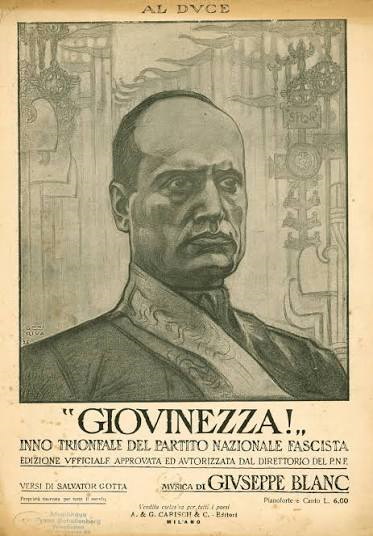
"Dedicated to the Duce: GIOVINEZZA! Triumphal Hymn of the National Fascist Party"
Strictly speaking, the Italian national anthem was still the Marcia Reale d'Ordinanza ("Regulated Royal March")— but Mussolini's cohorts habitually opted for Giovinezza ("Youth") with its rousing chorus:

Youth, Youth, Springtime of Beauty!
From the Harshness of Life, your Song rings out and takes Flight,
Youth, Youth, Springtime of Beauty!
From Fascism comes the Salvation of our Liberty.

So this is the song that rang out and took flight over the Century of Progress on June 3, 1933, with the Star Spangled Banner close behind.

“The central hall of the airplane like building is distinguished by large murals in the modern manner of maps which illustrate Italy’s communication system. In the center of the east wall the profile of Mussolini dominates the whole, with the figure “11” for the eleventh year of Fascist rule."

“Beneath the murals are photographs of Italy’s historic spots, ruins and scenic beauties, but they are overshadowed by the exhibits featuring products of the last ten years.”
Tribune reporter Virginia Gardner noted only in passing the exterior of the "striking red, black and silver building"— which for most constituted the chief attraction— focusing instead on the programatic interior where Mussolini "dominates the whole."


Virginia Gardner testifies to a Senate judiciary committee on September 3, 1941, contesting Francis Biddle's nomination as Attorney General.
From what we know of the architecture and decoration, Gardner was sticking close to the facts —which is not to say that she didn't have a point of view.
Gardner was in the Tribune newsroom from 1929 to 1940. A hard-nosed investigator, she was also a committed leftist and a card-carrying Communist since 1937 —clashing mightily with that paper's staunchly Republican owner and publisher Robert McCormick.
After leaving the Tribune, she made her way through various "radical" journals across the country, filling in the gaps with jobs of other kinds.
Gardner's old Chicago paper assessed her high-minded and often contentious career in a rather colorless obituary on February 5, 1992.

"Her Daily Worker articles on the Rosenbergs, who were convicted and executed for allegedly giving atomic bomb secrets to the Soviet Union, were compiled into a book titled “The Rosenberg Story.” Her biography of Louise Bryant, “Friend and Lover,” told the story of the woman who was subsequently featured in the movi, “Reds,”as a reporter covering the Russian Revolution and as the lover of journalist and communist supporter John Reed."

“While writing for the Daily Worker and other radical and communist publications, she worked in factories in New York.”
Virginia Gardner was tuned into political messaging wherever it occurred— including the interior of the Italian Pavilion.
For most, however, it was the bold aeronautical exterior that mattered —and the Italian organizers would have agreed.

By hanging tough in bad times, they secured the best building site at the Century of Progress —on the lake, at the beginning of the Avenue of Flags, right across from the Hall of Science (the Fair's number one official attraction).
But what— in fact —did they want their Pavilion to do for them? It barely counted as serious exhibition space.

As conceived, the Pavilion would grab the attention of every visitor— signaling the new Italy's emergence as a dynamic modern country.
The Pavilion would offer an iconic back-drop for high-impact events— and they had some stunning ones in the works.
The Pavilion would connect Italy to the adjacent Hall of Science— where they starred as the chief foreign exhibitor.

This newsreel footage fixes the spatial relationship between the Italian Pavilion and Hall of Science. The above segment appears at 52 seconds.
Right across the plaza, Italy claimed a whole wing of its own in the Hall of Science —once Italian Curator Enrico Bompiani overcame the objections of Chief Science Curator Henry Crewe. (Di Legge, Aquila, pp.217-18)

Designs of "Materiale per l'Esposzione di Chicago" = "Material for the Chicago Exposition" from the firm Costruzioni Meccaniche Riva in Milan. The "Automatic Regulator" at the bottom of the page is annotated in pencil "Primo del Mondo" = "FIrst in the World".
Bompiani mobilized an accomplished team of scientists, engineers, historians and craftsmen who realized a series of models of Italian innovations that alterred the course of history.
In Bompiani's own words, their chief theme was “the continuity of Italian scientific and engineering thought from Roman antiquity to our own days, reclaiming for Italy some of the defining inventions of the current century of progress” (“la continuità del pensiero scientifico e costruttivo italiano dall’antichità romana ai giorni nostri e di rivendicare all’Italia alcune invenzioni caratteristiche di questo secolo di progresso”.)
More explicitly, the Italian display was planned in three sections, featuring ancient and modern engineering, naval and aeronautical achievements and epoch-making inventions from the past hundred years.
All of this— needless to say— would be overlaid with a heavy political gloss, manifesting the triumph of the Fascist Idea (“Idea Fascista”) as demonstrated by the escalating achievements of Mussolini’s Corporate State, with its totalitarian motto, “Everything in the State, Nothing Outside the State, Nothing Opposed to the State” ("Tutto nello Stato, niente al di fuori dello Stato, nulla contro lo Stato"). (Di Legge, Aquila, p.218)

The "Great Volta Panel for the Chicago Exposition" was originally commissioned by the industrialist and poltician Francesco Somaini, patron of the “Volta Temple” in Como (1927-28, dedicated to the 18th-century scientist Alessandro Volta).
Italy's participation in the Hall of Science initiative was widely publicized back home as a matter of national pride. Before the 36 models were dispatched to Chicago (where Bompiani would install them personally), they were displayed in the headquarters in Rome of the National Council for Research, where they were officially admired by King Vittorio Emanuele III on March 21, 1933.
If we didn’t know otherwise, we might be excused for imagining that Federico Frigerio’s lavishly eclectic Quadro Voltiano had been prepared for Chicago’s 1893 Columbian Exposition, not the more stream-lined 1933-34 affair. (Frigerio was also the architect of the neoclassical Tempio Voltiano in Como.)
Even at the Century of Progress, the Italians —being Italian— might default to a series of rigorously researched and beautifully crafted objects to make their point, rather than going for jazzier effects.

Until more visual evidence is found to document the appearance of the Italian wing of the Hall of Science, the above photo might offer an impression.
Bompiani viewed the Italian scientific display as a public success, attracting 80 to 100,000 visitors a day, as compared to 160 to 250,000 visitors to the Hall of Science more generally. (Di Legge, Aquila, p.218)
That, however, was only part of the story. The initial plan was for the Italian Government to donate their scientific models to the new Rosenwald Museum (later the Griffin Museum of Science and Industry) which opened in Chicago in 1933 at the time of the Exposition.
When the hand-over took place in 1934, the Rosenwald curators immediately banished the models to storage, making it clear that they had no wish to clutter their exhibits with old-fashioned knick-knacks of that kind.
So, the Italians sent these laboriously realized objects back home —where they were displayed at a popular exhibition in Milan in 1939, then formed the core of that city’s Museo della Scienza e della Tecnologia Leonardo da Vinci (Museum of Science and Technology Leonardo da Vinci).

This photo emphasizes the Pavilion's horizontality and relative flatness, facing onto an extensive open area —and its potential as a backdrop for major events.
As a visual icon, the Italian Pavilion declared that nation's new-found modernity and hoped-for place on the world stage.
As a functioning piece of architecture, It created an outdoor setting for boldly orchestrated public spectacles.
On June 3, 1933, Prince Potenziani, Signora Castruccio, Rufus Dawes and other dignitaries massed on the scenographic front steps for the grand opening.
Then on July 15, 1933— only six weeks later— came the Century of Progress event to end all Century of Progress events.

Italo Balbo arrived in Chicago with his airborne armada, overwhelming the entire city.


Balbo touched down at around 6pm —several hours late — and was welcomed by a vast, eager largely Italian crowd.

“The crowd on the pier became impatient at the delay and called: “We want Balbo”. / GENERAL WAVES AT CROWD. / The general yielded at last to this call and came to the shore side of the ship, where he smiled and waved his arm in salute while the crowd yelled. / Meanwhile Consul General Castruccio was broadcasting over a radio hook-up to the people of Italy, describing for them the arrival of their national hero and his men.”
Consul Castruccio was busy as ever, keeping things on track. His was the voice that broadcast back to Italy the latest triumph “of their national air hero and his men.”

“At the dock of the Hall of Science was another welcoming throng, made up chiefly of Italian-American societies, one group with the black shirts of the Fascisti. Eight flower girls from the Italian pavilion were waiting, and behind them the Black Horse troop of the National Guard blocked the way, prepared to act as escort.”
The dock of the Hall of Science was barely a stone’s throw from the Italian Pavilion— from whence came a troop of eight costumed flower girls. Also in attendance was a cohort of males with ”the black shirts of the Fascisti”.
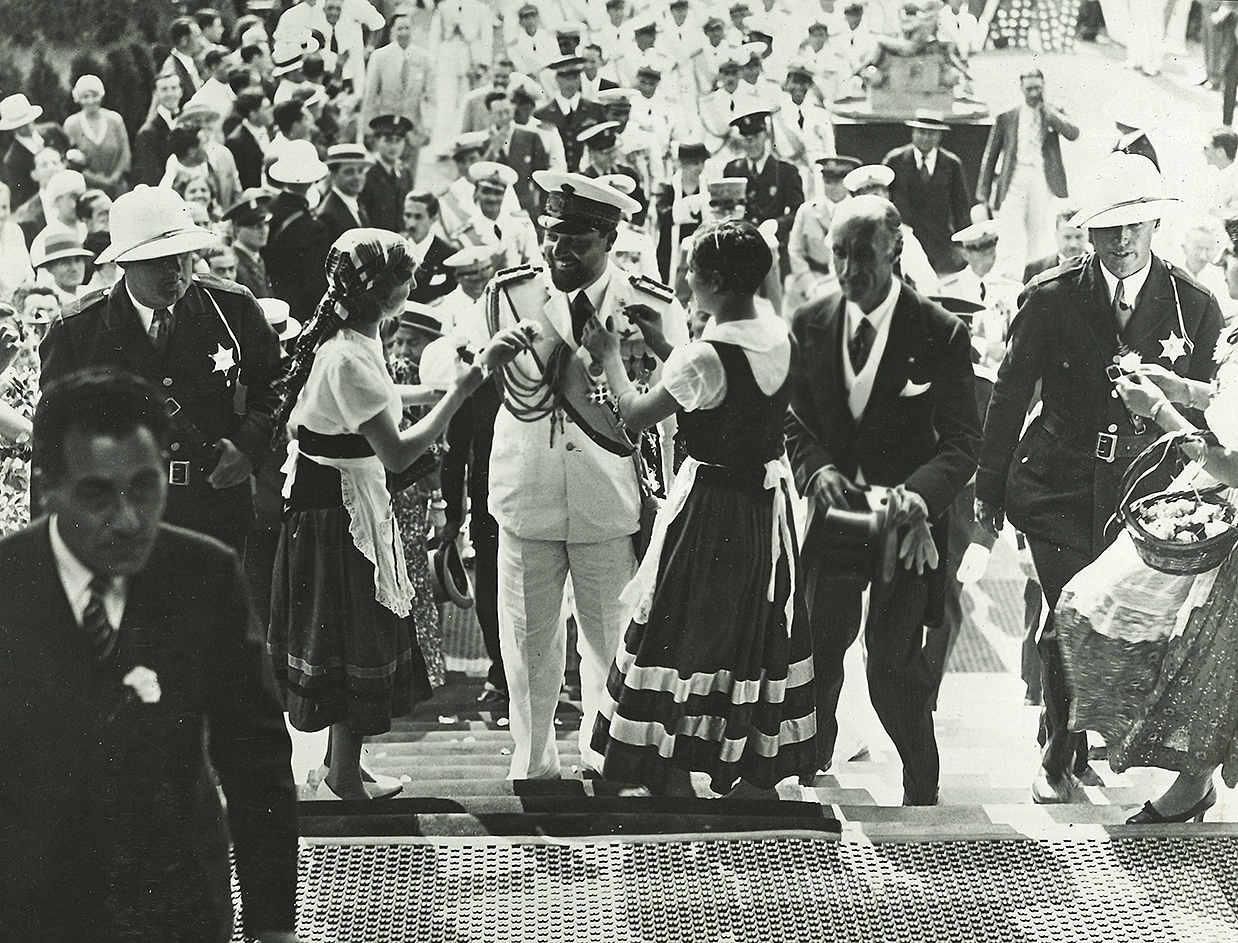
Folkloric flower girls greet Balbo at the Italian Pavilion on the afternoon of July 16.
Balbo's blackshirted fans, whoever they might have been, would not have been disappointed when he spoke.


“BALBO AT THE MICROPHONE: The crowd had been impatiently awaiting the appearance of Gen. Balbo before the microphone system. When he was introduced by Maj. Landis [Commander of the Great Lakes Squadron] there was prolonged applause. Small, compactly built, with only his mustache and beard to hide his youthfulness, Gen Balbo stood smiling until the demonstration died away."
“Then he began to speak in Italian—short punching phrases evidently modeled on the speeches of his leader, Mussolini. The Italians among the spectators applauded every point, and here and there those who did not understand the complete speech caught a work or phrase which they knew.”
“Duce Italia Fascist” was one of these phrases which brought forth bursts of approval from the assemblage. Gen. Balbo coupled the words “Mussolini” and “Chicago,” and another roar of cheering rose. He ended his speech with a long salute and the cry, “Viva Chicago”.
Bursts of approval... "Mussolini" and "Chicago". "Duce Italia Fascist"
At the Century of Progress, Balbo's chief task was to channel the Duce and project the Regime's message.
Along the way, it seems that he absorbed the Duce's manner too.


“MUSSOLINI TO BALBO: Deluged by congratulatory messages, Gen. Balbo when he reached his Drake hotel headquarters after the welcoming ceremonies exhibited one message of which he was particularly proud. It was from his chief, Premier Mussolini, in Rome, and it said:
‘Now that you have finished in a very brilliant way the first part of your mission I send to you my brotherly greeting and to all your officers and men. The announcement of your arrival thrilled the whole population of Italy. '
'I am glad that you are faithful to the Fascist rule I gave you before leaving, that is, sternest discipline in the air and conservation of strength on land. MUSSOLINI’”
"The Fascist Rule" of "Discipline" and "Strength"...
Balbo promptly shared this telegram with the American press —as intended —and the Duce's exhortation was instantly built into the story.

“Thousands on Lake Front Cheer Landing of Italian Air Fleet—Gen. Balbo, the Commander, Center of All Eyes”

"Italian Airmen Given Rousing Welcome in Soldiers’ Field After Landing—Hailed by Crowds at World’s Fair"
Balbo and his crew spent only three days in Chicago, but while they were there, they were the biggest story in town —and the "Balbo Story" lingers to the present day.
The Tribune bombarded their readers with page after page and photo after photo— “saturation coverage” and more.

"CROWDED EVENTS OPEN TODAY FOR ITALIAN AIRMEN"
Day after day, the Tribune outlined Balbo’s upcoming schedule.
Then they filled it in as it happened, for the next morning’s edition.

"3 p.m. Visit to the Italian Pavilion and Italian Pavillion and Italian exhibits in the Hall of Science."
Sunday July 16, 1933 at 3pm...
On the broad stairway of the Italian Pavilion...
That is when and where all the pieces came together —as planned.

First came formal visits, a High Mass at Chicago's Cathedral and a social visit to the Hall of Science.

“ITALIAN AIR MINISTER GUEST OF WORLD FAIR OFFICIALS AT LUNCHEON IN HALL OF SCIENCE. / Left to right, Mrs. Rufus C. Dawes, Gen. Italo Balbo, the honor guest; Mr. Dawes, president of A century of Progress; Augusto Rosso, Italian Ambassador to the United States, and Mayor Edward J. Kelly at event yesterday in the Trustees lounge of the Hall of Science”.
The luncheon ran late and it is not clear that Balbo actually saw Italy’s scientific exhibits.

“THEY STROLL TO PAVILION / The general was smiling and happy as he strolled the few hundred years to the Pavilion, followed by his crew and a number of civilians. Occasionally he raised his arm in the Fascist salute as “Vivas” and “Bravis” were should by Italians in the crowds.”
Balbo and his flyers made their way from the Hall of Science to the nearby Pavilion— Roman saluting along the way to the evident satisfaction of the numerous Italians.

“’This flight is but an incident in Italy’s technical development of modern aviation,’ the speech began. ‘Far more important than the fact that two continents and an ocean have been spanned in mass flight for the first time is the fact that in the tenth year of the Fascist revolution, we have been able thus to bring a message of friendship to the United States, the mother of aviation, and to this marvelous Century of Progress.'”
Balbo addressed a select assembly inside the Pavilion— speaking in Italian while Consul Castruccio translated. The famed aviator emphasized the special relevance of his coordinated group flight at that historic moment —"the tenth year of the Fascist revolution".

“BALBO AND HIS FLYERS INSPECT ITALIAN PAVILION AT WORLD FAIR; COMMANDER CHEERED AS HE MAKES HIS ADDRESS. / Group picture of Gen. Italo Balbo and his flyers as they appeared on the steps of the Italian pavilion at World Fair yesterday afternoon. Those at left in white uniforms are the captains and at right in gray, are the mechanics. Gen. Balbo is in front, center, holding sword. To the left is Prince Spai [ie. Spada], Italian Fair commissioner; at the right Augusto Rosso, Italian ambassador. At the right of the prince is Gen. Aldo Pellegrini, second in command of fleet. Gen. Balbo made his address from this spot.”
Then they were ready for the culminating moment of Balbo's visit —when all the symbols lined up— on the steps of their airplane-shaped building, under the silver wing branded "Italia".

This is evidently a detail from a photo a few seconds earlier or later in the same Tribune series, but not the one they published in the paper.

Consul Castruccio is off on the side —outranked by an ambassador, a prince and several generals. Still, he had certainly earned his smile of satisfaction.
None of this would have happened without him.

This Balbo photo is from another event in New York a few days later. He wears a matching white Air Force uniform and employs his distinctive “upflung arm” (noted by the Tribune in Chicago), implying a Fascist salute without quite arriving there.

“HAILED BY CROWDS / Gen. Balbo climaxed his crowded day at A Century of Progress yesterday with an address to thousands of Italian Americans who assembled in and about the Italian Pavilion and on the Fair grounds.”
“Long and resounding cheers greeted his statement, delivered dramatically and with upflung arm, that he would go back to Italy with the ‘everlasting memory of the sympathetic and friendly greeting” given him by Chicago and America.’”

“CHICAGOANS OF ITALIAN DESCENT CONGRATULATE AIR ARMADA’S CHIEF ON ACCOMPLISHMENT OF HIS MISSION. / Gen. Balbo shaking hands with men and women of his own race who surrounded him with praises in the reception room of the Drake hotel last night after his return from the ceremonies of welcome in Soldiers’ field where he and his companions were greet by federal, state, city and World’s Fair officials and cheered by a crowd of 60,000 persons.
Italian Americans could not get enough of Italo Balbo, but who knew when the "Mussolini Thing" might erupt?

“5,000 Acclaim Balbo Flyers at Italian Dinner; Throngs Mass on Michigan Ave. to See Airmen”
Some 5,000 admirers attended the massive Balbo banquet in the grand ballroom of the Stevens Hotel on the evening of July 16. This was organized by The Italians and Americans of Chicago, an ad hoc organization that coordinated various events for the aviator’s visit.
When Balbo and his crew entered the vast dining room, they received an ovation lasting a full quarter hour. However…

“HUNDREDS GIVE FASCIST SALUTE. / As Gen. Balbo and his men entered the banquet hall there were cries of ’Viva Balbo’ and the Fascist cry of “Eja, Eja, alala.” Hundreds of arms were slanted upward in the Fascist salute. Gen. Balbo returned the salute.”
There were only “hundreds of arms” issuing from thousands of banqueters —but the guest of honor “returned the salute”.

“Just before Gen. Balbo spoke he was presented with a huge bronze memorial by the Italians of Chicago.”

Balbo expressed his joy at the gift and the overwhelming reception.

“’The purpose of our flight,’ said General Balbo further on, ‘is to demonstrate Italy’s good will for America and to knit closer the ties of friendship. This flight results after ten years in which we have shown the world a new Italy. I give all credit to Benito Mussolini.’”
"I give all credit to Benito Mussolini." That is certainly what the Duce wanted to hear and probably much of Balbo's audience too.
Meanwhile, the public couldn't get enough of him —with or without the Duce attached—as he generated publicity every which way.
There were many, of course, eager to clamber on board and share the plubicity.
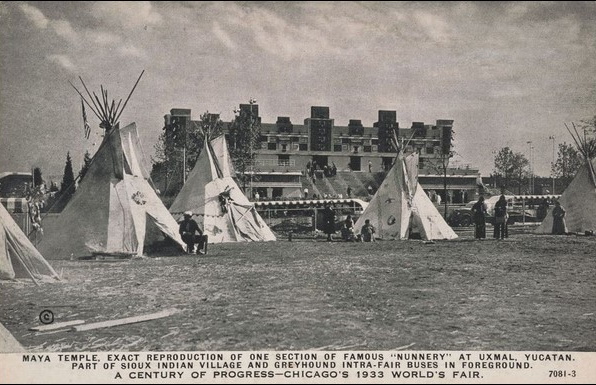
https://www.instagram.com/p/DHq49UbJJXl/
AI Overview
At the1933–1934 Century of Progress International Exposition in Chicago, "IndianVillages" included both an official American Indian Village and separate,privately operated attractions such as the Seminole Village on the Midway.Native peoples from across the United States lived, performed, and sold craftsat the fair amid broader themes of science and industrial progress. [1,2, 3, 4]
Rather like the Italian Village
The continuous Indian current--halfway between the background and the foreground of the Expositon
The Second Columbus encounters the people who didn't need even the First Columbus to discover them.
On one hand, it was all colorful fun-- but on the other hand, it also represented the starting point from which "progress" was measured.
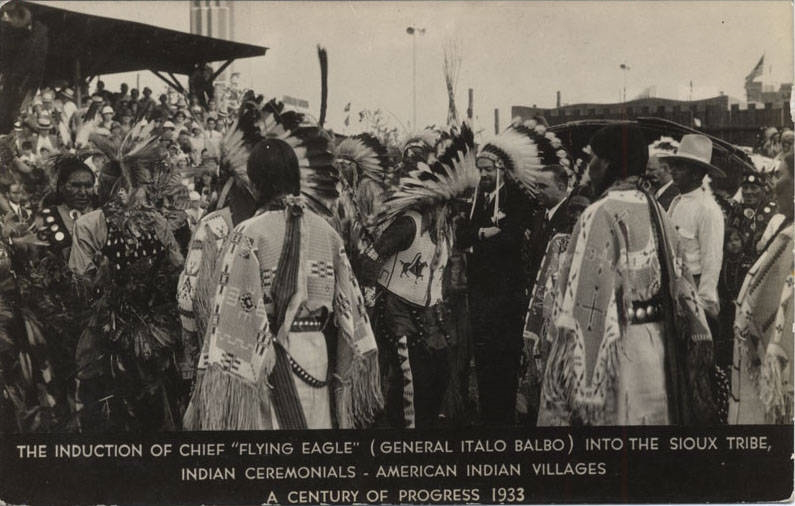

"The induction of Chief 'Flying Eagle' (General Italo Balbo) into the Sioux Tribe, Indian Ceremonials - American Indian Villages, A Century of Progress 1933"
Balbo and some of his flyers evidently paid only a quick visit to the Columbus Statue on 16 July although it doesn't figure in the Tribune's published schedule (they are all in the eye-catching white uniforms that they wore that day)
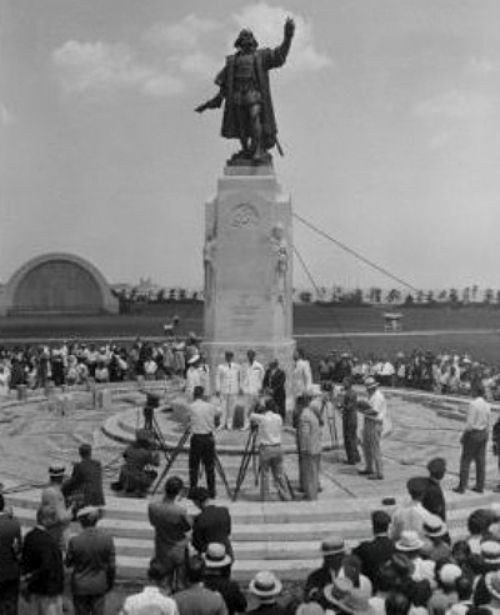
The actual dedication was on 3 August --Italian day

Marconi visit 3 October 1933
October 4 1933 was Italian Day at the Art Institute
(Roosevelt visited fair on October 2)
https://www.newspapers.com/search/results/?date=1933&keyword=Marconi&publication-ids=4351
Marconi visit 3 October 1933
October 4 1933 was Italian Day at the Art Institute
(Roosevelt visited fair on October 2)
https://www.newspapers.com/search/results/?date=1933&keyword=Marconi&publication-ids=4351
Pop in the Balbo Column Dedication here--in additiion to whatever else, they were trying relive their most glorious moment, since the fair had been reopened and was not doing as well --they needed to ratchet things up at the Italian Pavilion
Benito Mussolini moved quickly to realize a durable monument to Balbo's epoch-making flight. He extracted "The Balbo Column" from the site of Ostia (the ancient port of Rome) and shipped it to the American heartland with a new base and Fascist trimmings.
On 15 July 1934, it was installed in front of the Italian Pavillion at the Century of Progress Exposition— proclaimed to a largely ethnic crowd by Balbo himself, long-distance. (This time the radio broadcast worked.)

The ancient column perfectly bisected the aerodynamic wing— presumably as planned.
This telling juxtaposition of old and new was flanked by two enormous loudspeakers broadcasting Balbo's address from Rome.
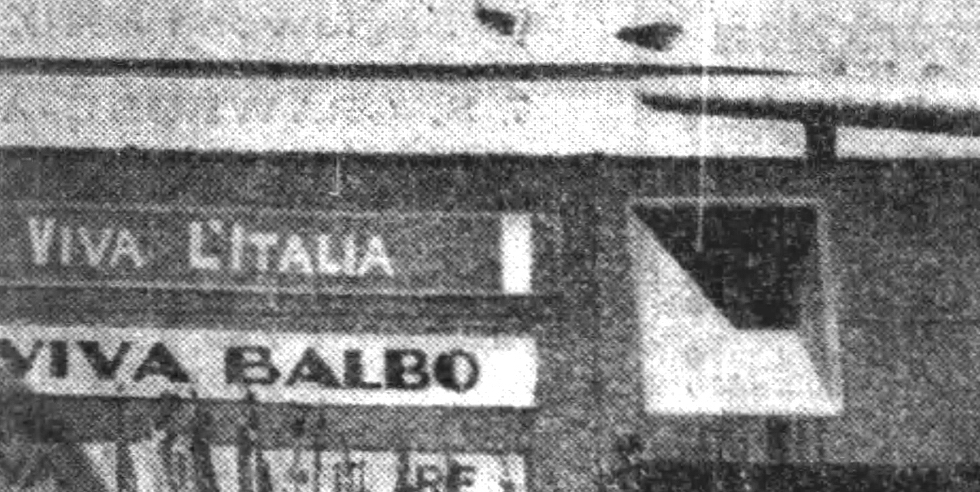
Viva L'Italia! Viva Balbo!
That was Italo Balbo's last hurrah on the American scene.
The column, however, still remains where it was —now that everything else is gone or diasappearing fast.
As for the now weathered inscription:
QUESTA COLONNA
DI VENTI SECOLI ANTICA
ERETTA SUL LIDO DI OSTIA
PORTO DI ROMA IMPERIALE
A VIGILARE LE FORTUNE E LE VITTORIE
DELLE TIREMI ROMANE
L'ITALIA FASCISTA SUSPICE BENITO MUSSOLINI
DONA A CHICAGO
ESALTAZIONE SIMBOLO RICORDO
DELLA SQUADRA ATLANTICA GUIDATA DA BALBO
CHE CON ROMANO ARDIMENTO TRASVOLO L'OCEANO
NELL' ANNO XI
DEL LITTORIO
This column, twenty centuries old, was erected on the beach of Ostia, the port of Imperial Rome, to watch over the fortunes and victories of the Roman triremes. Fascist Italy, with the sponsorship of Benito Mussolini, presents to Chicago a symbol and memorial in honor of the Atlantic Squadron led by Balbo, which with Roman daring, flew across the ocean in the 11th year of the Fascist era.
Political an dideologicalsignaling, yes

What was the Balbo Column all about--really?
Political messaging--and what else?
The Italians were creating an event for the sake of creating an event --as the Exposition fizzled before their very eyes.
By then, Giuseppe Castruccio was not a happy man--when it came to the Century of Progress at least.
Dedication of Balbo Monument
What did the Italians ultimately achieve? All 22 million visitors to the Exposition during its first season (May 27 to November 12, 1933) presumably marveled at the Pavilon's winged exterior and 5.6 million of them went inside. The figures for the second season (May 26 to October 31, 1934) declinedprecipitously —14 million and 1.5 million respectively.
Was the public saturated with the Fair?
Italian Village
Sally Rand
Related posts
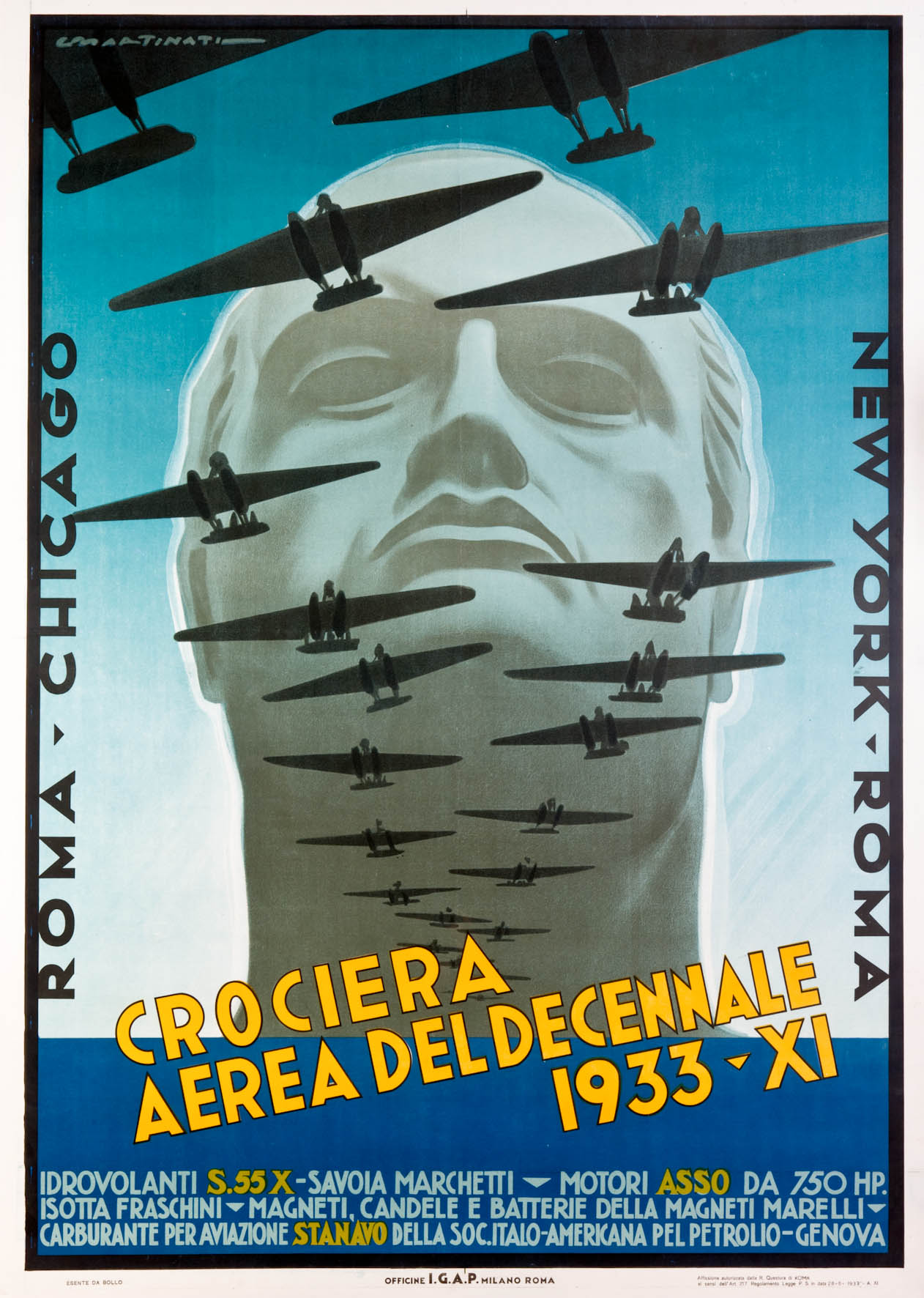
COLUMBUS, MARCONI, BALBO AND MUSSOLINI: Italian Heroes Collide in Chicago - Part 1
At Chicago's 1933-34 Century of Progress Exposition, Guglielmo Marconi, the inventor of the radiotelegraph and Italo Balbo, the aeronautical “Second Columbus” led a brilliantly orchestrated public relations campaign on behalf of Benito Mussolini’s regime.
Fascist Italy commanded a dazzling array of scientific, technological and cultural resources. It channeled them all into a sensational spectacle that astonished, intrigued and outraged the American public.
(1) The View From Marconi Plaza (Philadelphia)
(2) Marconi-Mania vs. Balbo-Mania (Chicago)
(3) Italo Balbo and the Columbus Thing
(4) My Hero!
COLUMBUS, MARCONI, BALBO AND MUSSOLINI: Italian Heroes Collide in Chicago - Part 2
At Chicago's 1933-34 Century of Progress Exposition, Guglielmo Marconi, the inventor of the radiotelegraph and Italo Balbo, the aeronautical “Second Columbus” led a brilliantly orchestrated public relations campaign on behalf of Benito Mussolini’s regime.
Fascist Italy commanded a dazzling array of scientific, technological and cultural resources. It channeled them all into a sensational spectacle that astonished, intrigued and outraged the American public.
(5) The Italian Pavilion (Chicago)
(6) The Other Exposition (Rome)
(7) The Commissioner Prince
(8) Two Directors and a Diplomat
COLUMBUS, MARCONI, BALBO AND MUSSOLINI: Italian Heroes Collide in Chicago - Part 4
At Chicago's 1933-34 Century of Progress Exposition, Guglielmo Marconi, the inventor of the radiotelegraph and Italo Balbo, the aeronautical “Second Columbus” led a brilliantly orchestrated public relations campaign on behalf of Benito Mussolini’s regime.
Fascist Italy commanded a dazzling array of scientific, technological and cultural resources. It channeled them all into a sensational spectacle that astonished, intrigued and outraged the American public.
(11) The Second Columbus Crashes and Burns
WORK IN PROGRESS

GUGLIELMO MARCONI: Science, Fascism, Antisemitism and What Else?
History has given a free pass to Guglielmo Marconi, who was both a scientific genius and a Fascist ideologue.
There are two stories to tell—first in Italy and then in America.
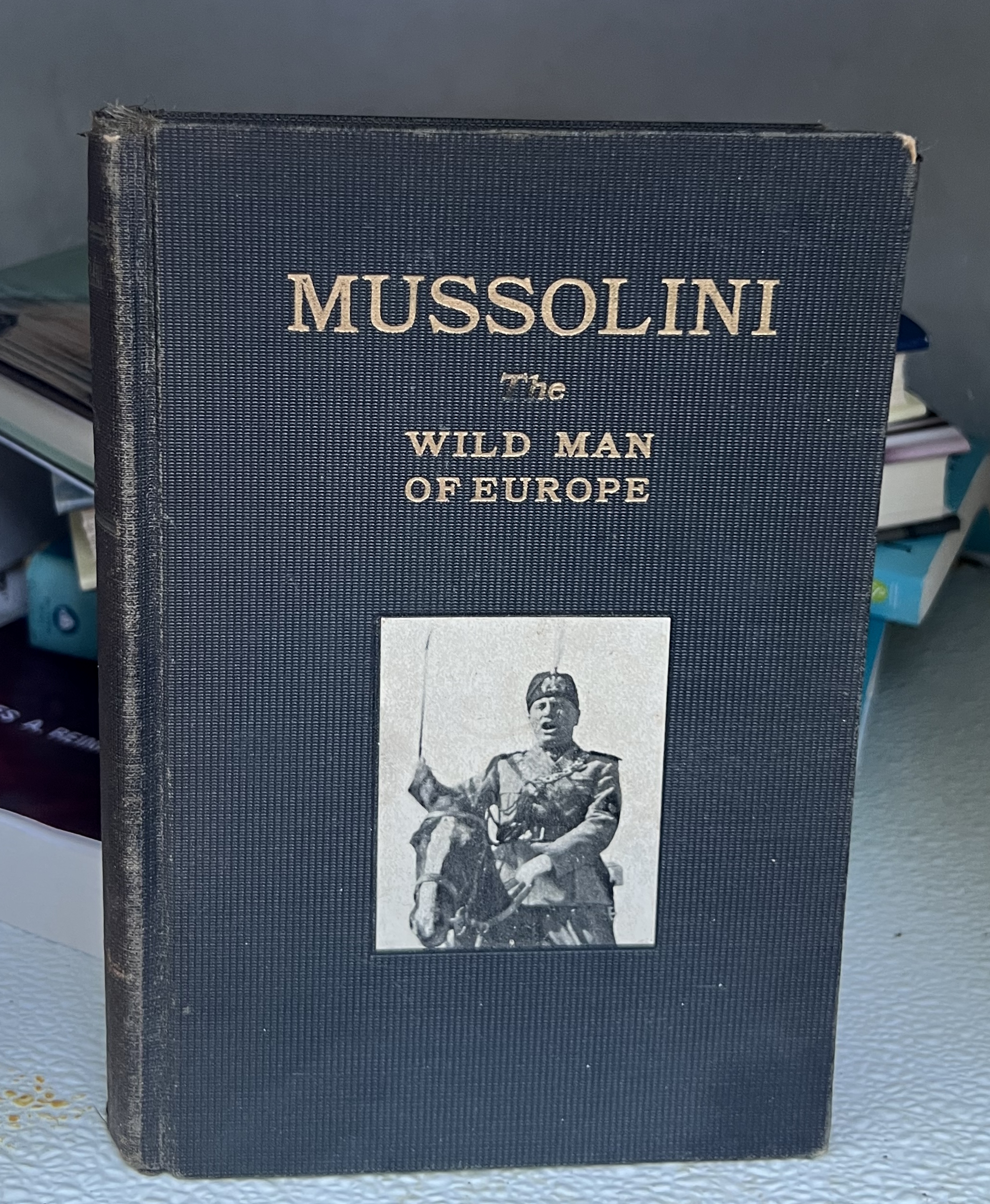
MUSSOLINI: THE WILD MAN OF EUROPE - Part 1
In a "Little Library" in Washington DC, I happened upon "Mussolini: The Wild Man of Europe"— John Bond's eccentric exposé of Benito Mussolini, printed in the Nation's Capital in 1929.
In my first post, "Wild Man, Part 1", Bond helped reveal the inner workings of the Ku Klux Klan in Washington DC, Atlanta GA and Altoona PA.
In "Wild Man, Part 2", we took Bond's book to Fascist Italy and viewed the Duce through the outraged author's eyes.
Here in "Wild Man", Part 3", we bring Bond back to Philo-Fascist America. There we see the Duce lauded by Italian Americans, by Hollywood celebrities and by the mainstream press.
Who was John Bond? A "Militant Freemason", a virulent anti-Catholic and an anti-Mussolini conspiracy theorist.
How about his message? Bond was strange and obsessed but he wasn't always wrong.
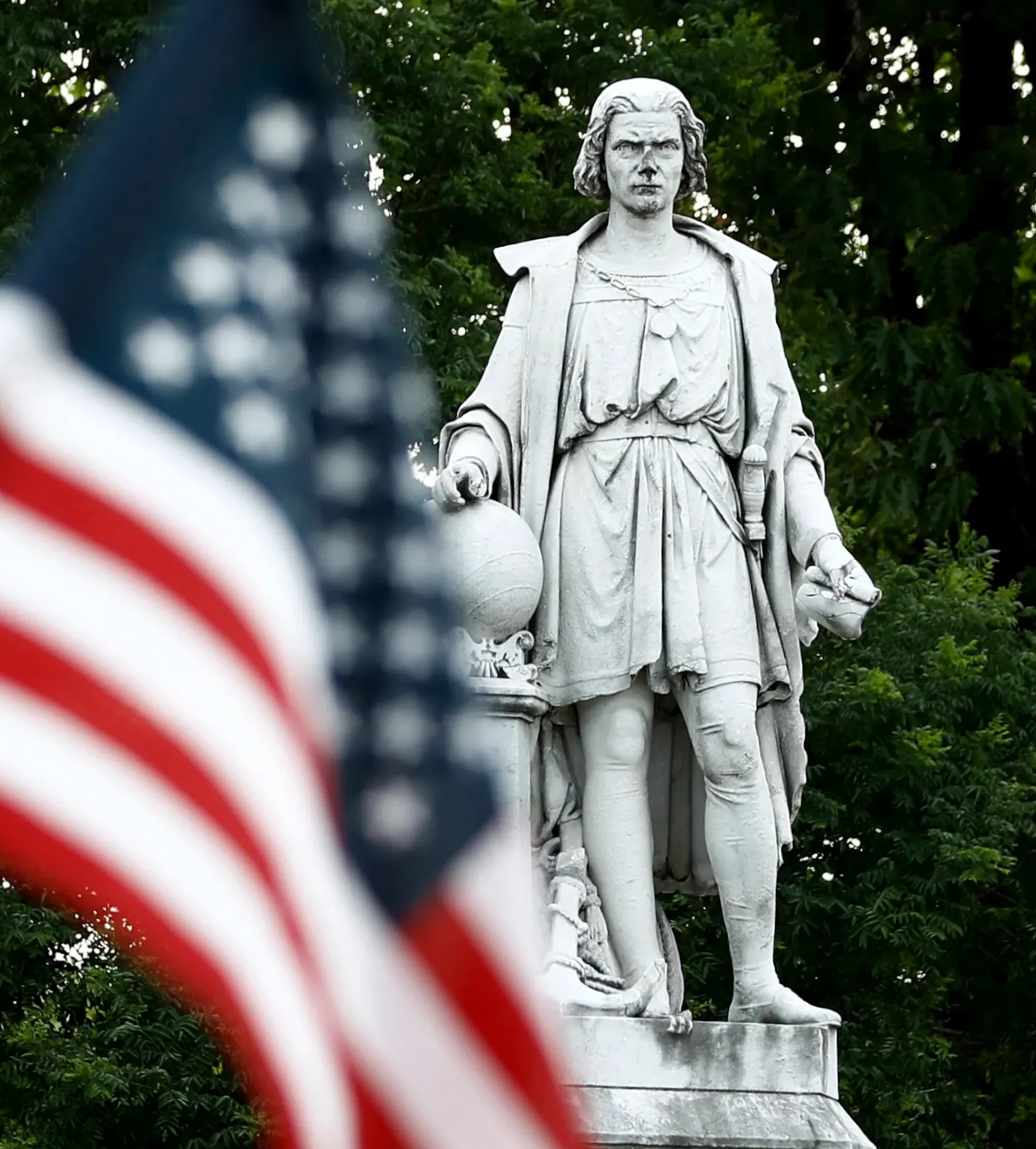
WHOSE COLUMBUS? WHOSE COLUMBUS DAY? Part 1: It begins with a statue in Philadelphia in 1876
Why is Columbus Day the most controversial of American holidays?
People disagree —often violently —about its past and present meaning.
Here are the facts. Make of them what you will!
***
The story begins in South Philly (then and now) and takes us to the American Civil War and the 1876 Centennial Exposition.
We meet Christopher Columbus (in several incarnations), sculptor Emanuele Caroni and Nunzio Finelli (ideator of Philadelphia’s Columbus Statue, long in Fairmount Park, now in Marconi Plaza).
Lorem ipsum dolor sit amet, consectetur adipiscing elit. Suspendisse varius enim in eros elementum tristique. Duis cursus, mi quis viverra ornare, eros dolor interdum nulla, ut commodo diam libero vitae erat. Aenean faucibus nibh et justo cursus id rutrum lorem imperdiet. Nunc ut sem vitae risus tristique posuere.