MUSSOLINI: THE WILD MAN OF EUROPE - Part 2
CONTENTS:
(4) ANTI-CATHOLICS AND ANTI-ITALIANS
(5) JOHN BOND IN ROME
(6) MUSSOLINI AND ITALIAN FREEMASONRY
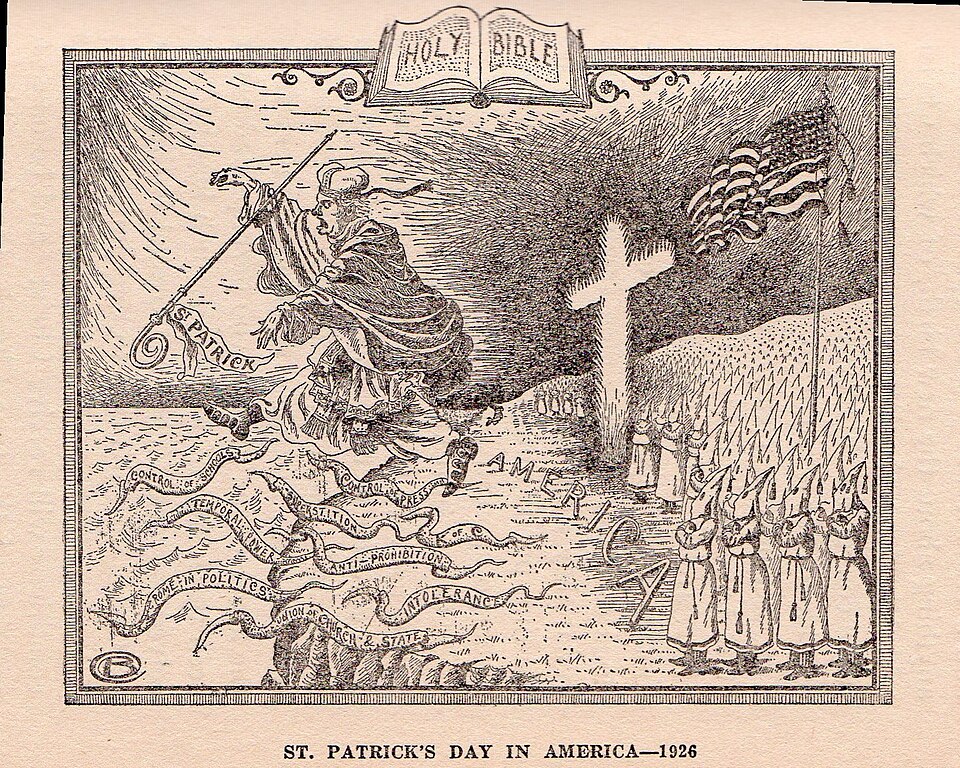
Cartoon by Reverend Branford Clarke in the book Klansmen: Guardians of Liberty, authored by Bishop Alma White of the Pillar of Fire Church in Zarephath NJ

FOR THE BACKSTORY, SEE:
MUSSOLINI: THE WILD MAN OF EUROPE - Part 1
FOR THE NEXT CHAPTERS, SEE:
MUSSOLINI: THE WILD MAN OF EUROPE - Part 3
(4) ANTI-CATHOLICS AND ANTI-ITALIANS
"Saint Patrick's Day in America—1926"
With its dense imagery and fuzzy cross-hatching, it is hard to believe that this cartoon is only a hundred years old.
The anti-Irish vehemence seems quaintly old-fashioned too— but the authors were on the far edge of Protestant evangelicalism, in a cosmic time-warp of their own.
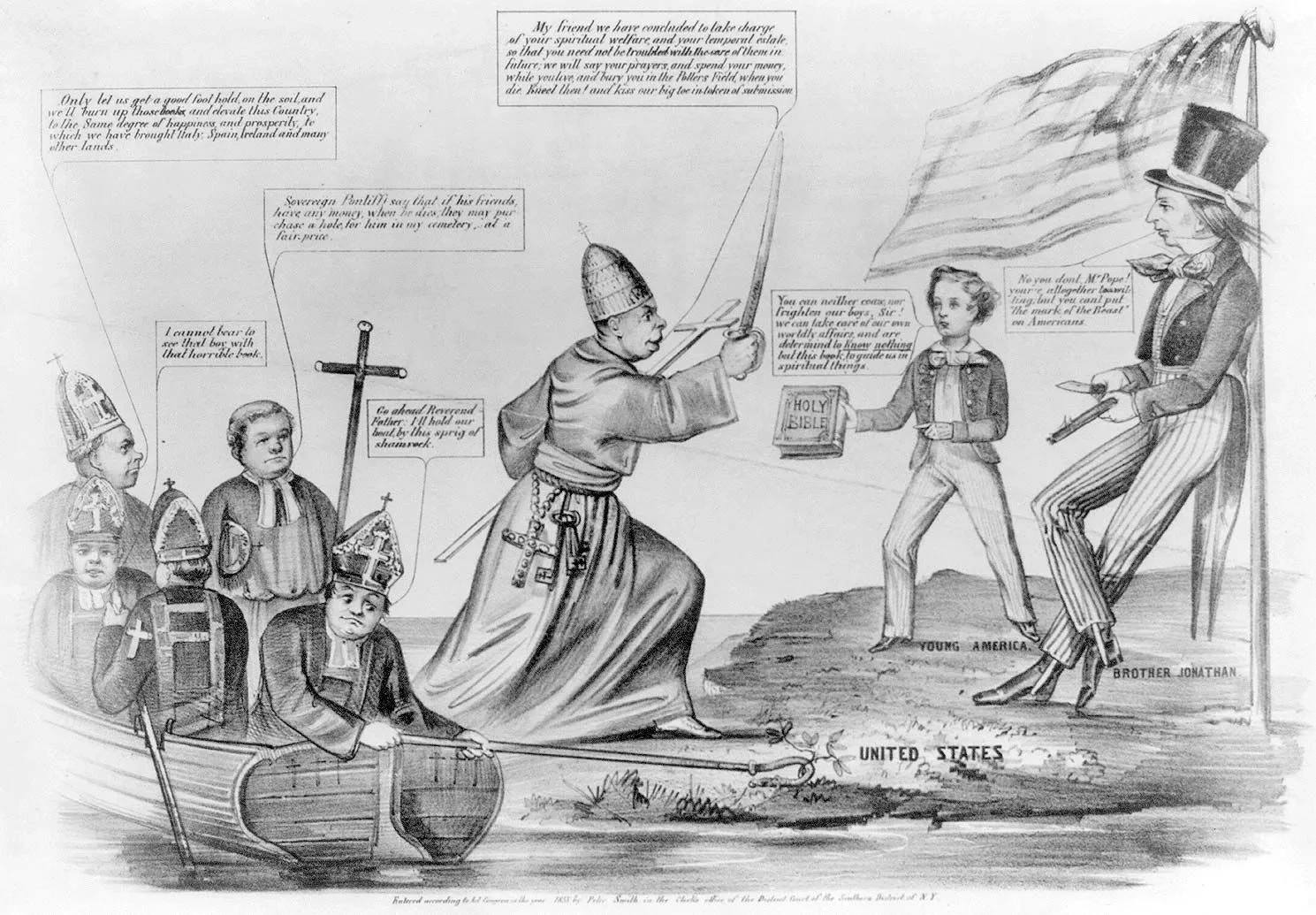
"Brother Jonathan" (a forerunner of Uncle Sam) and "Young America" confront Irish Catholicism with the help of the Protestant Bible. Currier and Ives issued this print in 1855, at the height of the Know-Nothing movement (to which "Young America" alludes).
In fact, the 1926 print reverses an image from 70 years earlier.
There we see Irish Catholics and Irish Catholicism landing on American shores— with nary a hint of the devastating Potato Famine (1845-52) that propelled them.

Saint Patrick drove the snakes from Ireland in the Fifth Century. Then in America in the Twentieth Century, the refounded Ku Klux Klan sought to drive them back.
Paddy's "snakes" deserve a closer look:
* Control of Schools * Control of Press * Temporal Power * Superstition * K(nights) of C(olumbus) * Anti Prohibition * Rome in Politics * Intolerance * Union of Church & State *
These were clearly 1926 issues. Back in 1855, Institutional Catholicism was only an abstract menace in America, not a real-life presence.
Brother Jonathan and Young America could scarcely envision a large and entrenched Catholic population, a massive Catholic school system, an extensive Catholic press and countless Catholics entering local and even national politics.
As for the Knights of Columbus ("K of C"), they were not founded until 1882.


"REGARDING THE ITALIAN POPULATION / A Nuisance to Pedestrians /Their Sleeping Apartments / Afternoon's Pleasant Diversions / The Way to Dispose of Them / The Way to Arrest Them." The Mascot was New Orleans' most sensational newspaper.
Then there was the bigger picture: Toward the turn of the century, surges of Catholic immigration from other places (especially Italy and Poland) began diluting the old Hibernian majority.
The Irish, however, often dominated the Church hierarchy and shaped the public face of American Catholicism.
Anti-Italianism was rife but— curiously enough— not explicitly anti-Catholic, although the Popes were all Italian and the Church spread its tentacles from Rome.
In fact, thedeadliest eruption of anti-Italian feeling occurred in New Orleans in 1891, where over half the population was Catholic.
SEE ALSO:
WHOSE COLUMBUS? WHOSE COLUMBUS DAY? Part 2: The New Orleans Massacre (1891) and Italian-American Identity

Although the Italian menace predominates, there are less obvious references to Asians, Eastern Europeans and maybe Mexicans.
Politically subversive rats infested with mafia criminality, violent anarchism and presumably other diseases?
Anti-Italianism in those years was blatantly racist, with a heavy dose of political and cultural anxiety tossed in.

857,046 immigrants arrived in the United States in 1903, including some 285,000 Southern Italians (the largest single group).
In terms of threat, however, the half-million or so non-Italians barely figure in this issue of Judge, a popular satirical magazine.

Meanwhile, the ghost of President William McKinley— assassinated in in 1901 by a Detroit-born anarchist of Polish (not Italian) extraction— reacts to the perils of immigrant dumping with a distinctly Italian gesture.
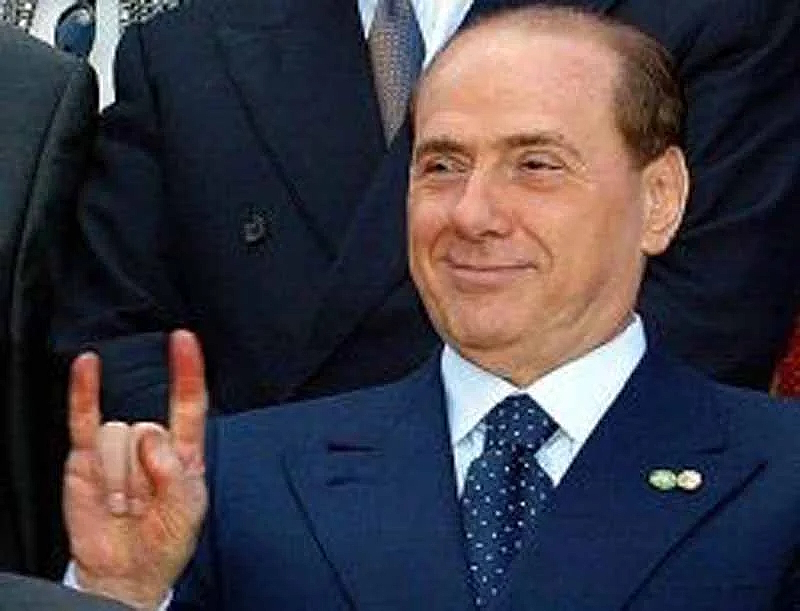
Fare le Corna...
Configuring the horns of the Devil to ward off the Evil Eye— utterly all'italiana.
(5) JOHN BOND IN ROME
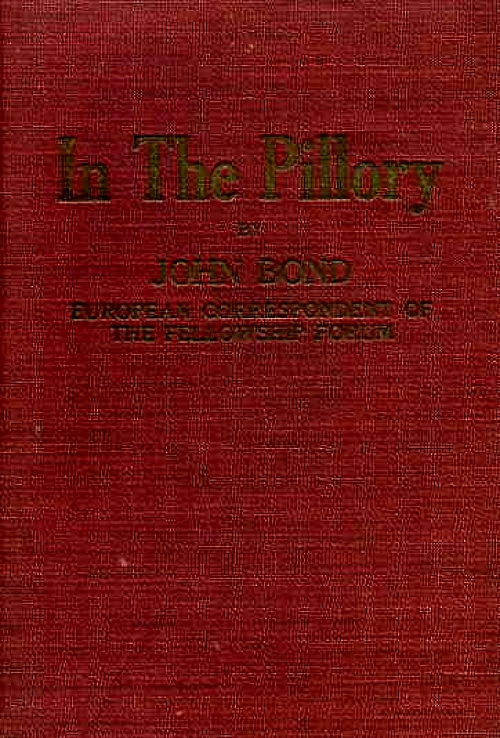
"European Correspondent of the Fellowship Forum" is proudly embossed on the cover, not merely the title page.
When we open John Bond’s, In The Pillory: The Tale of the Borgia Pope, it looks and feels like a quirky “period piece”.
But bigotry often has a timeless quality and this is another case in point. We already focused on the "Saint Patrick's Day in America—1926" print from that same moment.

John Bond's book offered "NIne Crowded Chapters" and "39 Spendid Illustrations".
In The Pillory was published in 1927 (by way of The Fellowship Forum and The Independent Publishing Company, both of Washington DC).
Still, it breathes the centuries-old air of anti-Catholic fact and fantasy, especially the rock-ribbed British Protestant kind. Guy Fawke's Night bonfires, "No Popery" and all that...
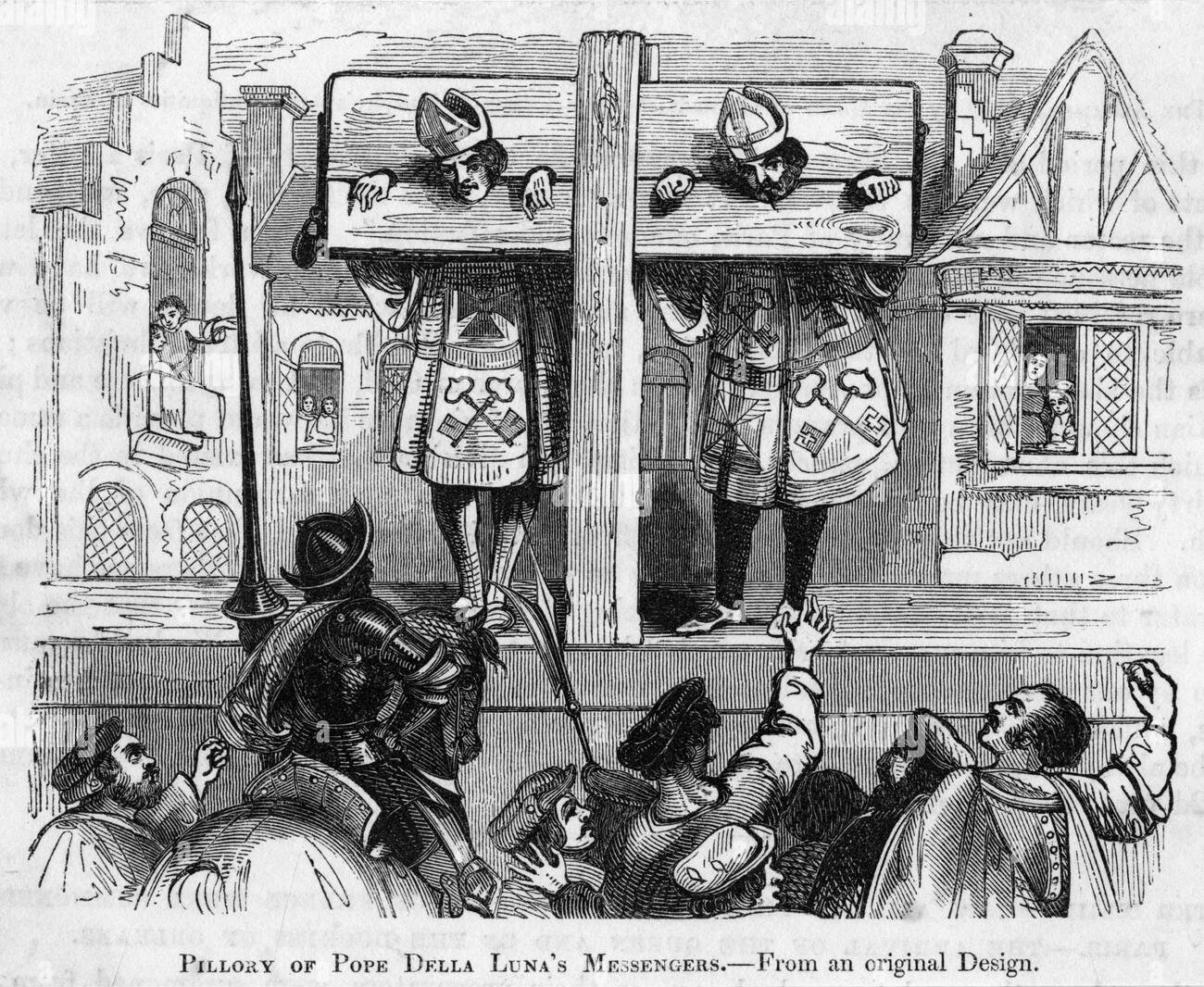
"Pillory of Pope della Luna's Messengers.—From an original Design." This 19th Century English image is set in 15th century Flanders.
Embedded in Rome, in the very lair of the Papal Beast, Bond signed off on his preface in December 1926 (incidentally or not, Year IV of the Fascist Era). He is putting the Catholic Church In The Pillory, he explains, in the person of that stellar reprobate Pope Alexander VI Borgia (reigned 1492-1503):
"There is more than one Chamber of Horrors in the Museum of History, but none like that of the Borgia. The central figure is that of Roderigo Borgia, who as Alexander VI sat on the papal throne for upward of eleven years; around him are grouped his mistresses; a brood of bastard children; a retinue of henchmen and an endless procession of victims. It was the darkest period in the life of Christianity, just before the dawn of the Reformation. Rome had become a sink of unspeakable corruption where, in the words of Dante, 'Christ was sold every day.'"
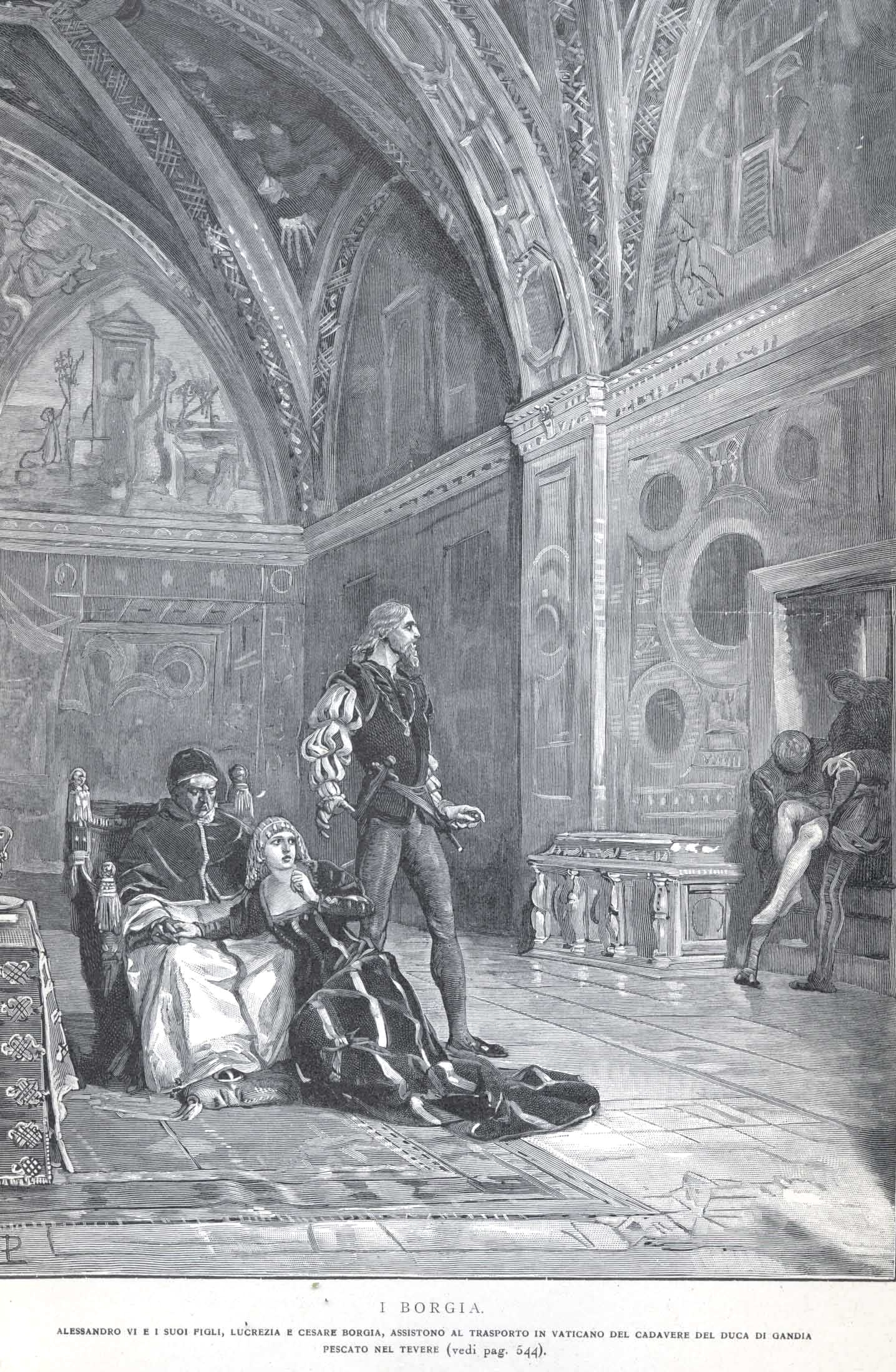

"The Borgias: Alexander VI and His Children Lucrezia and Cesare Borgia Participate in the Transport of the Duke of Gandia's Body After It Was Fished Out of the Tiber, see page 544."
In Pillory, Bond seeks to distance himself...at least somewhat... from anti-Catholicism of the more vulgar sort. His alleged argument is not with that faith ...as a faith... but its authoritarian abuses— especially in the political sphere.
"They... recognize the distinction between Catholicism as a religious creed and Popery as a fraudulent and un-Christian institution. Our warfare is directed not against Catholics, whether they are of the Roman or the Greek or any other persuasion —it is directed solely and wholly against the Neo-Caesarism of the popes. Our quarrel is not with the profession of any religious faith but with a political system invented and kept alive to enslave the minds of mankind and to destroy the freedom of conscience."
We may or may not take Bond’s protestations of quasi-tolerance at face value, as he thrashes his way through a time-worn tale of poisoned chalices, mutilated corpses, papal mistresses and orgies on the very altar.
In any case, he ends his preface with a rousing call-to-arms:
"The Borgias are dead and gone but they are still brewing poison in the Vatican."
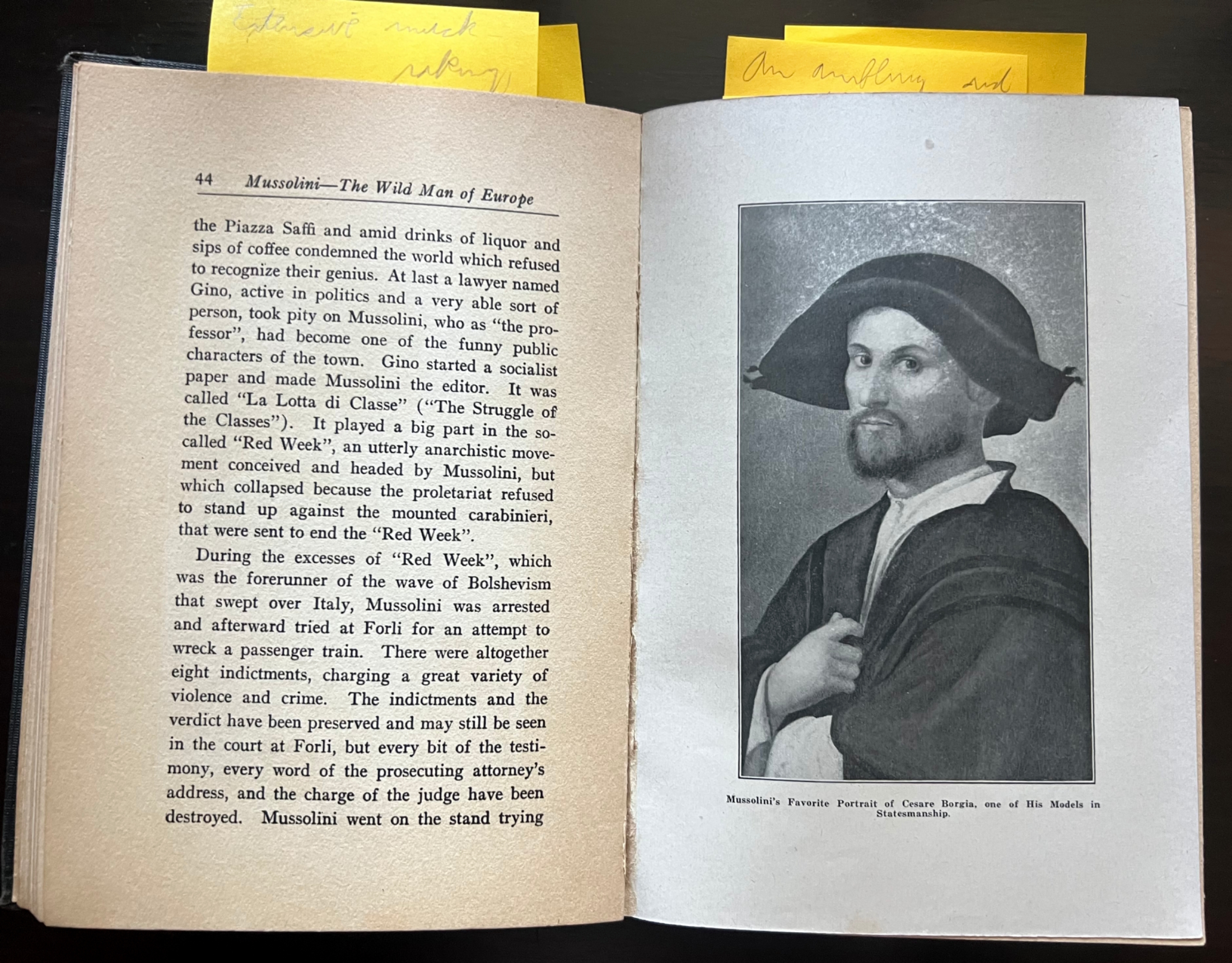

"Mussolini's Favorite Portrait of Cesare Borgia, one of His Models in Statesmanship."
What can that possibly mean? After four centuries, Zombie Borgias prowl the Papal Palace... crafting the same old toxin... and thus BENITO MUSSOLINI?
I have read through Wild Man several times (a journey I would not recommend to most)—and the screed becomes more puzzling rather than less.
Rome as the Eternal Capital of Catholic Evil? Not a new concept.
Bond’s animus, however, was “directed solely and wholly against the Neo-Caesarism of the popes”—their political and territorial imperialism, that is to say.
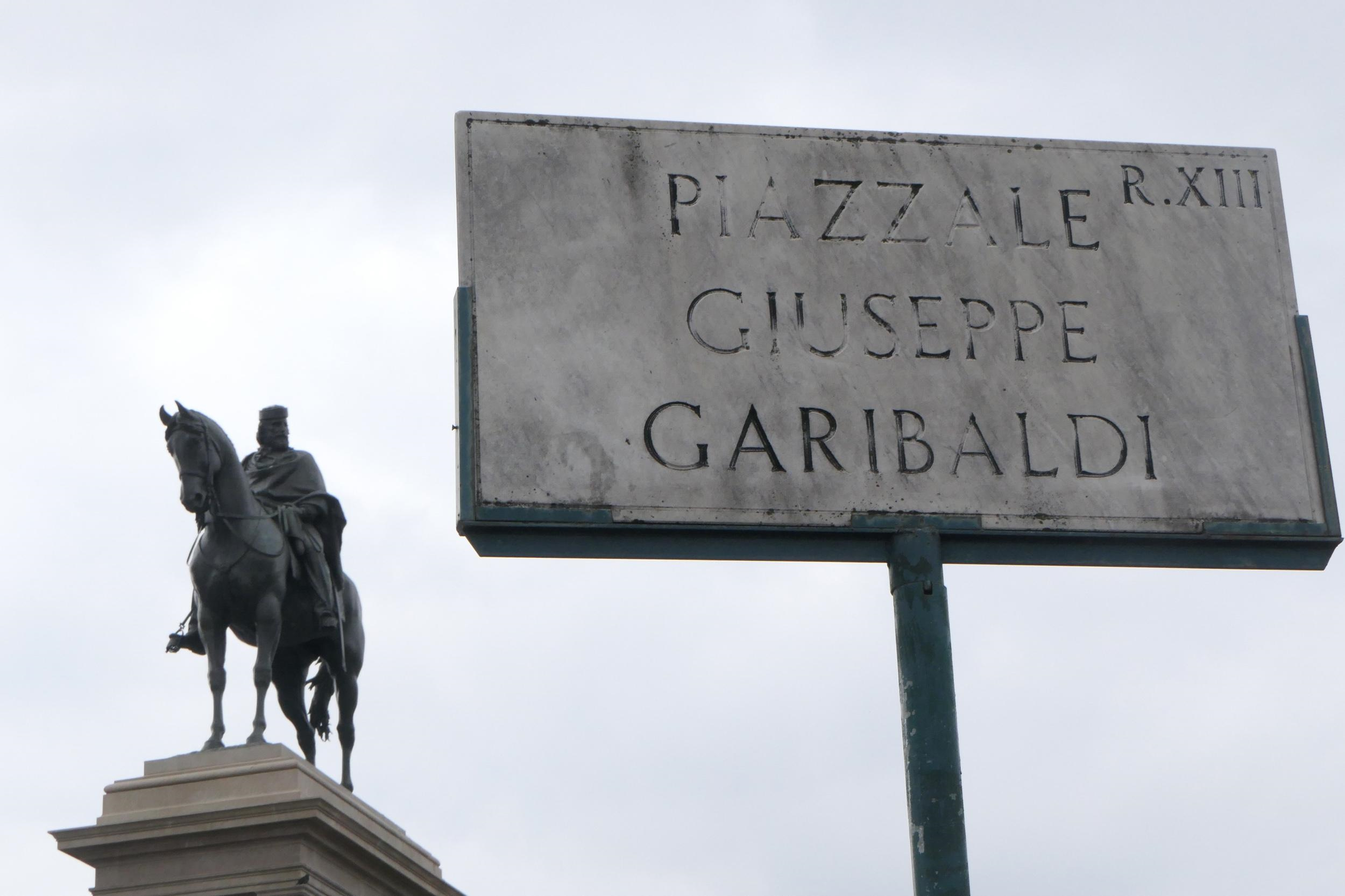
From this vantage point, in 1870, the Hero of the Two Worlds and his Red Shirts surveyed the soon-to-be Capital of United Italy.
Something is missing here... a lot of Italian history, in fact... the Risorgimento, just to begin...
FOR THE UNIFICATION OF ITALY, SEE:
JEWS IN THE RISORGIMENTO
In 1870, the rapidly emerging Kingdom of Italy annexed the City of Rome and expunged the last remnant of the State of the Church from the world map.
A half century later, Bond was sounding the old alarm —long after most observers had consigned Papal Caesarism to the dustbin of history.
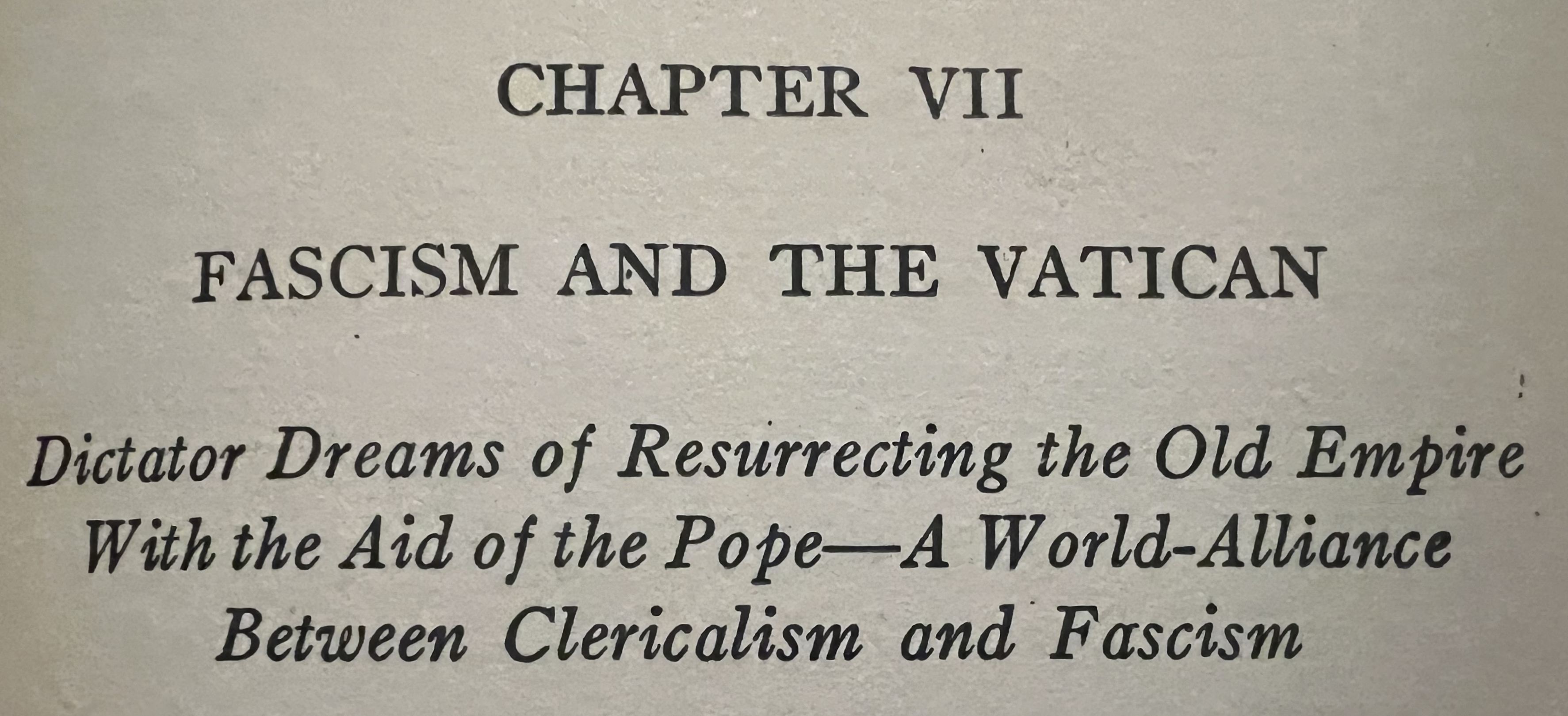
"FASCISM AND THE VATICAN: Dictator Dreams of Resurrecting the Old Empire With the Aid of the Pope —A World-Alliance Between Clericalism and Fascism"
Writing in 1927 (Pillory) and 1929 (Wild Man), this Borgia-obsessed anti-Catholic polemicist had a very specific development in mind —the looming Patti Lateranensi (Lateran Accords) between the Papacy of Pius XI and the newly-fascist Kingdom of Italy.
Fascism and the Vatican... the double threat of Duce and Pope... there was only one sticking point... the Duce himself...
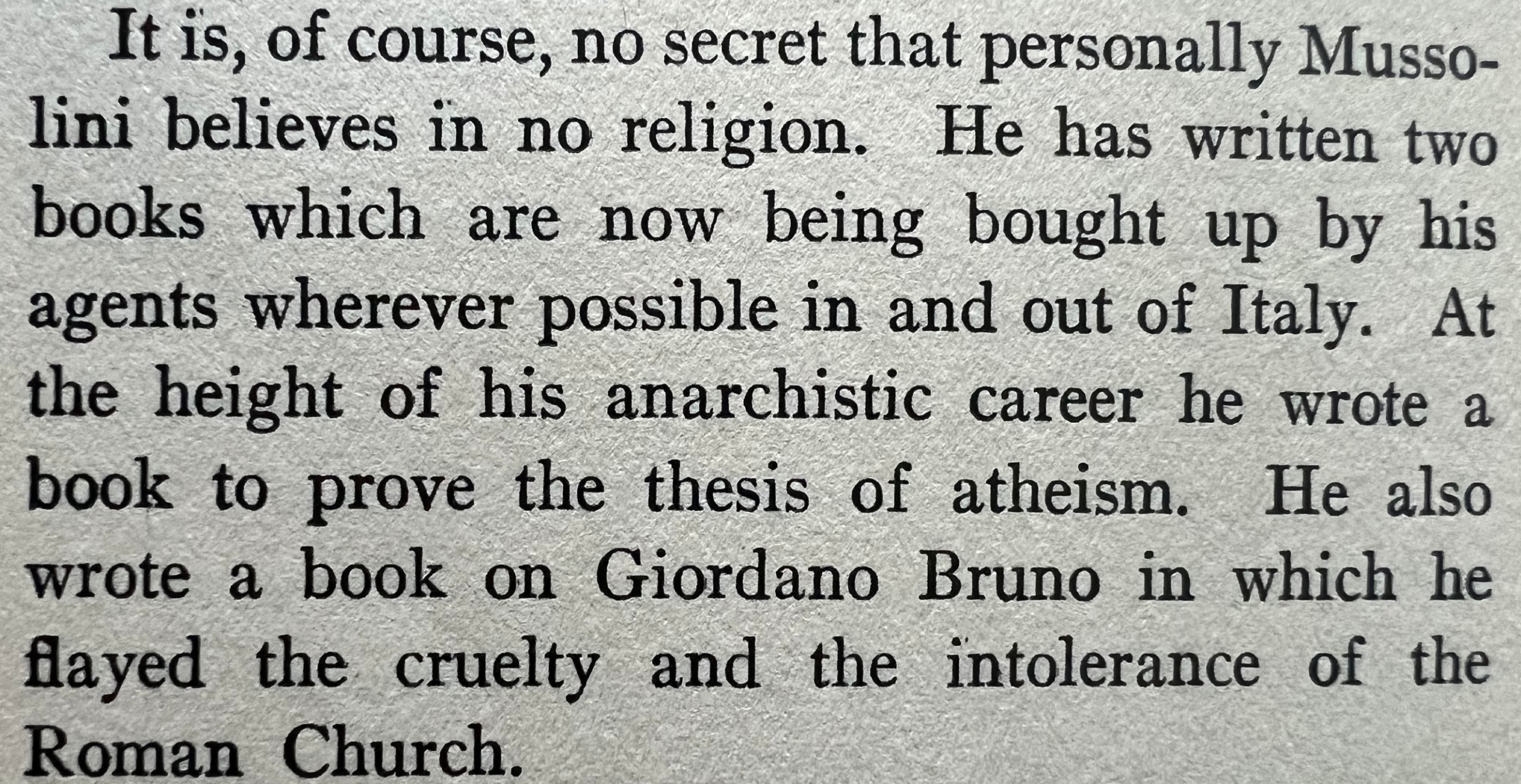
"It is, of course, no secret that personally Mussolini believes in no religion. He has written two books which are now being bought up by his agents wherever possible in and out of Italy. At the height of his anarchistic career, he wrote a book to prove the thesis of atheism. He also wrote a book on Giordano Bruno in which he flayed the cruelty and the intolerance of the Roman Church."
In Lausanne, Switzerland, in 1904, the 20 year-old Benito Mussolini published an 80-page pamphlet with the ringing title, "Dio Non Esiste" (God Does not Exist). But for the life of me, I find no trace of a Giordano Bruno book by the Duce-to-be.
In Trent (then in the Habsburg Empire) in 1910— at age 26 and at "the height of his anarchistic career"—he did indeed publish "L'Amante del Cardinale" ("The Cardinal's Lover").
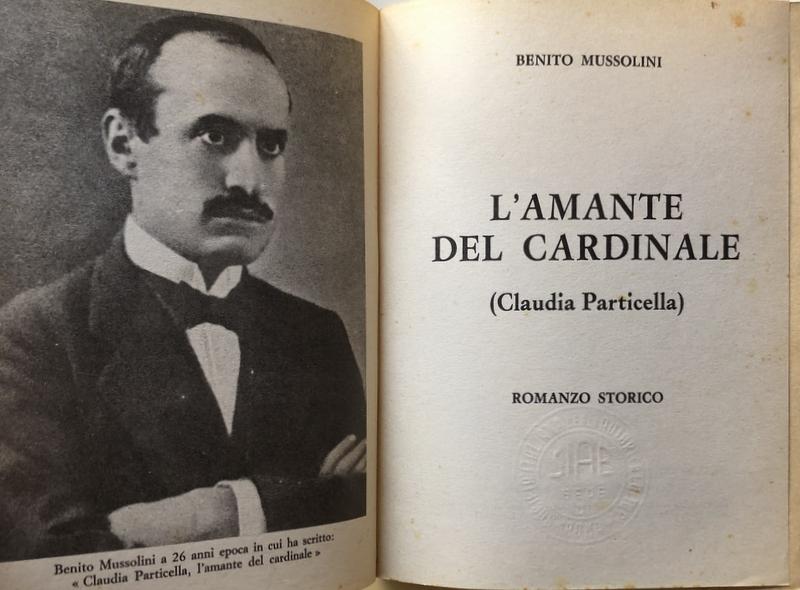
"Benito Mussolini at the age of 26, at the time he wrote 'The Cardinal's Lover, Claudia Particella'"
This vehemently anti-Catholic historical potboiler —reeking of sex, violence and moral corruption —ran for four months (20 January to 11 May 1910) in Il Popolo, the Socialist newspaper in Trent where Mussolini worked.
Even if the Giordano Bruno book did not quite exist, John Bond was right about one thing at least. The Duce did his single-minded best to eradicate every trace of these two increasingly inconvenient works —especially in the years leading to his political rapprochement with the Vatican in 1929.
In regard to his "true beliefs", Mussolini may have been many things but even a mildly observant Catholic was never one of them. His radical blacksmith father named him after Benito Juarez, the Mexican revolutionary and anti-cleric. Then in the course of his tumultuous career, he bounced from the Left (Socialism) to the Extreme Left (Anarchism) to a newly-invented Right (variously National Socialism, Corporate Statism and/or Fascism).
Mussolini remained (more or less) an atheist until the very end, thereby proving Bond's main point: Cynical Opportunism was the true Roman Way— time-honored and Borgia-approved —whether garbed in a cassock and triple tiara or a black shirt and tasseled fez.
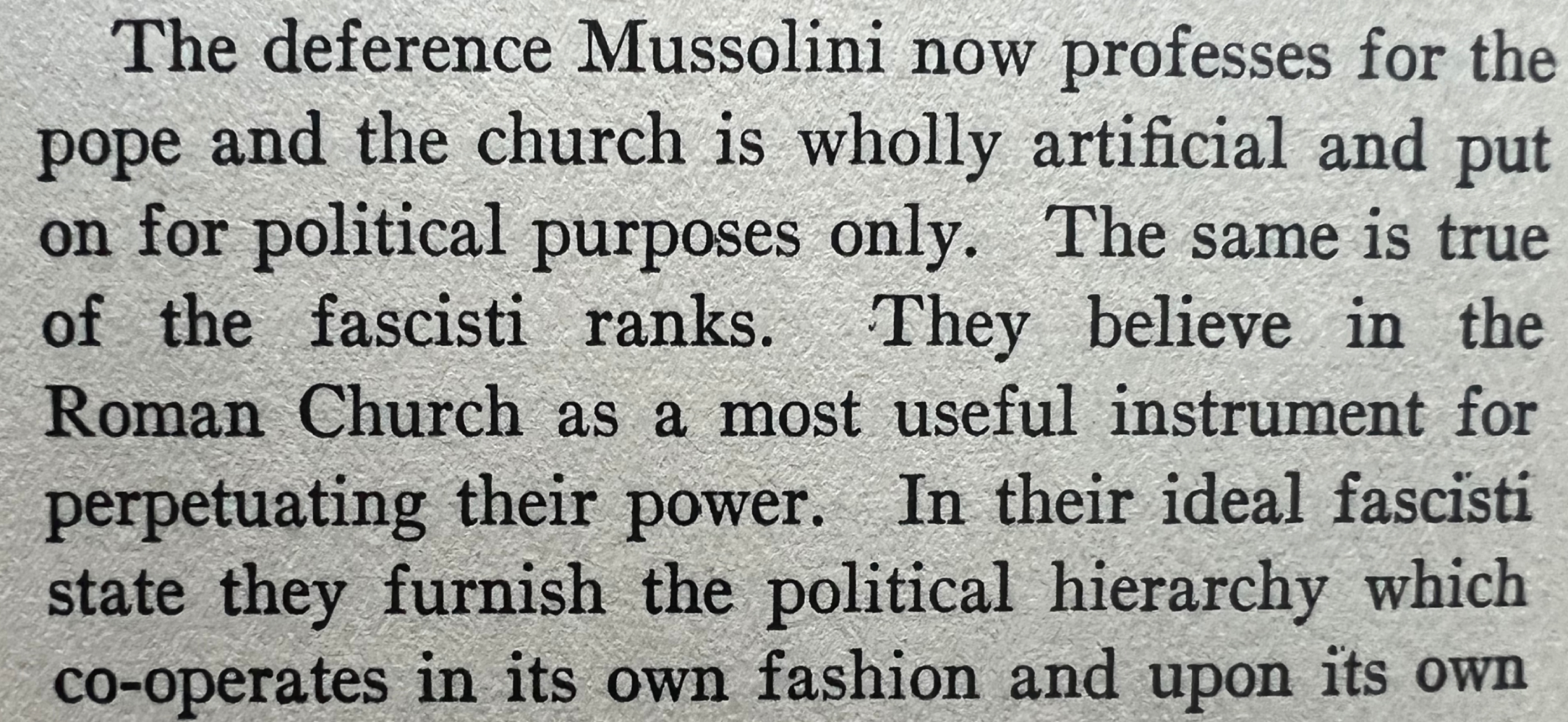

"The deference Mussolini now professes for the pope and the church is wholly artificial and put on for political purposes only. The same is true of the fascisti ranks. They believe in the Roman Church as a most useful instrument for perpetuating their power. In their ideal fascisti state they furnish the political hierarchy which co-operates in its own fashion and upon its own terms with the hierarchy of the church."
Bond attests with some pride, "This book has been written from a good post of observation under the very eyes of the fascisti government but not under its guidance or by its dictation.” (Wild Man, Preface, p.10)
That was no small claim, since the Mussolini regime kept journalists on a very short leash— even foreign oddities like Bond. Still, there was much to observe in those days, weeks and months.
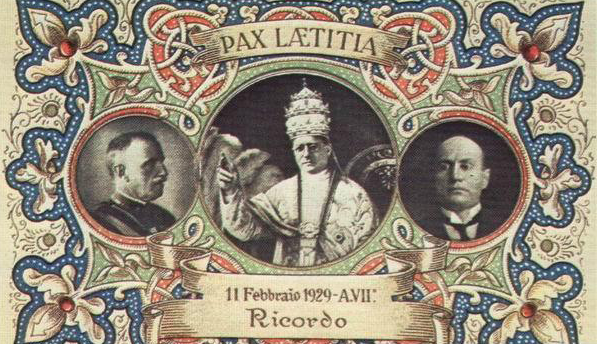
“PEACE AND JOY, 11 February 1929 – Year VII. Souvenir.”, from left to right, King Vittorio Emanuele III, Pope Pius XI and Prime Minister Benito Mussolini. Although the Pope is allotted the starring role, the Fascist dating scheme (ANNO VII) is included.
The author of Wild Man signed off on his preface in 1928, but the title page reads 1929 —just in time for a stop-press update (see below) regarding the 11 February 1929 Concordat.
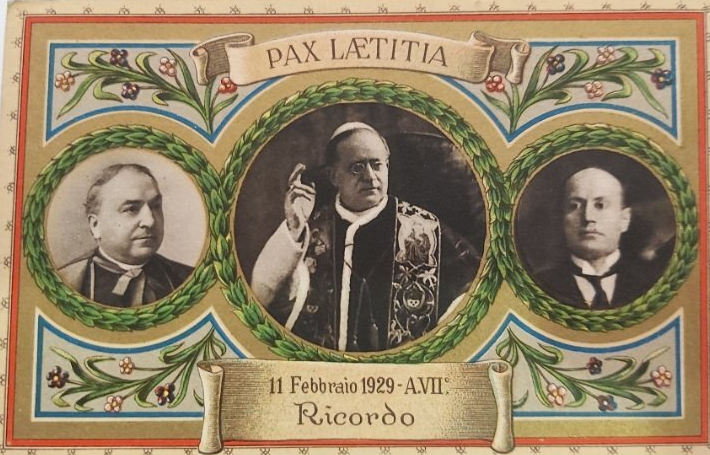
More "PEACE AND JOY" with Pope Pius XI front and center, flanked by Cardinal Gasparri (Papal Secretary of State) and Benito Mussolini (Italian Prime Minister). King Vittorio Emanuele III is nowhere to be seen.
On paper at least, the Patti Lateranensi (Lateran Accords) ended the long stand-off between the Church and the avowedly secular Kingdom of Italy— as it emerged from the Risorgimento, until it was subsumed into Mussolini's Fascist Entity.
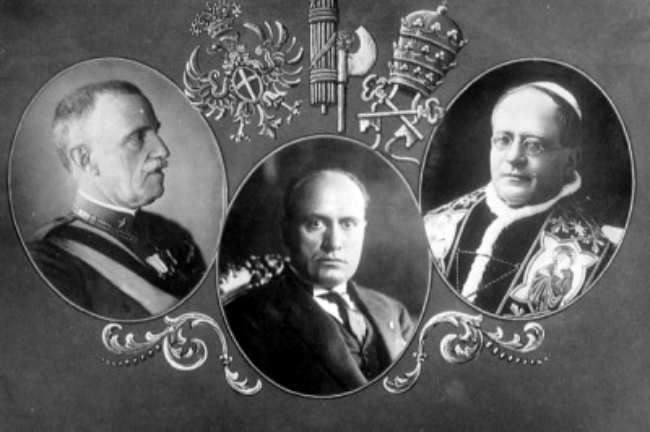
Vittorio Emanuele III, Benito Mussolini and Pius XI share equal billing, although the Duce appears conspicuously in the middle (under a fascio), perhaps implying his role as mediator.
Going into the negotiations, there were complex issues of protocol and more. The Church did not yet recognize the Italian government, so the Pope could not deal directly with Mussolini, King Vittorio Emanuele III or their representatives.
What was the current legal and diplomatic status of the Church? After 1870, was it still a geopolitical entity or not? Was Pius XI merely a religious leader or also a head of state?
And who spoke for Italy? In theory, it was a constitutional monarchy ruled by King Vittorio Emanuele III, whom Mussolini served as Prime Minister. In real terms, however, the Duce was the Duce (Leader or Commander) and called most of the shots.

11 February 1929, at the Lateran Palace following the signing of the Acords. Benito Mussolini is at the center of the group (in formal attire with top hat). Cardinal Pietro Gasparri (Pius XI's Secretary of State) is to his right.
Bond observes,“In their ideal fascisti state they furnish the political hierarchy which co-operates in its own fashion and upon its own terms with the hierarchy of the church.” (Wild Man, pp.102-3)
Since expediency is all that counts— on both sides— "faith" and "belief" are left out of the equation.
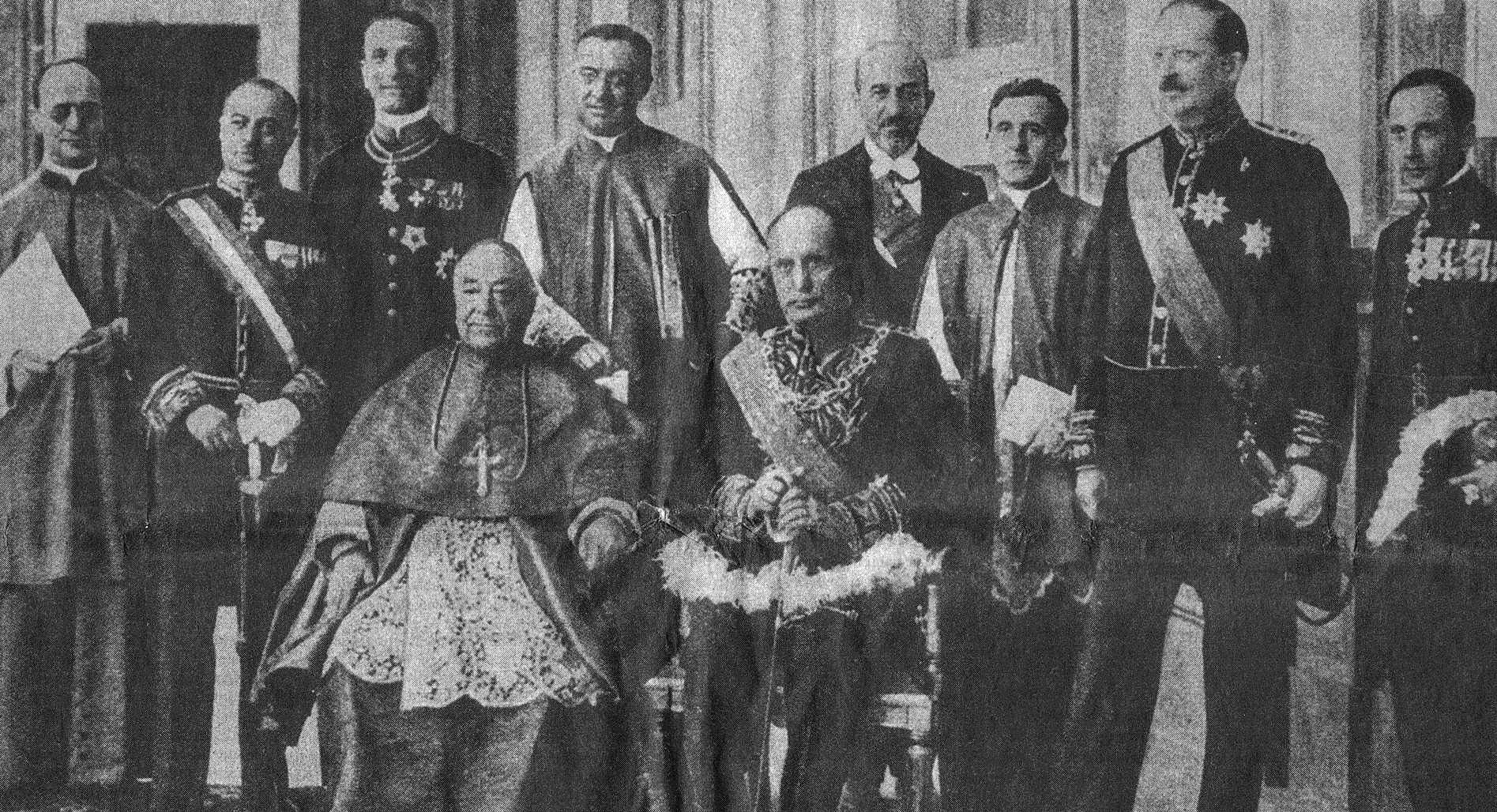
7 June 1929: Mussolini (seated next to Secretary of State Cardinal Gasparri) visits the Vatican to ratify the Lateran Accords in full ceremonial court dress— emphasizing his role as emissary of a king. He knew to temper his wildness when the occasion required.
How about Bond's "World-Alliance Between Clericalism and Fascism", with its ancient roots?
Did this vast scheme actually exist in 1929? Or were the Lateran Accords a strictly Italian affair, lodged in the nitty-gritty of Post-Unfication politics?
On one side of the negotiations stood the political representatives of the Italian State, on the other the overwhelmingly Italian agents of the Universal Church.
They were all fighting for space in both the Eternal City and the new Italy— and by 1929, they were ready to make a deal.
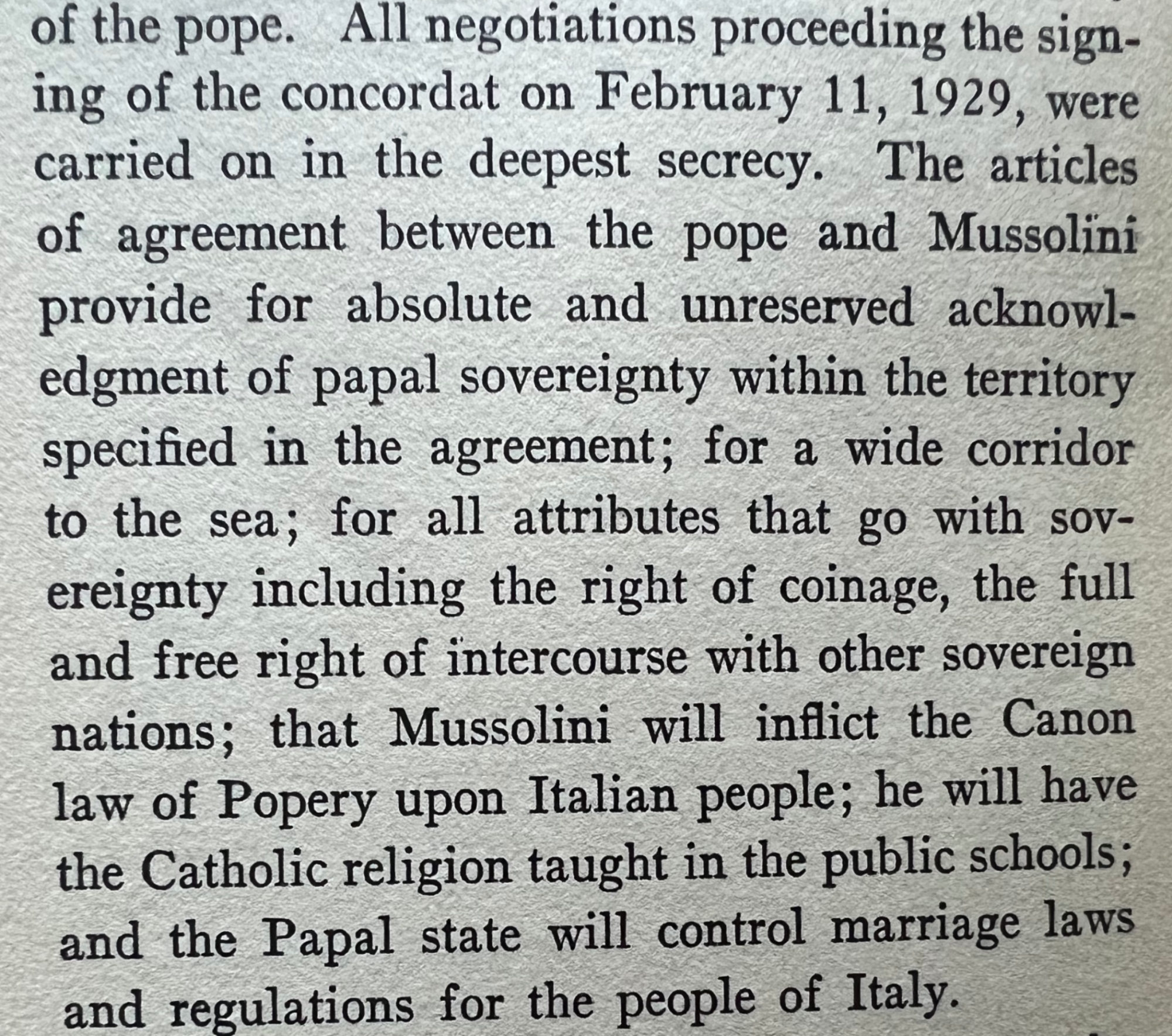
“All negotiations proceeding [sic] the signing of the concordat on February 11, 1929, were carried on in the deepest secrecy. The articles of agreement between the pope and Mussolini provide for absolute and unreserved acknowledgment of papal sovereignty within the territory specified in the agreement; for a wide corridor to the sea; for all attributes that go with sovereignty including the right of coinage, the full and free intercourse with other sovereign nations; that Mussolini will inflict the Canon Law of Popery upon Italian people; he will have the Catholic religion taught in the public schools; and the Papal state will control marriage laws and regulations for the people of Italy.”
Bond sketched in the terms of the Accords, which were negotiated "in deepest secrecy".
First there were issues regarding the Papacy and its political relationship with the rest of the world. Italy recognized it as a sovereign entity with its own (minuscule) territory, its own laws and its own diplomatic relations with other states. The Kingdom of Italy would retain most Church properties seized during the Risorgimento but agreed to pay compensation.
In the eyes of many, these were relatively minor concessions compared with the rest. The Italian State— quite stunningly —granted the Catholic Church massive influence in the daily lives of any and all Italians, some of whom were not even nominally Catholic.
In the Lateran Accords, Catholicism was privileged as Italy’s official religion. Catholic religious instruction was introduced in Italian public schools. The Church was given an essential role in defining the norms of marriage. And God only knew where this was going to end…

Two constituencies were particularly alarmed by the Lateran Accords, Italian Jews and Italian Freemasons.
From the very beginning, Jewish equality was bred into the DNA of the liberal Kingdom of Italy as it emerged from the Risorgimento.
SEE:
JEWS IN THE RISORGIMENTO
Many Italian Jews still viewed the Catholic Church as their natural enemy, especially those who had been liberated from Ghettos only with the fall of the Papal regime sixty years before.
As for the rise of Mussolini, some Jews might pretend—for a while, at least—that the Fascist State was not a threat, merely the natural heir to the empowered Italy of the Risorgimento.
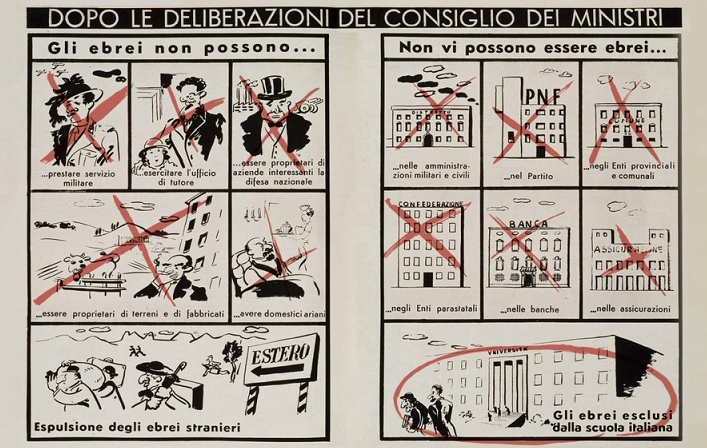

The main points of the National Racial Laws of 1938—decreed just nine years after the Lateran Accords. “Following the Deliberations of the Council of Ministers: Jews cannot…serve in the military…work as tutors…own businesses associated with national defense…own land or buildings…have Aryan domestic servants. Also, Foreign Jews are expelled. Jews can no longer participate…in military and civil administration…in the [Fascist] Party… in provincial and civic entities…in state-run entities…in banks…in insurance associations. Jews are excluded from Italian schools.”
Until they were proven tragically wrong...
(6) MUSSOLINI AND ITALIAN FREEMASONRY
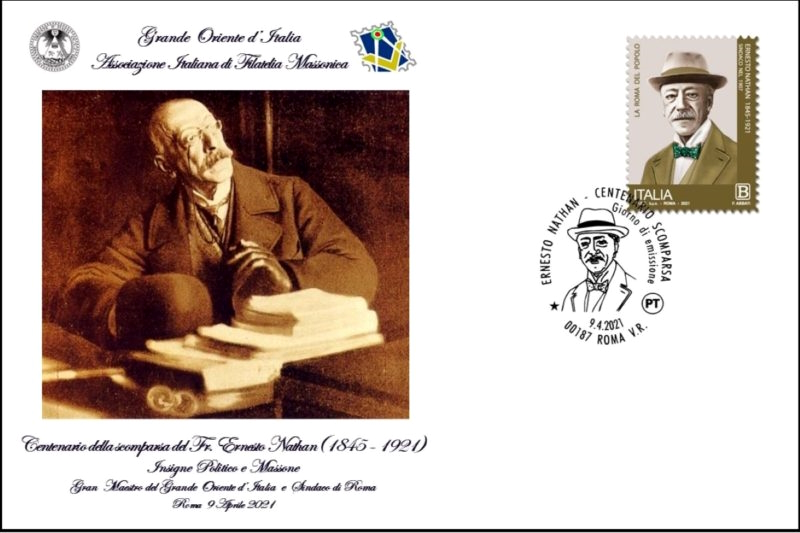
The Jew Ernesto Nathan was Mayor of Rome (1907-13) and twice Grand Master of Italian Masonry. Nathan was born into a fervently pro-Unification family and died a year before Mussolini’s March on Rome.
John Bond was the European Correspondent of The Fellowship Forum, “Freemasonry’s Representative at the Nation’s Capital” in Washington DC.
He had not a word to say about Italian Jews, which included a conspicuous number of prominent Masons. Still, he devoted 27 impassioned pages with 9 illustrations to the plight of Italian Masons more generally.
Freemasonry is an international movement that came out of the European Enlightenment, uniting liberals, free-thinkers and especially opponents of "Catholic Superstition".
Its enlightened humanism could take curious twists and turns, however—as we saw in early 20th-century America with the rise of “Militant Freemasonry” locked in step with the Ku Klux Klan.
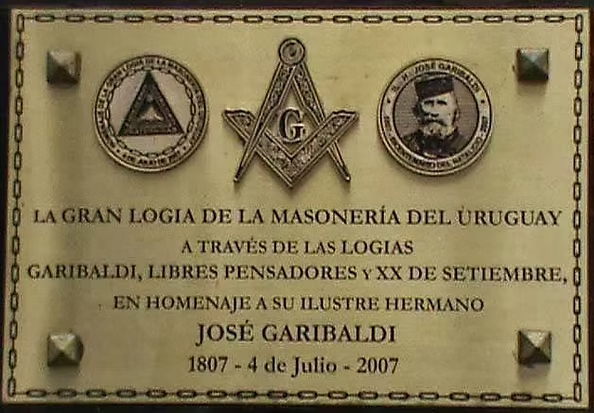
This influential lodge in the Uruguayan capital was chartered by the Grand Lodge of Pennsylvania on February 6, 1832.
In Italy, Masonry had its militant aspect as well— linked to the Risorgimento struggle for national unification.
Giuseppe Garibaldi, “Hero of the Two Worlds”, was initiated in Montevideo (Uruguay) in 1844, then received the High Degrees of the Scottish Rite in Turin in 1862. Wherever he went, he forged connections with fellow masons— often nationalist patriots essential to his endeavors.
In the spring of 1864, representatives of Italy’s 72 lodges met in Florence and on 21 May, they proclaimed the formation of the Grande Oriente d’Italia—a central coordinating lodge for the emerging nation— with Garibaldi himself as Grand Master.
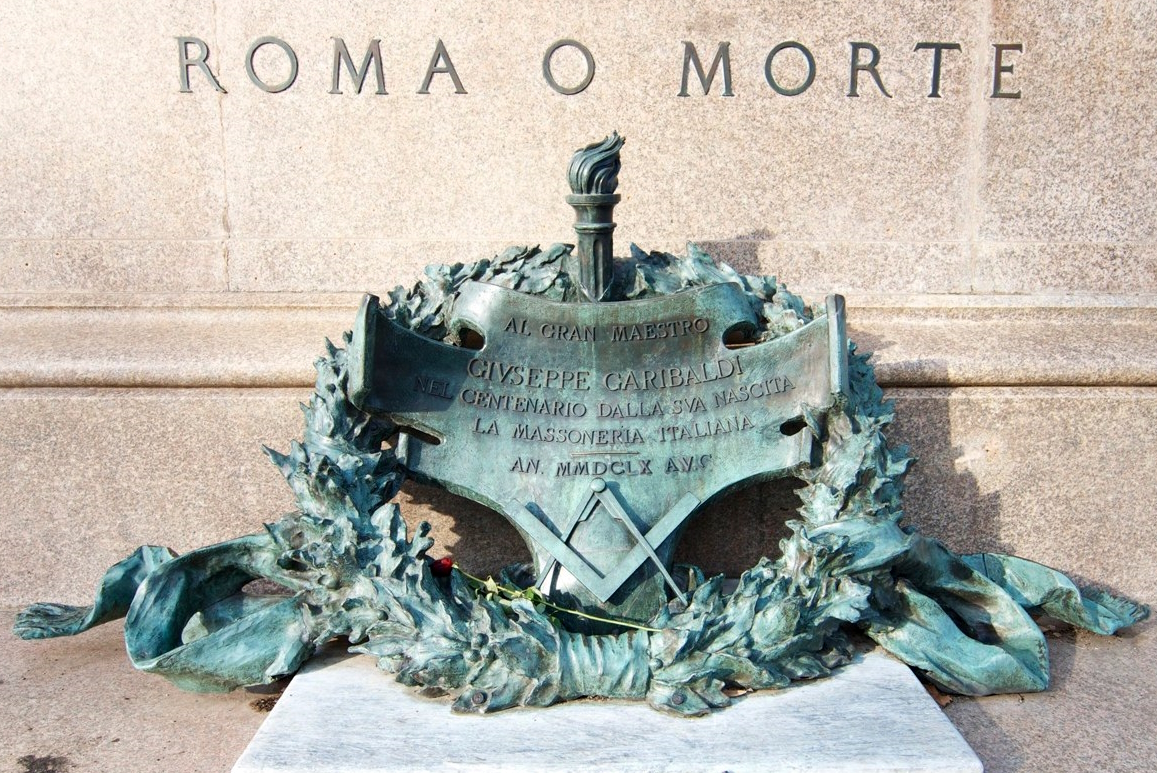
“Italian Masonry to the Grand Master Giuseppe Garibaldi in the Year 2660 on the Centennial of His Birth.” The Masons calculated the date 1907 by working from 753 BC, the founding of Rome.
ROME OR DEATH!
Garibaldi’s stirring pledge to unite Italy and retake its natural Capital.
In 1907, Italy’s Freemasons added a bronze laurel wreath with their Compass and Square to the base of the National Garibaldi Monument at the crest of the Janiculum Hill.
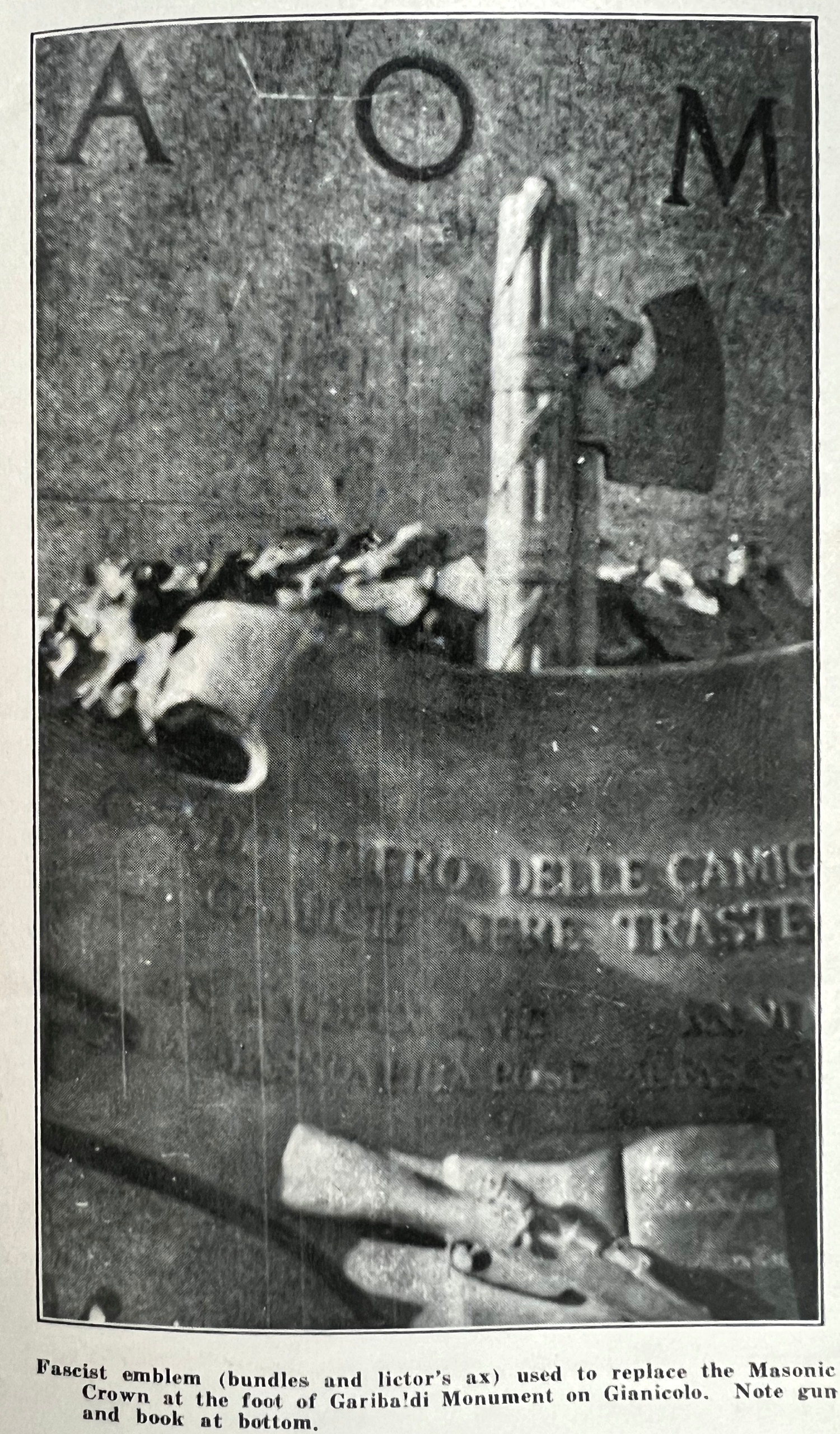
\"Fascist emblem (bundles and lictor's ax) used to replace the Masonic Crown at the foot of Garibaldi's Monument on Gianicolo. Note gun and book at bottom."
This fraternal tribute didn’t remain there long. After the Lateran Treaty of 1929, Mussolini reoriented the equestrian statue —with Garibaldi looking out over the great expanse of Rome, not peering down on the Vatican City recently relinquished to the Pope.
The Duce then removed the Masonic emblems, replacing them with orthodox Fascist symbols (the Compass and Square were reinstated in 1943).
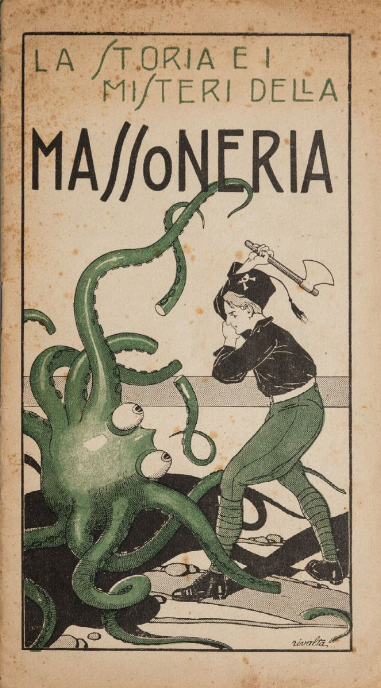
“The History and Mysteries of Masonry” (Rome, 1925) with a dedication to Benito Mussolini. The cover by Carlo Rivalta features a black-shirted youth (with skull and crossbones on his fez) lopping off the tentacles of the piovra (octopus) of Freemasonry.
What did Benito Mussolini think of Giuseppe Garibaldi?
On one hand, Garibaldi was a prodigious military and patriotic phenomenon. Without his Risorgimento, there would be no modern Italian state —the Duce’s included.
On the other hand, Garibaldi was a free-wheeling liberal and an old-fashioned democratic individualist —totally out of step with the Duce’s boldly totalitarian program.
Also— leaving ideology aside —the Duce could not bear to be upstaged.
Even in death, Garibaldi was too charismatic for the Duce’s liking and Garibaldismo too deeply engrained in Italy’s patriotic soul.
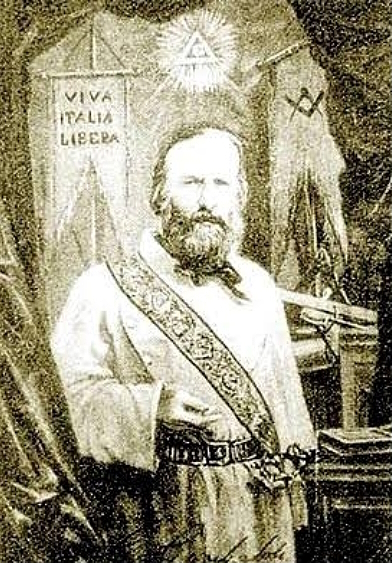
This evidently 19th-century print shows the Hero of the Two Worlds with a profusion of Masonic emblems and regalia. It is widely diffused on the web, without reliable sourcing.
And then there was the Masonic thing…
Mussolini was relentlessly on point in his messaging, so Freemasonry was an intolerable distraction at very least.

Left to right: Giovanni Gentile (editor), Benito Mussolini (promoter) and Giovanni Treccani (publisher) preside over the first (1929) edition of the Enciclopedia Italiana Di Scienze, Lettere Ed Arti (Italian Encyclopedia of Sciences, Letters and Arts)
In 1925, Giovanni Gentile— Benito Mussolini’s much-lauded “Philosopher of Fascism” —famously proclaimed the essential truth of the emerging "Corporate State" (Stato Corporativo).
TUTTO NELLO STATO, NIENTE AL DI FUORI DELLO STATO, NIENTE CONTRO LO STATO.
(EVERYTHING IS IN THE STATE, NOTHING IS OUTSIDE THE STATE, NOTHING IS OPPOSED TO THE STATE.)
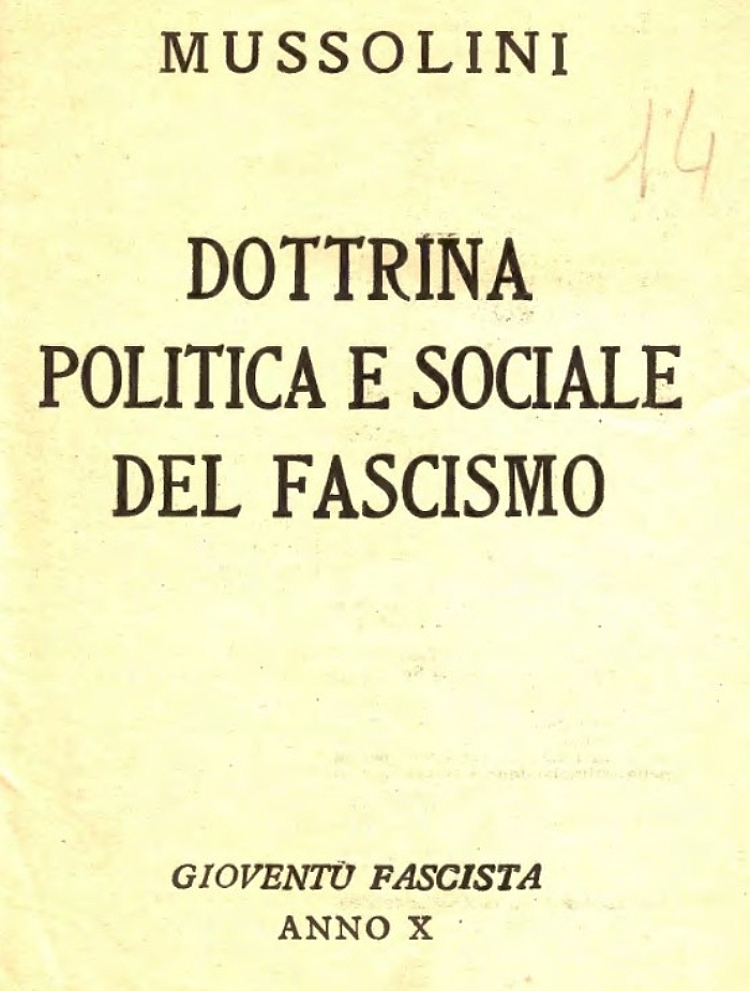
"The Political and Social Doctrine of Fascism"; this ghostwritten article appeared in the Enciclopedia Italiana under the Duce's name, then was extracted for wider circulation.
Who else but the Duce could enunciate the Doctrine of Fascism for the ages by way of the Italian Encyclopedia?
Who else but Giovanni Gentile could put the perfect words in the Duce’s mouth —and not for the first time?
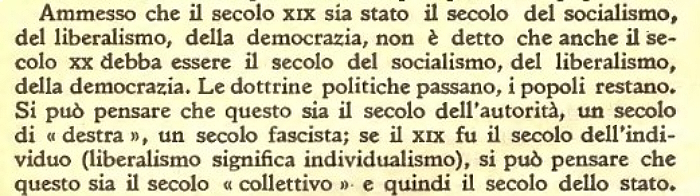
"If we accept that the Nineteenth Century was the century of Socialism, Liberalism and Democracy, it need not mean that the Twentieth Century is also a Century of Socialism, Liberalism and Democracy. Political doctrines come and go, but the people remain. Therefore, we can think of this as a Century of Authority, a Century of the Political Right and a Fascist Century. If the Nineteenth Century was the Century of the Individual (since Liberalism means Individualism), we can think of ours as a Century of Collectivism and by extension a Century of the State."
Benito Mussolini signs off on Giovanni Gentile’s definitive article on the principles of Fascism.
Freemasonry was obviously “Outside the State”—the Fascist one, at least—and easy prey for the Duce’s henchmen.
As early as 1912, L’Idea Nazionale (The Concept of Nation)—a proto-fascist journal—began an intense campaign of anti-Masonic defamation.
Then in November of 1921, at the first Congress of the National Fascist Party, Freemasonry was ruled—by acclamation—as incompatible with Fascism.
This ban was then codified by the Fascist authorities and given quasi-legal force
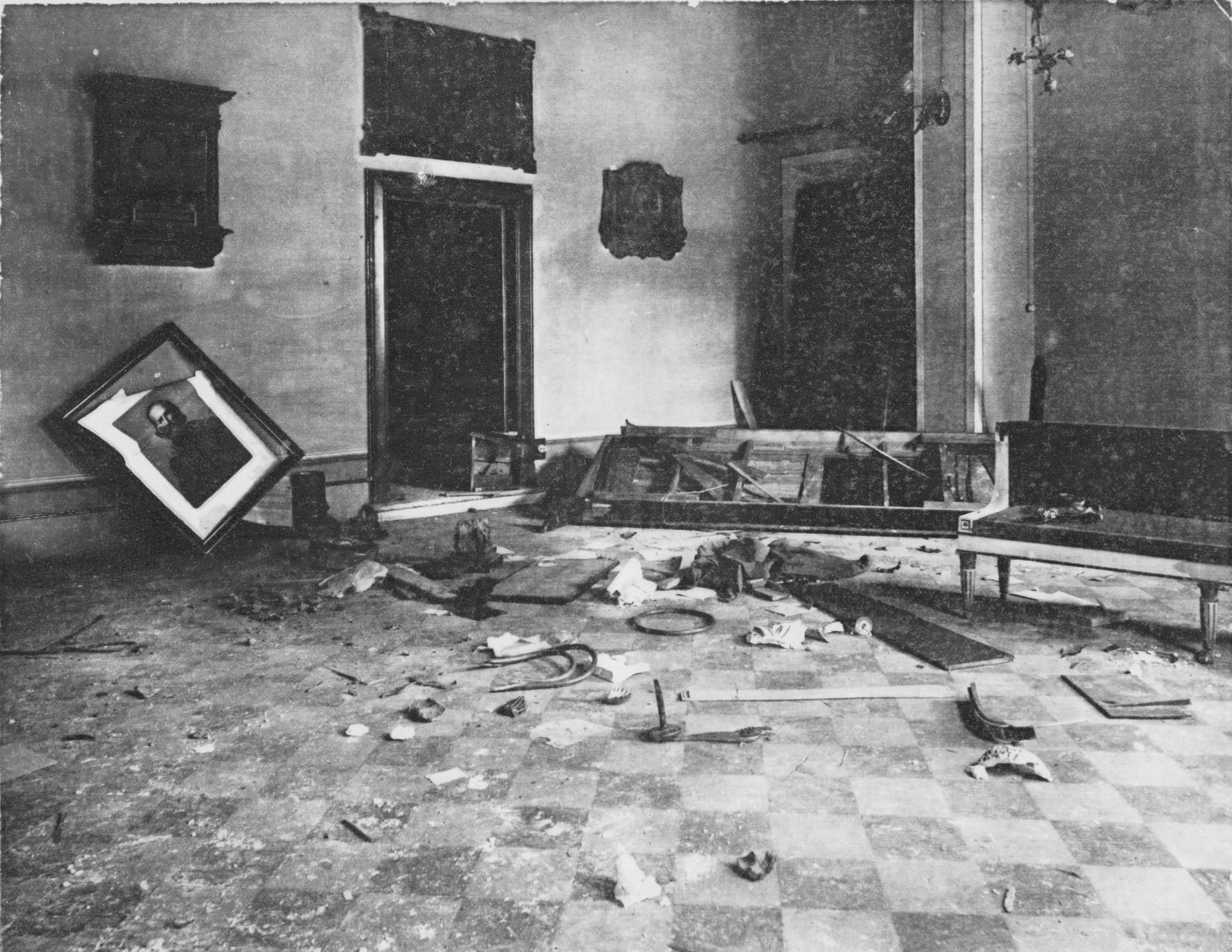
FATTI E NON PAROLE!
DEEDS NOT WORDS!
This was a favorite slogan of the Mussolini Regime and Masonic Lodges proved irresistibly soft targets for blackshirted “squadre” (marauding "teams" of Fascist thugs).
In the first years after the March on Rome (1922), came coordinated raids on fraternal headquarters—including Rome, Milan and Palermo (October 11, 1924) and Florence (October3-4, 1925).
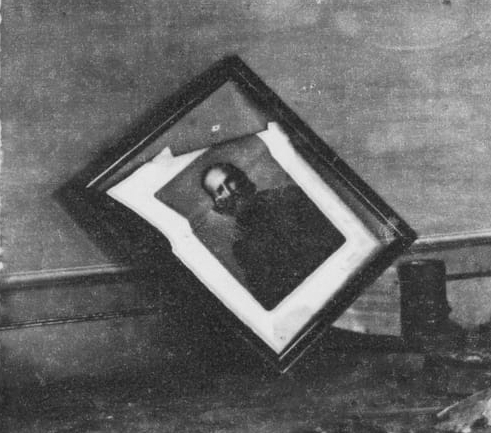
Giuseppe Garibaldi was a frequent victim of the Fascist Regime’s increasingly narrow definition of acceptable patriotism.
There was nothing subtle or restrained about Benito Mussolini’s management of the “Masonic Problem” —and we can say much the same for John Bond’s coverage on the other side.
“THE MASSACRE OF THE MASONS: Amid the Silence of a Shackled Press Lodges areDestroyed and Masons are Tortured and Killed —Three Days and Nights of Terrorin Florence —“Punitive Expeditions” Follow Proscriptions and Confiscations —HowMasons in Verona Were Lured to Their Death —Outlawry Still in Force —TheVictims on the Penal Islands”
In chronicling the persecution of his fellow Masons, he goes Full-Borgia— bombarding us with his most garish, sensational and fact-starved prose.

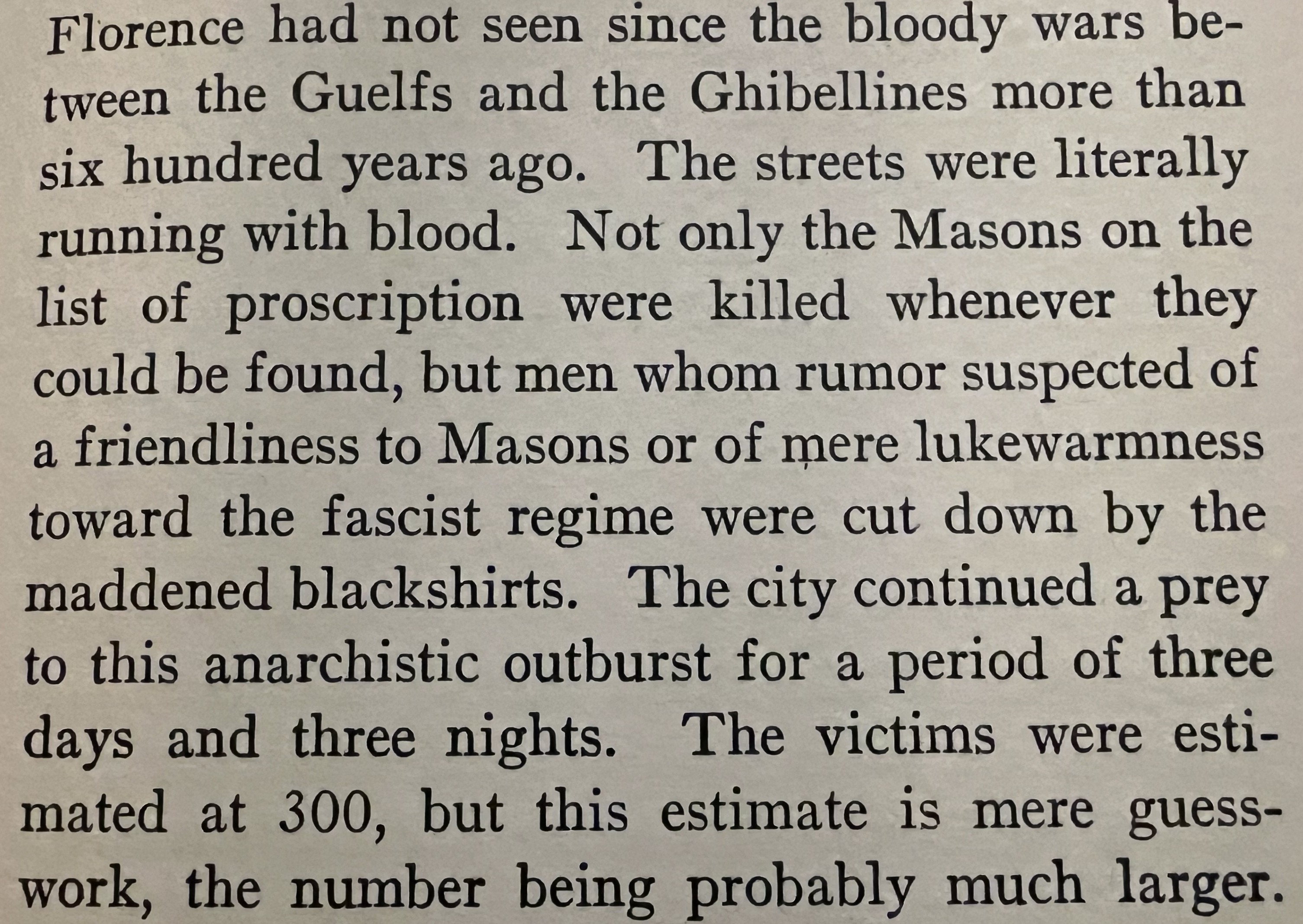
“By this time, the entire Fascist militia was on its legs and there began a riot of murder and destruction, the like of which Florence had not seen since the bloody wars between the Guelfs and the Ghibellines more than six hundred years ago. The streets were literally running with blood. Not only the Masons on the list of proscription were killed whenever they could be found, but men whom rumor suspected of a friendliness to Masons or of mere lukewarmness toward the fascist regime were cut down by the maddened blackshirts. The city continued a prey to this anarchistic outburst for a period of three days and three nights. The vicitims were estimated at 300, but this estimate is mere guesswork, the number being probably much larger."
In Florence, Masonic blood flowed for three days and three nights, with three hundred victims and counting???
Those events, in fact, are reasonably well-documented and genuinely horrible— if only 1% as bad as Bond claims (in statistical terms at least).
Three eminent local Masons were killed in the course of an overnight rampage (October 3/4, 1925) and we know their names: Giovanni Becciolini (a young Republican and Socialist), Gustavo Console (a lawyer and Socialist) and Gaetano Pilati (a wounded veteran of the Great War and a Socialist Deputy in the Chamber in Rome).

"Masons being thrown from windows to certain death by the Blackshirts." This rendering gives visual form to the anti-masonic violence in Verona evoked on pp.163-4.
Bond was reporting in the age of photography, so when he "shows us the picture” we might hope for more than a watercolor after the fact— disconnected from any eye-witness account.
“The story of how a score of Masons were decoyed into the fascist headquarters in the heart of Verona and then pitched out of the windows from a height of five stories traveled from mouth to mouth and is still related in the city on the banks of the Adige.”
Verona, in fact, was notorious for its brutal squadrismo, so it is no stretch to imagine local Masons harassed by Fascists and probably worse. Still, I am yet to find evidence of the Masonic massacre there that Bond presents in such vivid detail. Meanwhile, the three Masonic murders in Florence remain a living memory, a constant source of journalistic recollection and more.
Such occurences —and even less dramatic ones— simply don't get lost in Italian towns and cities. Wherever you turn, local historians are combing libraries, archives and newspaper files while interviewing the children, grandchildren and great-grandchildren of witnesses to history. And these days, we have the persistent testimony of the internet also.
As for Bond’s sourcing… According to him, the chilling tale of twenty-odd Masons thrown from the heights of the Fascist headquarters in Verona—with nary a day, month or year attached— “traveled from mouth to mouth and is still related in the city”.
Utter hearsay... in other words... but no less compelling for all that? “Amid the Silence of a Shackled Press Lodges are Destroyed and Masons Tortured and Killed”.

Bond and his friends grabbed any information that came their way —in the depths of the Fascist news black-out —and made of it what they could.
Maybe three dead Masons in Florence, then thirty, then three hundred? Like the old game of “Telephone” or “Whisper! Whisper!” —spinning off decimal places as they went?

“When all is said and done, the partnership between Mussolini and the pope is involuntary and unnatural. There is but one genuine bond of union between them —a common hatred of Free Masonry. A joint war on Free Masonry not only within the petty confines of this kingdom but throughout the entire world is the one tangible and certain program on which both these men in black are fully agreed and which they will push with all the means at their command.”
When all is said and done…???
“All what?” we might ask.
For John Bond, every question had three possible answers: “Free Masonry”, “Benito Mussolini” and “The Catholic Church”.
But why settle for one if you can claim all three?
Thus a "joint war on Free Masonry” waged by “both these men in black”: Mussolini and the Pope.
Related posts
MUSSOLINI: THE WILD MAN OF EUROPE - Part 1
In a "Little Library" in Washington DC, I happened upon "Mussolini: The Wild Man of Europe"— John Bond's eccentric exposé of Benito Mussolini, printed in the Nation's Capital in 1929.
In my first post, "Wild Man, Part 1", Bond helped reveal the inner workings of the Ku Klux Klan in Washington DC, Atlanta GA and Altoona PA.
In "Wild Man, Part 2", we took Bond's book to Fascist Italy and viewed the Duce through the outraged author's eyes.
Here in "Wild Man", Part 3", we bring Bond back to Philo-Fascist America. There we see the Duce lauded by Italian Americans, by Hollywood celebrities and by the mainstream press.
Who was John Bond? A "Militant Freemason", a virulent anti-Catholic and an anti-Mussolini conspiracy theorist.
How about his message? Bond was strange and obsessed but he wasn't always wrong.
MUSSOLINI: THE WILD MAN OF EUROPE - Part 3
In a "Little Library" in Washington DC, I happened upon "Mussolini: The Wild Man of Europe"— John Bond's eccentric exposé of Benito Mussolini, printed in the Nation's Capital in 1929.
In my first post, "Wild Man, Part 1", Bond helped reveal the inner workings of the Ku Klux Klan in Washington DC, Atlanta GA and Altoona PA.
In "Wild Man, Part 2", we took Bond's book to Fascist Italy and viewed the Duce through the outraged author's eyes.
Here in "Wild Man", Part 3", we bring Bond back to Philo-Fascist America. There we see the Duce lauded by Italian Americans, by Hollywood celebrities and by the mainstream press.
Who was John Bond? A "Militant Freemason", a virulent anti-Catholic and an anti-Mussolini conspiracy theorist.
How about his message? Bond was strange and obsessed but he wasn't always wrong.
WORK IN PROGRESS

GUGLIELMO MARCONI: Science, Fascism, Antisemitism and What Else?
History has given a free pass to Guglielmo Marconi, who was both a scientific genius and a Fascist ideologue.
There are two stories to tell—first in Italy and then in America.
COLUMBUS, MARCONI AND BALBO: Italian Heroes Collide with American Reality
In 1930s America, Guglielmo Marconi, the inventor of the radiotelegraph and Italo Balbo, the aeronautical "Second Columbus" led a brilliantly orchestrated public relations campaign on behalf of Benito Mussolini's regime.
Fascist Italy commanded a dazzling array of scientific, technological and cultural resources. It channeled them all— astounding the American public at Chicago's Century of Progress Exposition in 1933-34.
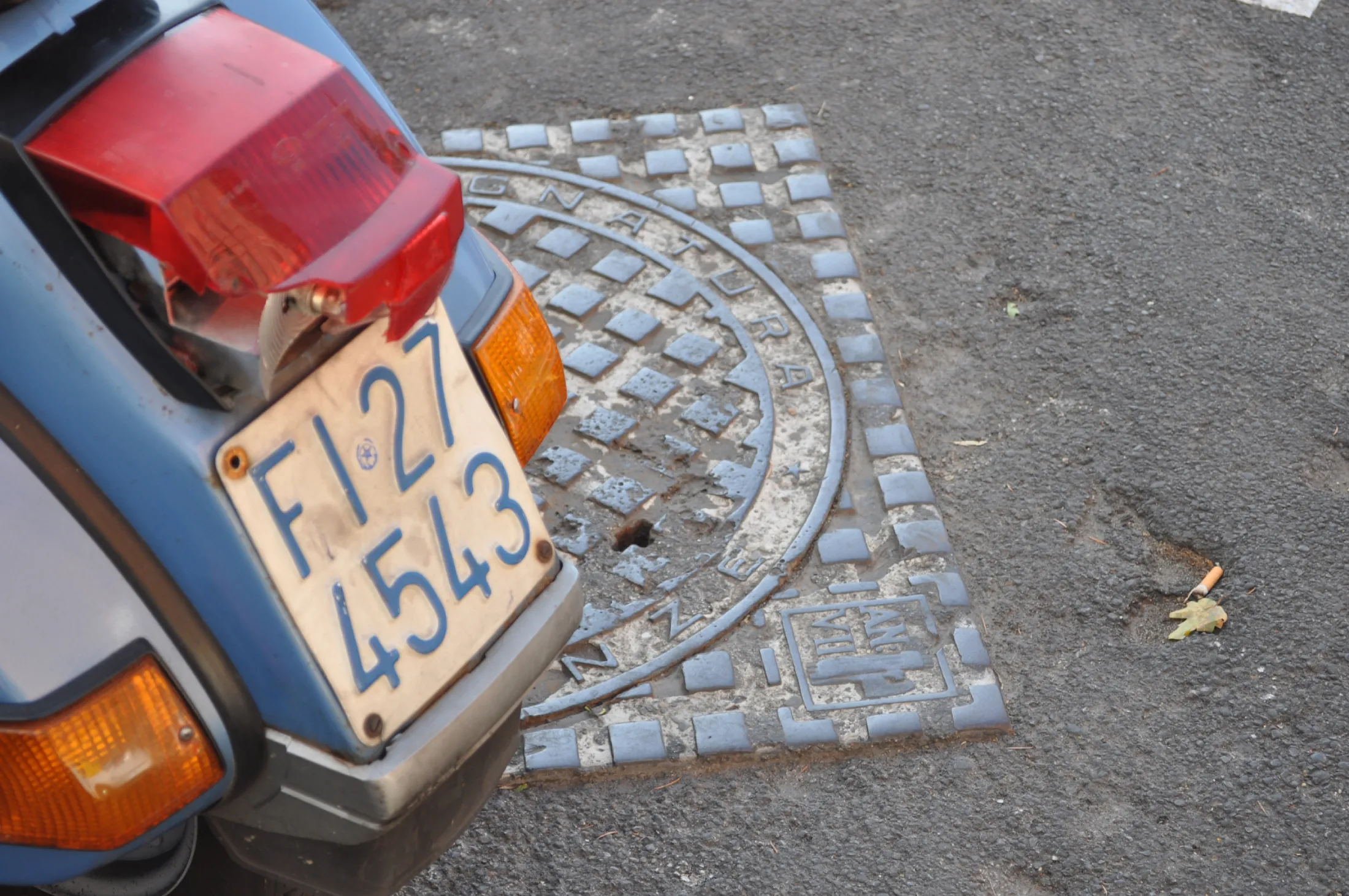
ANNO FASCISTA = FASCIST YEAR: Florence’s Mussolini-era sewer caps
Benito Mussolini had a rare knack for signs and symbols. Throughout Italy, they still follow us wherever we go.
What about Florence's ubiquitous "Anno Fascista = Fascist Year" sewer caps?
Thereby hangs many a tale...
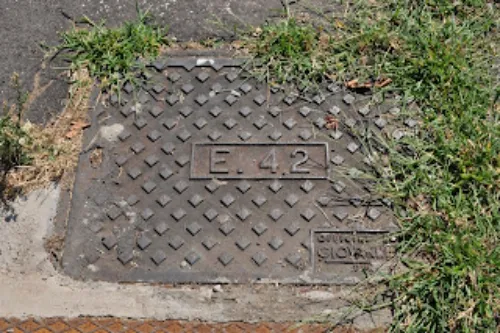
E.42: Mussolini's Fascist Theme Park on the Outskirts of Rome
What if the Duce threw a World's Fair and no one came?
That is basically the story of the E.U.R. (Esposizione Universale Roma 1942)—one of the Eternal City's strangest and most intriguing districts.
Lorem ipsum dolor sit amet, consectetur adipiscing elit. Suspendisse varius enim in eros elementum tristique. Duis cursus, mi quis viverra ornare, eros dolor interdum nulla, ut commodo diam libero vitae erat. Aenean faucibus nibh et justo cursus id rutrum lorem imperdiet. Nunc ut sem vitae risus tristique posuere.